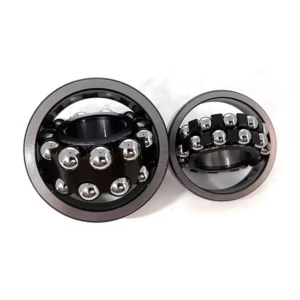
Self-Aligning Ball Bearing
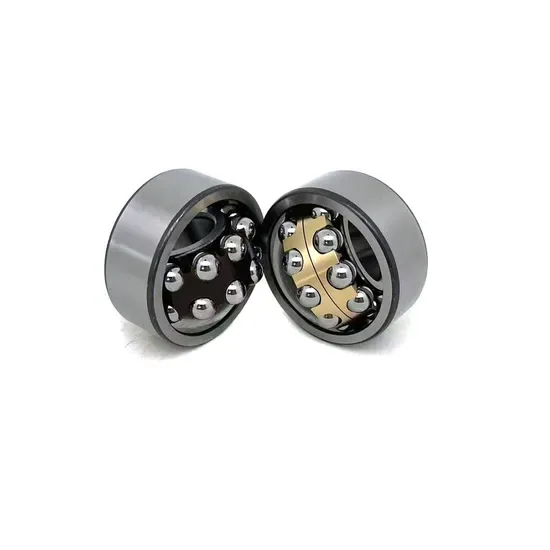
127 TN9 108 TN9 129 TN9 1200ETN9 2200 E-2RS1TN9 22 Self-Aligning Ball Bearings deliver reliable radial load support for wind turbines and renewable energy equipment.
Authorized Multi-Brand Coverage — Procure mixed-brand wind turbine spares in a single consolidated shipment without coordinating multiple suppliers.
| Parameter | Value |
|---|---|
| Designation | 127 TN9 108 TN9 129 TN9 1200ETN9 2200 E-2RS1TN9 22 |
| Bearing Type | Self-Aligning Ball Bearing |
| Load Direction | Radial |
| Cage Material | Glass fibre reinforced polyamide (TN9) |
| Seal Type | Contact seal on both sides (2RS1) / Open |
| Internal Design | Optimized (E suffix) |
| Lubrication | Grease or Oil |
| Feature | High Speed |
| Origin | Shandong, China |
| Industry | Typical Applications |
|---|---|
| Wind Power | Yaw drive mechanisms, pitch control actuators, generator cooling fans |
| Renewable Energy | Solar tracker rotation joints, hydroelectric turbine governor linkages |
| Industrial Gearboxes | High-speed input shafts, planetary gear stage supports |
Thermal expansion ignores basic designations; only precise suffix alignment prevents catastrophic seizure.
Sourcing teams often match the base number for a X&S 1200 2200 series self-aligning ball bearing but overlook the internal clearance and cage material. In high-ambient environments like desert wind farms, a standard clearance bearing installed in a generator cooling fan will expand and bind under thermal load. This misalignment between the physical operating reality and the procurement spreadsheet leads to sudden cage failure and unplanned turbine downtime [NEED_CITE: thermal seizure mechanisms in rolling element bearings].
Selecting the correct X&S 1200 2200 series self-aligning ball bearing requires looking past the basic dimensions to evaluate how the component handles specific turbine loads. Our engineering review process verifies that the selected cage material and seal configuration align with the actual rotational speeds and contamination risks present in nacelle and tower base environments, ensuring reliable operation across the asset lifecycle.
Wind turbine drivetrains subject components to complex radial loads, fluctuating rotational speeds, and extreme temperature gradients. At elevated temperatures, standard internal clearances disappear as the inner ring expands, making C3 or C4 clearance classes mandatory for non-drive end applications. Furthermore, the choice between open designs for oil-lubricated gearboxes and 2RS1 contact seals for grease-lubricated auxiliary motors dictates both friction levels and contamination exclusion [NEED_CITE: lubrication and sealing strategies for wind turbine drivetrains].
The TN9 suffix indicates a glass fibre reinforced polyamide cage, which provides high-speed stability and reduced friction compared to pressed steel alternatives, making it ideal for generator cooling applications. The E suffix denotes an optimized internal geometry that improves load distribution across the rolling elements, enhancing fatigue life under continuous radial stress. For units exposed to airborne dust or moisture, the 2RS1 contact seals provide critical contamination exclusion, though they introduce slight frictional heat that must be factored into the limiting speed calculations. Note that the "22" sequence in the designation string remains an unverified suffix requiring manufacturer catalog confirmation before finalizing the purchase order.
Installing a bearing with an incorrect cage material or missing seal variant leads to premature fatigue and catastrophic damage to the surrounding housing. According to failure mode classifications outlined in ISO 15243, contamination ingress and inadequate lubrication account for a significant share of early bearing failures in renewable energy assets. Relying solely on basic cross-references without verifying the TN9 or 2RS1 suffixes voids equipment warranties and triggers expensive crane mobilizations for nacelle repairs [NEED_CITE: rolling bearing failure mode classification per ISO 15243].
We prevent field failures by enforcing strict cross-reference alignment that covers base designations, clearance classes, and cage materials simultaneously. Our authorized distribution network ensures batch traceability for every X&S unit, eliminating the risk of counterfeit components with soft inner rings. We provide application-based selection reviews that evaluate your specific load, speed, and temperature parameters, ensuring the optimized internal design matches the equipment requirements. Furthermore, our single-source capability handles mixed-brand MRO requirements, simplifying supply chain logistics for remote wind farm sites.
To ensure precise application matching, please provide the specific radial and axial load profiles, operating temperature ranges, and rotational speeds for your wind turbine subsystems. Sharing the original OEM equipment numbers allows our engineering team to perform a comprehensive cross-reference review, verifying that the clearance class and seal configuration meet your exact site conditions.
Q: How do we verify the authenticity of these bearings before installation?
A: Every unit includes batch traceability and a unique QR code. Maintenance teams can scan this code using the official brand application on-site to verify the manufacturing origin and confirm that the TN9 cage and 2RS1 seal specifications match the physical component, eliminating the risk of installing counterfeit parts in critical turbine applications.
Q: Why is suffix alignment critical during cross-referencing?
A: Matching only the base number often overlooks vital operational parameters. A standard clearance bearing might seize under thermal expansion in a hot nacelle, while an open bearing will fail rapidly if installed in a dusty environment without 2RS1 seals. We verify clearance, cage material, and seal types to ensure complete operational compatibility.
Q: What are the selection boundaries for TN9 polyamide cages?
A: TN9 glass fibre reinforced polyamide cages offer excellent high-speed capability and low friction, making them ideal for grease-lubricated auxiliary motors. However, for applications involving extreme continuous heat or aggressive chemical exposure where the polymer matrix might degrade, machined brass cage alternatives must be evaluated during the technical selection phase.
Q: How do we choose between open and 2RS1 sealed variants?
A: Open bearings are required for circulating oil systems within main gearboxes, allowing continuous lubrication and cooling. The 2RS1 contact seal variants are specified for grease-lubricated, maintenance-free applications like yaw drives or cooling fans, where the seals must exclude moisture and particulate contamination while retaining the factory grease fill.
Our engineers will respond within 12 hours with a tailored solution.
Request Quote| Bearing Type | Self-Aligning Ball Bearing |
| Brand | SKF |
| Quality Standard | ISO 9001 / TS 16949 |
| Precision Grade | P0 / P5 / P6 (custom) |
| Material | Chrome Steel / Stainless |
| Cage Material | Steel / Brass / Polyamide |
| Lubrication | Grease / Oil (specify) |
| Operating Temp. | -40°C to +200°C |
| Min. Order Qty | 1 pc (samples available) |
| Prototype Lead Time | 7 Working Days |
| Load Capacity | Contact for C0/Cr values |
| Speed Rating | Contact for ndm limit |
| Vibration Level | Z1 / Z2 / Z3 (custom) |
| Noise Level | V1 / V2 / V3 (custom) |
| Fatigue Life | L10h per ISO 281 |
| Sealing Options | Open / Z / 2Z / RS / 2RS |
Our engineering team can modify bearing dimensions, materials, seals, and clearances to meet your specific operating requirements. Submit your drawing or spec sheet for a tailored proposal.
Main shaft bearings, gearbox bearings, and generator bearings for onshore and offshore wind turbines.
Heavy-duty bearings for crushers, conveyors, and rotary equipment in extreme dust and shock-load environments.
High-temperature bearings for rolling mills, continuous casting, and furnace applications.
Wheel hub bearings, transmission bearings, and e-motor bearings for passenger and commercial vehicles.
Axle box bearings, traction motor bearings, and gearbox bearings meeting EN/UIC railway standards.
High-precision spindle bearings, angular contact bearings, and super-precision bearings for CNC and robotics.
Our engineers analyze your operating conditions -- load, speed, temperature, environment -- and select or design the optimal bearing solution to maximize service life and reduce total cost of ownership.
Need non-standard dimensions, special materials, or modified clearances? We can modify standard SKF bearings or manufacture fully custom solutions with a 7-day prototype turnaround.
When bearings fail prematurely, our team conducts root-cause analysis using advanced diagnostic tools to identify the failure mode and recommend corrective action.
We deploy vibration monitoring, thermal imaging, and oil analysis programs that detect bearing deterioration early -- reducing unplanned downtime by up to 40%.
Proper installation is critical to bearing performance. Our certified technicians provide on-site installation support, alignment verification, and operator training worldwide.
From initial selection through end-of-life, our dedicated account managers provide scheduled maintenance plans, re-lubrication programs, and replacement forecasting for enterprise clients.
NDA protected · Free samples for orders > $50K · Reply within 12 hours