
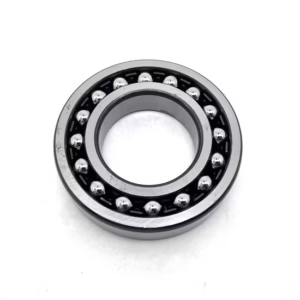
Self-Aligning Ball Bearing
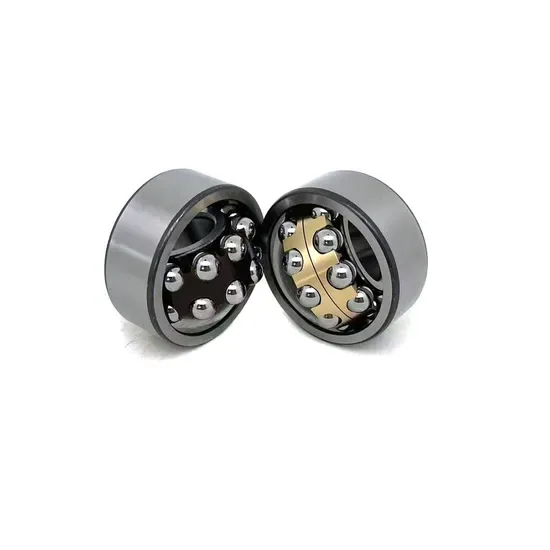
X&S 1300 1301 1302 1303 1304 1305 1306 1307 1307 K 130 Self-Aligning Ball Bearing — accommodates shaft misalignment for electric motors and machine tools.
Full Brand Authorization — Mixed orders covering the 1300 1301 1302 1303 1304 1305 1306 1307 1307 K 130 designations are fulfilled from a single authorized source, eliminating multi-vendor coordination.
| Parameter | Value |
|---|---|
| Designation | 1300 1301 1302 1303 1304 1305 1306 1307 1307 K 130 |
| Product Type | Self-Aligning Ball Bearing |
| Load Direction | Radial Bearing |
| Bore Type | Cylindrical and Tapered (K suffix) |
| Lubrication | Grease or Oil |
| Feature | High Speed |
| Origin | Shandong, China |
| HS Code | 8482109000 |
| Industry | Typical Applications |
|---|---|
| Electric Motors | Rotor shaft support requiring misalignment tolerance |
| Machine Tools | Spindle auxiliary drives and feed mechanism shafts |
| General Industrial Machinery | Conveyor drive shafts and agricultural equipment rotating assemblies |
Shaft deflection and housing bore misalignment are neutralized by the outer ring’s spherical raceway, preventing edge loading and premature fatigue.
In our Ningbo workshop, we have dismantled countless electric motors where standard deep groove ball bearings seized simply because the housing bore was machined slightly off-axis. When procurement teams source generic replacements based solely on basic dimensions, they often overlook the internal geometry required for these specific applications. The X&S Self-Aligning Ball Bearing series resolves this by allowing the inner ring and ball assembly to swivel within the outer ring. [NEED_CITE: self-aligning bearing kinematics and misalignment compensation]
Selecting the correct X&S Self-Aligning Ball Bearing requires more than matching the bore diameter. We review the specific radial loads, operating speeds, and thermal expansion characteristics of your electric motor or machine tool application to ensure the selected designation and clearance class will perform reliably under continuous operation.
Electric motor rotor shafts operate at high rotational speeds where even minor misalignment generates excessive friction and heat. The lubrication film must remain stable, requiring either high-quality grease or circulating oil depending on the cooling system design. Thermal expansion of the shaft during startup alters the internal clearance, meaning a standard CN clearance might result in thermal binding, whereas a C3 clearance accommodates the heat generated at elevated operating temperatures. [NEED_CITE: thermal expansion effects on internal bearing clearance]
The defining feature of the K suffix in this series is the 1:12 tapered bore, designed specifically for mounting on adapter sleeves. This configuration allows for precise adjustment of the internal radial clearance during installation, which is critical for achieving optimal preload in vibrating environments. Standard cylindrical bores are *ference fits. Understanding whether your equipment utilizes a tapered journal or a straight shaft dictates the choice between the standard and K variants, directly impacting the mounting procedure and final operational stability.
Installing a cylindrical bore bearing where a K taper was specified, or ignoring the required clearance class, leads to catastrophic operational failures. Under ISO 15243 failure mode classifications, these installation and selection errors manifest as smearing, thermal discoloration, and eventual cage disintegration. The resulting unplanned downtime and secondary damage to the motor housing far exceed the initial component savings. [NEED_CITE: rolling bearing failure mode classification per ISO 15243]
Our technical team cross-references the base designation alongside the bore type and clearance class to prevent field failures. For the 1300 1301 1302 1303 1304 1305 1306 1307 1307 K 130 range, we verify that the internal design matches the exact equipment requirements, not just the basic number. Batch traceability is maintained from the manufacturer to your facility, ensuring every shipment is backed by verifiable documentation. We provide application-based selection reviews covering load, speed, and temperature to eliminate guesswork.
To ensure accurate selection and cross-reference verification, please provide the radial and axial load profiles, operating speeds, and thermal conditions of your application. Sharing the OEM equipment number or existing housing dimensions allows our engineering team to confirm the precise clearance class and bore configuration required for your specific machinery.
Q: What is the difference between standard cylindrical bore and K (tapered) bore in self-aligning bearings?
A: The standard cylindrical bore is pressed directly onto a straight shaft journal. The K suffix indicates a 1:12 tapered bore designed to be mounted on an adapter sleeve. This tapered design allows technicians to precisely adjust and lock the internal radial clearance during installation, which is critical for optimizing performance in vibrating or high-speed applications.
Q: How to cross-reference self-aligning ball bearings without overlooking clearance and internal design?
A: Never rely solely on the base designation. You must verify the bore type, clearance class (such as C3 for thermal expansion), and cage material. A mismatch in these suffixes can cause thermal binding or cage failure in the field, even if the basic dimensions match the original equipment specifications perfectly.
Q: Grease vs. oil lubrication selection for high-speed self-aligning applications.
A: Grease is typically preferred for standard electric motor applications due to its sealing properties and simplified maintenance. However, oil lubrication is necessary for extremely high-speed machine tool spindles or when the bearing needs to act as a heat sink, requiring a continuous flow to carry away thermal energy generated by friction.
Q: How to verify the authenticity and batch traceability of X&S bearings upon delivery?
A: Every shipment includes a Certificate of Conformity and lot traceability documentation. You can scan the QR codes using the brand’s official mobile applications to verify the production batch, ensuring the physical products match the manufacturer’s records and have not been subjected to cloning or counterfeiting.
Q: What are the common failure modes of self-aligning ball bearings in electric motors?
A: Common failures include thermal binding due to incorrect clearance selection, cage wear from excessive vibration, and raceway smearing caused by improper mounting forces. Misalignment beyond the bearing’s compensation capacity or contamination entering an open bearing also significantly reduces the operational lifespan.
Our engineers will respond within 12 hours with a tailored solution.
Request Quote| Bearing Type | Self-Aligning Ball Bearing |
| Brand | SKF |
| Quality Standard | ISO 9001 / TS 16949 |
| Precision Grade | P0 / P5 / P6 (custom) |
| Material | Chrome Steel / Stainless |
| Cage Material | Steel / Brass / Polyamide |
| Lubrication | Grease / Oil (specify) |
| Operating Temp. | -40°C to +200°C |
| Min. Order Qty | 1 pc (samples available) |
| Prototype Lead Time | 7 Working Days |
| Load Capacity | Contact for C0/Cr values |
| Speed Rating | Contact for ndm limit |
| Vibration Level | Z1 / Z2 / Z3 (custom) |
| Noise Level | V1 / V2 / V3 (custom) |
| Fatigue Life | L10h per ISO 281 |
| Sealing Options | Open / Z / 2Z / RS / 2RS |
Our engineering team can modify bearing dimensions, materials, seals, and clearances to meet your specific operating requirements. Submit your drawing or spec sheet for a tailored proposal.
Main shaft bearings, gearbox bearings, and generator bearings for onshore and offshore wind turbines.
Heavy-duty bearings for crushers, conveyors, and rotary equipment in extreme dust and shock-load environments.
High-temperature bearings for rolling mills, continuous casting, and furnace applications.
Wheel hub bearings, transmission bearings, and e-motor bearings for passenger and commercial vehicles.
Axle box bearings, traction motor bearings, and gearbox bearings meeting EN/UIC railway standards.
High-precision spindle bearings, angular contact bearings, and super-precision bearings for CNC and robotics.
Our engineers analyze your operating conditions -- load, speed, temperature, environment -- and select or design the optimal bearing solution to maximize service life and reduce total cost of ownership.
Need non-standard dimensions, special materials, or modified clearances? We can modify standard SKF bearings or manufacture fully custom solutions with a 7-day prototype turnaround.
When bearings fail prematurely, our team conducts root-cause analysis using advanced diagnostic tools to identify the failure mode and recommend corrective action.
We deploy vibration monitoring, thermal imaging, and oil analysis programs that detect bearing deterioration early -- reducing unplanned downtime by up to 40%.
Proper installation is critical to bearing performance. Our certified technicians provide on-site installation support, alignment verification, and operator training worldwide.
From initial selection through end-of-life, our dedicated account managers provide scheduled maintenance plans, re-lubrication programs, and replacement forecasting for enterprise clients.
NDA protected · Free samples for orders > $50K · Reply within 12 hours


