
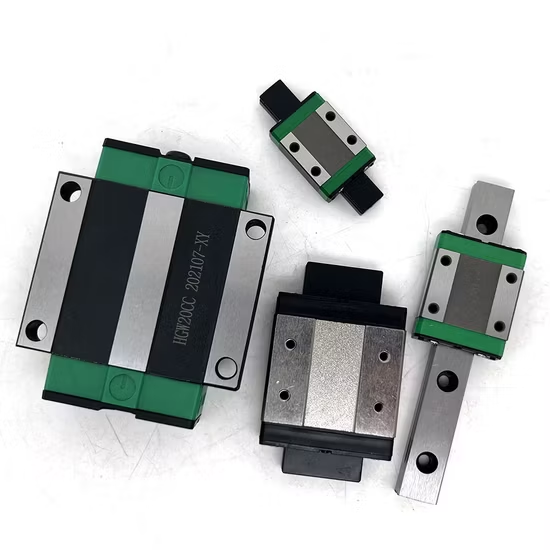
Sliding Block Guide

X&S EGW25CA EGW15SA EGW25SA EGW30SA Linear Guide Bearing — built with bearing steel and HRC58-62 hardness for woodworking machinery and automatic systems.
Cross-reference alignment verified — We match block type, rail profile, and preload class rather than just the base number to prevent field binding.
| Parameter | Value |
|---|---|
| Designation | EGW25CA EGW15SA EGW25SA EGW30SA |
| Product Type | Linear Guide Bearing |
| Material | Bearing steel or alternative variants |
| Hardness | HRC58-62 [NEED_CITE: standard hardness range for bearing steel] |
| Lubrication | Grease or oil |
| Corrosion Resistance | High corrosion resistance |
| Profile Type | Solid profile |
| Surface Treatment | Polished |
| Length | Standard or customized |
| Certification | CE |
| Origin | Shandong, China |
Note: Suffix definitions for the listed designations are unverified and require manufacturer catalog confirmation prior to final order placement.
| Industry | Typical Applications |
|---|---|
| Woodworking Machinery | CNC router spindle traversing, panel saw crosscut carriages, edge bander feed tracks |
| Automatic Systems | Pick-and-place gantry arms, automated storage retrieval shuttles, precision assembly fixtures |
Matching the base number is never enough when internal block geometry dictates machine survival.
In the Pearl River Delta manufacturing hub, I frequently see woodworking CNC routers suffer from severe spindle noise and premature track wear. The root cause is rarely the rail itself, but a cross-reference error where the base designation matches while the internal block arrangement or seal type fails to keep fine MDF dust out. When a standard block is forced into a high-speed precision routing environment, the lack of proper dust scraping and incorrect preload leads to rapid degradation of the rolling surface [NEED_CITE: linear guide failure modes in dusty environments]. Procurement teams often focus solely on the nominal size, overlooking the critical suffix variations that define the actual load capacity and sealing integrity.
Selecting the correct X&S EGW25CA EGW15SA EGW25SA EGW30SA linear guide bearing requires looking past the basic flange or square shape. In automated woodworking, the carriage undergoes rapid directional changes, demanding a block design that maintains rigidity without generating excessive friction heat. We review the specific recirculation path and end-cap design to ensure the chosen model handles the dynamic loads of high-speed gantry movements, preventing the carriage from lifting off the rail during sudden deceleration.
Woodworking environments generate highly abrasive particulate matter that easily infiltrates standard carriage seals. The operating environment dictates whether a contact seal with high scraping force or a non-contact shield with lower friction is appropriate. Lubrication intervals must be adjusted based on the travel distance and speed; grease provides better staying power for slower, heavily loaded axes, while oil might be necessary for high-speed traversing to minimize thermal buildup. Furthermore, the solid profile construction must resist deflection under the combined radial and moment loads typical of overhung routing spindles [NEED_CITE: impact of particulate contamination on linear motion systems].
The solid profile type ensures that the rail maintains its geometric straightness even when mounted on slightly uneven machine bases, a common reality in heavy woodworking equipment. The polished surface treatment is not merely aesthetic; it significantly reduces the friction coefficient between the rolling elements and the raceway, which is vital for maintaining smooth motion at high feed rates. The HRC58-62 hardness guarantees that the load-bearing surfaces resist brinelling when the machine encounters unexpected shock loads during heavy material cutting operations.
Substituting a medium-load block for a heavy-load variant just because the base width matches will inevitably lead to unplanned downtime. According to ISO 15243 framework principles for rolling bearing damage, inadequate load capacity combined with poor sealing results in abrasive wear and surface spalling [NEED_CITE: rolling bearing failure mode classification per ISO 15243]. This cascades into catastrophic damage to the entire linear axis, voiding machine warranties and halting production lines for weeks while replacement parts are sourced and realigned.
Sourcing these components requires more than just finding a matching part number on a spreadsheet. We ensure that the internal rolling element size and preload class exactly match your OEM requirements, preventing the thermal binding that occurs when clearance is miscalculated. Every batch is verified for authenticity, eliminating the risk of counterfeit blocks with soft inner rings that collapse under operational loads. Our technical team cross-references the exact seal configuration to guarantee compatibility with your specific environmental exposure, ensuring long-term reliability.
To ensure optimal performance, please provide the detailed load profiles, including radial, lateral, and moment forces acting on the carriage. Share the maximum travel speed, acceleration rates, and the specific environmental conditions, such as dust concentration or moisture levels. Supplying the original equipment manufacturer’s part numbers or machine model allows our engineering team to perform a comprehensive cross-reference check and verify the exact block arrangement required for your application.
Q: How do we verify the authenticity of these linear guide components?
A: We provide full batch traceability and QR codes that link directly to the manufacturer’s official verification system. This ensures the bearing steel and internal components are genuine, protecting your woodworking machinery from the premature failures associated with counterfeit parts that use substandard, soft inner materials.
Q: What cross-reference checks are critical beyond the base model number?
A: We verify the block type, seal configuration, and preload class, not just the base width. A mismatch in these suffixes can lead to improper dust exclusion or incorrect internal clearance, causing rapid wear or thermal binding in high-speed automatic systems.
Q: How should we choose between grease and oil lubrication?
A: Grease is typically preferred for heavily loaded, slower-moving axes where retention is key, while oil is better suited for high-speed traversing to minimize friction heat. The choice depends on your specific travel speed, duty cycle, and the accessibility of the carriage for automated re-lubrication.
Q: What causes premature failure in woodworking machinery linear guides?
A: The primary culprit is fine abrasive dust infiltrating the block, combined with incorrect preload selection. This leads to severe abrasive wear on the raceways. Ensuring the correct seal type and verifying the load capacity against the actual cutting forces prevents these catastrophic failures.
Our engineers will respond within 12 hours with a tailored solution.
Request Quote| Bearing Type | Sliding Block Guide |
| Brand | SKF |
| Quality Standard | ISO 9001 / TS 16949 |
| Precision Grade | P0 / P5 / P6 (custom) |
| Material | Chrome Steel / Stainless |
| Cage Material | Steel / Brass / Polyamide |
| Lubrication | Grease / Oil (specify) |
| Operating Temp. | -40°C to +200°C |
| Min. Order Qty | 1 pc (samples available) |
| Prototype Lead Time | 7 Working Days |
| Load Capacity | Contact for C0/Cr values |
| Speed Rating | Contact for ndm limit |
| Vibration Level | Z1 / Z2 / Z3 (custom) |
| Noise Level | V1 / V2 / V3 (custom) |
| Fatigue Life | L10h per ISO 281 |
| Sealing Options | Open / Z / 2Z / RS / 2RS |
Our engineering team can modify bearing dimensions, materials, seals, and clearances to meet your specific operating requirements. Submit your drawing or spec sheet for a tailored proposal.
Main shaft bearings, gearbox bearings, and generator bearings for onshore and offshore wind turbines.
Heavy-duty bearings for crushers, conveyors, and rotary equipment in extreme dust and shock-load environments.
High-temperature bearings for rolling mills, continuous casting, and furnace applications.
Wheel hub bearings, transmission bearings, and e-motor bearings for passenger and commercial vehicles.
Axle box bearings, traction motor bearings, and gearbox bearings meeting EN/UIC railway standards.
High-precision spindle bearings, angular contact bearings, and super-precision bearings for CNC and robotics.
Our engineers analyze your operating conditions -- load, speed, temperature, environment -- and select or design the optimal bearing solution to maximize service life and reduce total cost of ownership.
Need non-standard dimensions, special materials, or modified clearances? We can modify standard SKF bearings or manufacture fully custom solutions with a 7-day prototype turnaround.
When bearings fail prematurely, our team conducts root-cause analysis using advanced diagnostic tools to identify the failure mode and recommend corrective action.
We deploy vibration monitoring, thermal imaging, and oil analysis programs that detect bearing deterioration early -- reducing unplanned downtime by up to 40%.
Proper installation is critical to bearing performance. Our certified technicians provide on-site installation support, alignment verification, and operator training worldwide.
From initial selection through end-of-life, our dedicated account managers provide scheduled maintenance plans, re-lubrication programs, and replacement forecasting for enterprise clients.
NDA protected · Free samples for orders > $50K · Reply within 12 hours


