

ISO 9001 Certified
TS 16949
Genuine SKF
Need Technical Advice?
Reply within 12 hours · 15+ certified engineers on call
Wheel Hub Bearing
X&S DAC4080036/34 Rear Wheel Hub Bearing for Heavy Duty
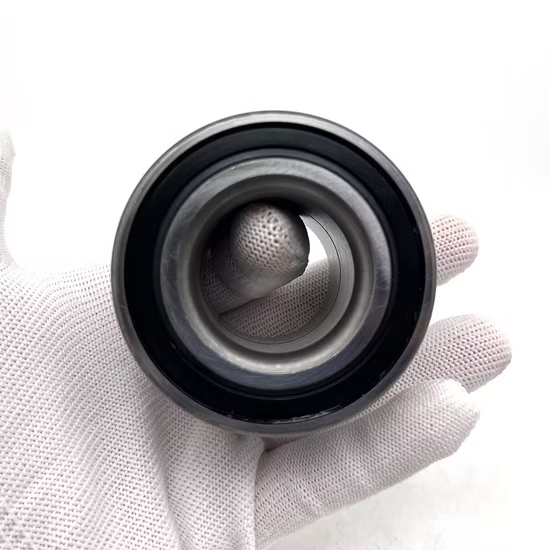
X&S DAC4080036/34 Wheel Hub Bearing 40×80 mm P6 C2 — engineered for heavy-duty axles with integrated ABS compatibility.
- C2 clearance and P6 precision maintain stable rotation under continuous heavy loads.
- Chrome steel construction ensures reliable performance in demanding vehicle repair applications.
- Each shipment includes comprehensive material test reports and dimensional inspection records for complete quality assurance.
7
Day Prototype
vs. 8-12 wks standard
50+
Countries Served
Global logistics network
12h
Quote Response
Expert engineers on call
Typical Applications
Wind Power
Mining
Steel & Metallurgy
Automotive / EV
Rail Transit
Precision Machinery
Genuine SKF Bearings
NDA Protected
Free Sample for Orders > $50K
Global Shipping
Product Details
Original Factory Batch Traceability — Every X&S DAC4080036/34 wheel hub bearing ships with verifiable lot documentation linking the component directly back to its specific production run.
Technical Specifications
| Parameter | Value |
|---|---|
| Designation | X&S DAC4080036/34 DAC40800036/34 DAC408000302 |
| Bearing Type | Double Row Angular Contact Wheel Hub Bearing |
| Bore Diameter (d) | 40 mm |
| Outside Diameter (D) | 80 mm |
| Width (B) | 36/34 mm (unverified suffix — requires manufacturer catalog confirmation) |
| Clearance Class | C2 |
| Precision Class | P6 |
| Material | Chrome Steel |
| ABS Sensor Configuration | With ABS |
| Lubrication | Grease or Oil |
| Certification | ISO9001, TS16949, CE |
| Origin | Shandong, China |
Application Suitability
| Industry | Typical Applications |
|---|---|
| Heavy Vehicle Repair | Commercial truck rear axle hub assemblies |
| Automotive Maintenance | Light commercial vehicle wheel end rebuilds |
| Fleet Operations | Trailer axle hub replacements for material handling logistics |
Why Suffix Alignment Dictates Survival for the X&S DAC4080036/34 Wheel Hub Bearing
Matching the base dimension is merely the starting line; ignoring the internal clearance and ABS configuration guarantees field failure.
Procurement teams often source wheel end components by cross-referencing only the primary 40x80mm footprint, completely overlooking the C2 clearance and integrated sensor requirements. This oversight leads to thermal binding under heavy highway loads or sudden anti-lock braking system signal loss. When a heavy-duty truck operates with a standard CN clearance instead of the specified C2, the thermal expansion of the axle and hub quickly eliminates the internal operating gap [NEED_CITE: thermal expansion effects on internal bearing clearance]. We ensure every suffix, from the precise dimensional height to the ABS tone ring compatibility, is strictly validated against the original equipment requirements before dispatch.
Matching the Component to the Axle Environment
Deploying the correct X&S DAC4080036/34 wheel hub bearing requires understanding that heavy commercial axles generate immense radial loads combined with significant axial thrust during cornering. Our technical review process verifies that the double row angular contact design properly absorbs these combined forces without separating the raceways. By confirming the exact OEM equipment number, we prevent the installation of under-specced alternatives that might physically fit the knuckle but lack the structural integrity for sustained highway freight operations.
Enduring Highway Friction and Contamination
The wheel end environment exposes components to extreme thermal cycling, high-speed rotational friction, and aggressive road debris. A C2 internal clearance is specifically engineered to compensate for the heat generated by heavy braking and continuous rolling friction, preventing the rollers from skidding when the hub expands. Furthermore, the integrated sealing system must keep fine particulate matter out of the grease cavity; even minor contamination acts as a lapping compound that rapidly degrades the raceway surface finish [NEED_CITE: rolling bearing failure mode classification per ISO 15243]. Selecting the correct lubrication option—whether pre-packed grease or oil bath compatible—is critical to maintaining a stable hydrodynamic film under these punishing conditions.
Decoding the Internal Engineering and Tolerances
The DAC prefix confirms a double row angular contact architecture, essential for managing the complex moment loads experienced at the wheel end. The 40mm bore and 80mm outside diameter define the physical envelope, while the P6 precision class ensures tight geometric tolerances that minimize rotational vibration and noise at highway speeds. Crucially, the C2 clearance class provides a tighter internal gap than standard, which is necessary to maintain optimal load distribution across the rolling elements when the assembly reaches operating temperature. The integrated ABS configuration ensures the magnetic or physical tone ring aligns perfectly with the chassis-mounted speed sensor, preventing erratic braking interventions. Finally, the 036/34 suffix dictates the exact inner and outer width profiles required for proper clamping force when the axle nut is torqued.
The Financial Impact of Incorrect Hub Selection
Installing a hub unit with mismatched internal geometry or incorrect sensor alignment triggers a cascade of expensive operational failures. Premature spalling and catastrophic cage disintegration can lead to sudden wheel detachment, resulting in severe collateral damage to the brake calipers and suspension knuckles. Beyond the immediate hardware replacement costs, fleets face massive financial penalties from unplanned downtime and voided warranty claims on adjacent drivetrain components [NEED_CITE: economic impact of premature bearing failure in commercial fleets]. Relying on incomplete cross-references compromises the entire safety architecture of the vehicle.
Securing Precision Through Authorized Channels
Sourcing mixed-brand requirements through a single authorized channel eliminates the coordination friction of dealing with multiple suppliers. We execute cross-brand interchange reviews that strictly match the C2 clearance and ABS sensor layout, rather than just accepting a basic dimensional equivalent. Every batch is backed by traceability to the manufacturer, supported by QR verification through official brand applications to instantly rule out counterfeit units. Our application-based selection review actively checks the load, speed, and thermal parameters of your specific fleet to ensure the selected hub unit will survive the intended duty cycle.
Documentation & Authenticity
- Certificate of Conformity verifying TS16949 automotive production standards for this specific batch.
- Original factory batch and lot traceability linking the hub unit to its exact forging and heat treatment run.
- Official app QR verification support to instantly authenticate the packaging and component markings.
- Material test report confirming the metallurgical composition and hardness of the chrome steel raceways.
- Dimensional and running accuracy inspection report validating the P6 tolerance before shipment.
Storage, Handling & Mounting
- Retain the original factory packaging until the exact moment of installation to protect the ABS sensor ring from impact damage.
- Store the hub units in a climate-controlled environment to prevent condensation from compromising the pre-packed grease cavity.
- Use clean, lint-free gloves when handling the component to avoid transferring acidic moisture onto the precision P6 raceways.
- Apply induction heating strictly within specified temperature limits to expand the 40mm bore without altering the chrome steel metallurgy.
- Torque the axle nut to the exact OEM specification to achieve the correct clamping force required for the 36/34mm width profile.
Initiating the Technical Review Process
To ensure complete compatibility, please provide the specific OEM equipment number or the exact radial and axial load parameters experienced by your fleet. Sharing the operational temperature range and the preferred lubrication method allows our engineering team to validate the C2 clearance selection and perform a comprehensive L10 life calculation. This technical verification guarantees that the cross-referenced hub unit perfectly aligns with your maintenance intervals and safety requirements.
Frequently Asked Questions
Q: Why is it critical to verify both the ABS configuration and the clearance suffix during cross-referencing?
A: Matching only the base 40x80mm dimension ignores vital operational parameters. An incorrect ABS tone ring will trigger dashboard fault codes and disable the braking system, while a standard CN clearance instead of the required C2 will cause thermal binding under heavy loads. Both oversights lead to immediate field failure and severe safety risks for heavy commercial vehicles.
Q: How does the C2 clearance perform compared to standard clearance in heavy-duty wheel applications?
A: The C2 clearance provides a tighter internal gap designed specifically to compensate for the thermal expansion of the axle and hub during continuous highway operation. As the assembly heats up from braking and rolling friction, the components expand to reach the optimal operating clearance. Using a standard or C3 clearance in this specific application would result in excessive internal play, roller skidding, and accelerated raceway wear.
Q: What documentation proves the inner ring hardness meets automotive standards?
A: Genuine automotive hub units are accompanied by a comprehensive material test report that verifies the metallurgical composition and heat treatment results. Counterfeit bearings often feature soft inner rings that fail to reach the required hardness, leading to rapid brinelling under heavy axle loads. Requesting the dimensional and running accuracy inspection report alongside the material certification ensures the component meets strict P6 precision and durability thresholds.
Q: What are the standard protocols for mounting DAC series hub units with integrated ABS rings?
A: Installation requires precise thermal expansion of the inner ring using controlled induction heating, avoiding open flames that can destroy the ABS sensor ring or degrade the internal grease. The axle nut must be torqued to the exact manufacturer specification to properly clamp the specific width profile. Forcing the unit into the knuckle without proper heating will damage the P6 precision raceways and compromise the bearing lifespan.
Q: What does TS16949 certification guarantee for aftermarket wheel hub bearings?
A: TS16949 certification ensures that the manufacturing facility adheres to stringent automotive quality management systems, focusing on defect prevention and the reduction of variation in the supply chain. For aftermarket buyers, this means the hub unit is produced with the same rigorous process controls, statistical quality monitoring, and traceability standards as components installed on the original assembly line, ensuring consistent reliability.
Product Summary
- Product Name
- X&S DAC4080036/34 Rear Wheel Hub Bearing for Heavy Duty
- Category
- Wheel Hub Bearing
- Brand
- SKF
- Certification
- ISO 9001 · TS 16949
- Lead Time
- 7 Working Days
Get a Custom Quote
Our engineers will respond within 12 hours with a tailored solution.
Request QuoteGeneral Specifications
| Bearing Type | Wheel Hub Bearing |
| Brand | SKF |
| Quality Standard | ISO 9001 / TS 16949 |
| Precision Grade | P0 / P5 / P6 (custom) |
| Material | Chrome Steel / Stainless |
| Cage Material | Steel / Brass / Polyamide |
| Lubrication | Grease / Oil (specify) |
| Operating Temp. | -40°C to +200°C |
| Min. Order Qty | 1 pc (samples available) |
| Prototype Lead Time | 7 Working Days |
Performance Parameters
| Load Capacity | Contact for C0/Cr values |
| Speed Rating | Contact for ndm limit |
| Vibration Level | Z1 / Z2 / Z3 (custom) |
| Noise Level | V1 / V2 / V3 (custom) |
| Fatigue Life | L10h per ISO 281 |
| Sealing Options | Open / Z / 2Z / RS / 2RS |
Custom Specifications Available
Our engineering team can modify bearing dimensions, materials, seals, and clearances to meet your specific operating requirements. Submit your drawing or spec sheet for a tailored proposal.
Wind Power
Main shaft bearings, gearbox bearings, and generator bearings for onshore and offshore wind turbines.
Mining & Quarrying
Heavy-duty bearings for crushers, conveyors, and rotary equipment in extreme dust and shock-load environments.
Steel & Metallurgy
High-temperature bearings for rolling mills, continuous casting, and furnace applications.
Automotive / EV
Wheel hub bearings, transmission bearings, and e-motor bearings for passenger and commercial vehicles.
Rail Transit
Axle box bearings, traction motor bearings, and gearbox bearings meeting EN/UIC railway standards.
Precision Machinery
High-precision spindle bearings, angular contact bearings, and super-precision bearings for CNC and robotics.
Application Design
EngineeringOur engineers analyze your operating conditions -- load, speed, temperature, environment -- and select or design the optimal bearing solution to maximize service life and reduce total cost of ownership.
Custom Modification
7-Day TurnaroundNeed non-standard dimensions, special materials, or modified clearances? We can modify standard SKF bearings or manufacture fully custom solutions with a 7-day prototype turnaround.
Failure Analysis
DiagnosticsWhen bearings fail prematurely, our team conducts root-cause analysis using advanced diagnostic tools to identify the failure mode and recommend corrective action.
Predictive Maintenance
Up to 40% Less DowntimeWe deploy vibration monitoring, thermal imaging, and oil analysis programs that detect bearing deterioration early -- reducing unplanned downtime by up to 40%.
On-site Installation
Global CoverageProper installation is critical to bearing performance. Our certified technicians provide on-site installation support, alignment verification, and operator training worldwide.
Lifecycle Support
Enterprise SLAFrom initial selection through end-of-life, our dedicated account managers provide scheduled maintenance plans, re-lubrication programs, and replacement forecasting for enterprise clients.
Why SKF China
The engineering partner advantage
7 Days
Prototype Lead Time
vs. 8-12 weeks via standard channels
15+
Certified Engineers
SKF-certified, on-call for your project
50+
Countries Delivered
Reliable global logistics network
Request a Quote
Get a custom quote for
X&S DAC4080036/34 Rear Wheel Hub Bearing for Heavy Duty
NDA protected · Free samples for orders > $50K · Reply within 12 hours
Related Products
More Wheel Hub Bearing Products
![X&S DAC391740036/34 DAC40700043 Wheel Hub Bearing for Machineries [WARN] draft identifier mismatch](https://skfip.com/wp-content/uploads/2026/09/xs-dac391740036-34-dac40700043-wheel-hub-bearing-for-machineries-warn-draft-identifier-mismatch-e947a8.avif)

![[WARN] draft identifier mismatch Energy Saving Wheel Hub Bearing Dac32730054 Dac35720434 Dac40740036/34 for Small Cars](https://skfip.com/wp-content/uploads/2026/09/timken-dac34640034-dac35650035-dac38710233-30-wheel-hub-bearing-authorized-export-9599eb-300x150.webp)