
![X&S DAC32720038 DAC32720345 Wheel Hub Bearing for Rolling Mill [WARN] draft identifier mismatch](https://skfip.com/wp-content/uploads/2026/09/xs-dac32720038-dac32720345-wheel-hub-bearing-for-rolling-mill-warn-draft-identifier-mismatch-734921.avif)
ISO 9001 Certified
TS 16949
Genuine SKF
Need Technical Advice?
Reply within 12 hours · 15+ certified engineers on call
Wheel Hub Bearing
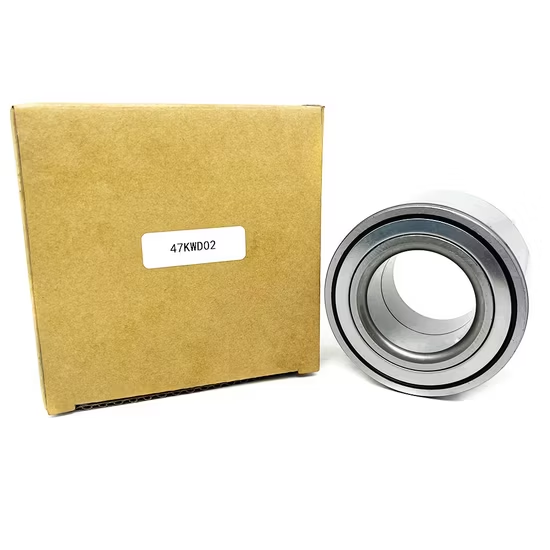
X&S DAC39680637 DAC39680737 DAC39720037 Wheel Hub Bearing for Auto Chassis Parts
X&S DAC39680637 DAC39680737 DAC39720037 Wheel Hub Bearing P2 C3 — C3 clearance accommodates thermal expansion under heavy automotive loads, and integrated ABS ensures compatibility with modern vehicle braking systems.
- Carbon steel construction provides structural integrity for chassis applications.
- Each order includes material test reports and dimensional inspection certificates.
7
Day Prototype
vs. 8-12 wks standard
50+
Countries Served
Global logistics network
12h
Quote Response
Expert engineers on call
Typical Applications
Wind Power
Mining
Steel & Metallurgy
Automotive / EV
Rail Transit
Precision Machinery
Genuine SKF Bearings
NDA Protected
Free Sample for Orders > $50K
Global Shipping
Product Details
Traceable Batch Origins — Every X&S DAC39680637 DAC39680737 DAC39720037 wheel hub bearing ships with verifiable manufacturer lot documentation to guarantee material consistency and prevent field failures.
Technical Specifications
| Parameter | Value |
|---|---|
| Designation | DAC39680637 DAC39680737 DAC39720037 |
| Product Type | Wheel Hub Bearing |
| Material | Carbon Steel |
| Precision Class | P2 |
| Clearance Class | C3 |
| ABS Integration | With ABS |
| Certification | ISO9001, TS16949, ISO9006, QS9000, VDA6.1 |
| Origin | China |
Application Suitability
| Industry | Typical Applications |
|---|---|
| Automotive Manufacturing | Front and rear wheel hub assemblies for passenger vehicles |
| Auto Chassis Repair | Replacement units for steering knuckle and suspension interfaces |
| Fleet Maintenance | High-mileage commercial light truck wheel end rebuilds |
Why Base Numbers Alone Cause Chassis Vibrations
Matching the base DAC number without verifying the C3 clearance and ABS ring configuration leads to premature thermal binding and sensor faults.
Procurement engineers often source wheel hub units based solely on the primary designation, overlooking critical internal variations. When a standard clearance bearing is pressed into a tight automotive knuckle, the interference fit eliminates internal play. Under highway speeds, friction generates heat, causing the steel components to expand. Without the proper clearance to accommodate this thermal growth, the rolling elements bind against the raceways [NEED_CITE: thermal expansion effects on interference fits in rolling bearings]. This results in audible humming, accelerated wear, and eventual catastrophic seizure, forcing warranty claims and repeat repairs.
Matching Precision and Clearance to Automotive Loads
Sourcing the correct X&S DAC39680637 DAC39680737 DAC39720037 wheel hub bearing requires looking past the outer dimensions. Our technical team reviews the specific interference fit requirements of the target vehicle’s steering knuckle to ensure the C3 internal clearance is maintained post-assembly. We also verify the magnetic encoder track on the ABS ring matches the OEM sensor gap, preventing dashboard warning lights after installation.
Thermal Dynamics and Sealing in Wheel Ends
Wheel hub assemblies endure a brutal combination of radial loads from vehicle weight and axial thrust during cornering. The carbon steel construction provides the necessary fatigue resistance for these dynamic forces. However, the operating temperature fluctuates significantly between cold starts and heavy braking events. This thermal cycling demands a C3 clearance class to prevent the bearing from tightening excessively [NEED_CITE: bearing internal clearance selection under thermal gradients]. Furthermore, integrated seals must keep out road salt and brake dust without creating excessive friction that degrades the lubricating grease.
Decoding the P2 and C3 Specifications
The P2 precision class ensures exceptionally tight dimensional tolerances and running accuracy, which is critical for minimizing noise and vibration in modern automotive cabins. Paired with the C3 clearance, this configuration allows the bearing to handle the press-fit installation into the hub and knuckle without preloading the rolling elements beyond their design limits. The integrated ABS sensor ring is manufactured with precise magnetic pole spacing to ensure accurate wheel speed readings for the vehicle’s anti-lock braking and electronic stability control systems.
The Hidden Costs of Incorrect Hub Assemblies
Installing a hub bearing with incorrect internal geometry or a mismatched ABS encoder leads to immediate diagnostic failures and costly comebacks. According to failure mode classifications in ISO 15243, improper clearance resulting from unverified press-fits causes smearing and early fatigue spalling on the raceways [NEED_CITE: rolling bearing damage and failure analysis per ISO 15243]. This unplanned downtime frustrates end-users and damages the reputation of the parts distributor, turning a simple replacement into a complex diagnostic nightmare.
Why Engineering Verification Matters Here
We address the common cross-reference errors where base numbers match but internal designs differ. For the DAC series, we specifically verify the C3 clearance and ABS encoder compatibility, not just the outer dimensions. Our batch traceability ensures you receive genuine carbon steel components with verified heat treatment. We provide application-based selection reviews to confirm the P2 precision meets your specific vehicle platform requirements, eliminating the guesswork in mixed-brand procurement.
Documentation & Authenticity
- Certificate of Conformity confirming ISO9001 and TS16949 manufacturing standards for this specific lot.
- Batch and lot traceability linking the DAC units directly to the carbon steel heat treatment records.
- Dimensional and running accuracy inspection reports validating the P2 tolerance class before shipment.
- Material test reports guaranteeing the structural integrity of the rings and rolling elements.
- ABS magnetic encoder verification logs ensuring correct pole spacing for vehicle stability systems.
Storage, Handling & Mounting Protocols
- Keep the DAC units in original moisture-barrier packaging until pressing to prevent corrosion on the P2 precision raceways.
- Use calibrated hydraulic presses for installation; hammering will brinell the carbon steel raceways and ruin the C3 clearance.
- Verify the ABS sensor ring orientation and air gap immediately after pressing to prevent signal dropout.
- Apply the correct torque to the central axle nut to establish the required internal preload without collapsing the C3 clearance.
- Avoid using magnetic lifting tools near the integrated ABS encoder to prevent demagnetizing the sensor track.
Requesting Technical Validation
To ensure exact fitment, provide the specific vehicle identification number or OEM equipment numbers so we can cross-reference the ABS encoder specifications and flange dimensions. Share the knuckle interference fit tolerances to confirm the C3 clearance will remain optimal post-assembly. Supplying these parameters allows our engineering team to validate the P2 precision suitability and guarantee a seamless integration into your auto chassis parts inventory.
Frequently Asked Questions
Q: Why is C3 clearance critical for automotive wheel hub bearings compared to standard CN clearance?
A: Standard CN clearance often disappears entirely when the bearing outer ring is press-fitted into the steering knuckle. As the hub heats up during driving, thermal expansion causes the internal components to bind, leading to excessive friction and premature failure. The C3 clearance provides the necessary internal space to accommodate both the interference fit and operational thermal growth, ensuring smooth rotation.
Q: How to verify the ABS sensor ring compatibility when cross-referencing DAC wheel hub bearings?
A: Base designations often ignore the specific magnetic pole count and encoder track width required by different vehicle ECUs. You must verify the exact OEM part number to ensure the integrated ABS ring matches the vehicle’s wheel speed sensor gap and signal requirements. We cross-reference the encoder specifications, not just the physical bearing dimensions, to prevent dashboard fault codes.
Q: What are the risks of using lower precision bearings in applications that require P2 precision?
A: Lower precision grades exhibit greater dimensional variations and radial runout. In automotive wheel hubs, this translates directly into steering wheel vibration, uneven tire wear, and audible humming at highway speeds. P2 precision ensures the tight tolerances necessary for smooth, quiet operation and optimal load distribution across the rolling elements, extending the service life of the entire suspension assembly.
Q: How to perform proper mounting and interference fit checks for double-row wheel hub bearings?
A: Always use a hydraulic press applying force only to the ring being press-fitted, never transferring load through the rolling elements. For these DAC units, ensure the pressing force is applied squarely to avoid cocking the outer ring in the knuckle. After installation, rotate the hub by hand to check for smooth binding-free movement, confirming the C3 internal clearance was not compromised during assembly.
Product Summary
- Product Name
- X&S DAC39680637 DAC39680737 DAC39720037 Wheel Hub Bearing for Auto Chassis Parts
- Category
- Wheel Hub Bearing
- Brand
- SKF
- Certification
- ISO 9001 · TS 16949
- Lead Time
- 7 Working Days
Get a Custom Quote
Our engineers will respond within 12 hours with a tailored solution.
Request QuoteGeneral Specifications
| Bearing Type | Wheel Hub Bearing |
| Brand | SKF |
| Quality Standard | ISO 9001 / TS 16949 |
| Precision Grade | P0 / P5 / P6 (custom) |
| Material | Chrome Steel / Stainless |
| Cage Material | Steel / Brass / Polyamide |
| Lubrication | Grease / Oil (specify) |
| Operating Temp. | -40°C to +200°C |
| Min. Order Qty | 1 pc (samples available) |
| Prototype Lead Time | 7 Working Days |
Performance Parameters
| Load Capacity | Contact for C0/Cr values |
| Speed Rating | Contact for ndm limit |
| Vibration Level | Z1 / Z2 / Z3 (custom) |
| Noise Level | V1 / V2 / V3 (custom) |
| Fatigue Life | L10h per ISO 281 |
| Sealing Options | Open / Z / 2Z / RS / 2RS |
Custom Specifications Available
Our engineering team can modify bearing dimensions, materials, seals, and clearances to meet your specific operating requirements. Submit your drawing or spec sheet for a tailored proposal.
Wind Power
Main shaft bearings, gearbox bearings, and generator bearings for onshore and offshore wind turbines.
Mining & Quarrying
Heavy-duty bearings for crushers, conveyors, and rotary equipment in extreme dust and shock-load environments.
Steel & Metallurgy
High-temperature bearings for rolling mills, continuous casting, and furnace applications.
Automotive / EV
Wheel hub bearings, transmission bearings, and e-motor bearings for passenger and commercial vehicles.
Rail Transit
Axle box bearings, traction motor bearings, and gearbox bearings meeting EN/UIC railway standards.
Precision Machinery
High-precision spindle bearings, angular contact bearings, and super-precision bearings for CNC and robotics.
Application Design
EngineeringOur engineers analyze your operating conditions -- load, speed, temperature, environment -- and select or design the optimal bearing solution to maximize service life and reduce total cost of ownership.
Custom Modification
7-Day TurnaroundNeed non-standard dimensions, special materials, or modified clearances? We can modify standard SKF bearings or manufacture fully custom solutions with a 7-day prototype turnaround.
Failure Analysis
DiagnosticsWhen bearings fail prematurely, our team conducts root-cause analysis using advanced diagnostic tools to identify the failure mode and recommend corrective action.
Predictive Maintenance
Up to 40% Less DowntimeWe deploy vibration monitoring, thermal imaging, and oil analysis programs that detect bearing deterioration early -- reducing unplanned downtime by up to 40%.
On-site Installation
Global CoverageProper installation is critical to bearing performance. Our certified technicians provide on-site installation support, alignment verification, and operator training worldwide.
Lifecycle Support
Enterprise SLAFrom initial selection through end-of-life, our dedicated account managers provide scheduled maintenance plans, re-lubrication programs, and replacement forecasting for enterprise clients.
Why SKF China
The engineering partner advantage
7 Days
Prototype Lead Time
vs. 8-12 weeks via standard channels
15+
Certified Engineers
SKF-certified, on-call for your project
50+
Countries Delivered
Reliable global logistics network
Request a Quote
Get a custom quote for
X&S DAC39680637 DAC39680737 DAC39720037 Wheel Hub Bearing for Auto Chassis Parts
NDA protected · Free samples for orders > $50K · Reply within 12 hours
Related Products
More Wheel Hub Bearing Products
![Xinsheng Wheel Hub Bearing DAC255200206A DAC35720433 DAC39680037 for EVs [WARN] draft identifier mismatch](https://skfip.com/wp-content/uploads/2026/09/xinsheng-wheel-hub-bearing-dac255200206a-dac35720433-dac39680037-for-evs-warn-draft-identifier-mismatch-15fe14.avif)

