


ISO 9001 Certified
TS 16949
Genuine SKF
Need Technical Advice?
Reply within 12 hours · 15+ certified engineers on call
Clutch Bearing
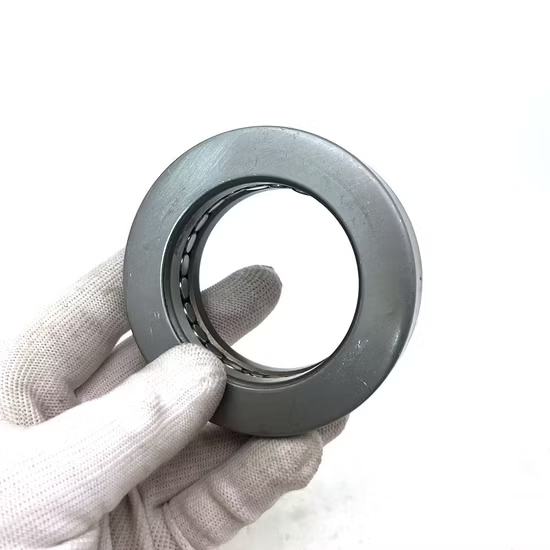
X&S BL412 RL422 RL423 RL432 RL448 RL488 F-566193 Clutch Release Bearing
X&S BL412 RL422 RL423 RL432 RL448 RL488 F-566193 Clutch Release Bearing P0-P2 Standard Clearance — Engineered with 59-62 HRC chrome steel and G10/G16 precision balls for stable high-speed clutch engagement.
- Supports grease or oil lubrication across diverse automotive and conveying applications.
- Verify cross-reference alignment on clearance, cage design, and precision class to prevent premature field failures.
7
Day Prototype
vs. 8-12 wks standard
50+
Countries Served
Global logistics network
12h
Quote Response
Expert engineers on call
Typical Applications
Wind Power
Mining
Steel & Metallurgy
Automotive / EV
Rail Transit
Precision Machinery
Genuine SKF Bearings
NDA Protected
Free Sample for Orders > $50K
Global Shipping
Product Details
Three-point cross-reference alignment — verifying internal design, seal configuration, and lubrication compatibility prevents catastrophic field failures beyond basic number matching.
Technical Specifications
| Parameter | Value |
|---|---|
| Designation | BL412 RL422 RL423 RL432 RL448 RL488 F-566193 |
| Bearing Type | Clutch Release Bearing |
| Material | Chrome Steel |
| Precision Class | P0, P6, P5, P4, P2 |
| Clearance Class | Standard |
| Lubrication | Grease or Oil |
| Hardness | 59-62 HRC |
| Ball Quality | G10/G16 |
| ABS Sensor | Without ABS |
| Certification | TS16949, CE |
| Origin | Shandong, China |
Application Suitability
| Industry | Typical Applications |
|---|---|
| Material Handling | Heavy-duty conveying equipment clutch actuation mechanisms |
| Automotive Manufacturing | Assembly line transfer vehicle clutch engagement systems |
| Heavy Vehicle Repair | Commercial truck and tractor clutch release fork assemblies |
| General MRO | Industrial gearbox manual clutch disengagement linkages |
Why Internal Geometry Dictates Clutch Release Bearing Survival
Base number matching without verifying internal geometry guarantees premature seizure under thermal load.
In Dubai’s extreme ambient heat, I have seen conveying lines halt completely because a replacement part matched the outer dimensions but lacked the correct internal clearance for thermal expansion. When a X&S BL412 RL422 F-566193 clutch release bearing is installed with standard clearance in an application demanding extra room for heat dissipation, the rolling elements bind. This friction generates rapid temperature spikes, ultimately melting the cage and burning out the release fork [NEED_CITE: thermal binding failure modes in clutch actuators]. Procurement teams often focus solely on the outer diameter, overlooking how internal design variations dictate operational survival.
Matching the X&S BL412 RL422 F-566193 clutch release bearing to Conveying Loads
Conveying equipment clutches experience high-frequency engagement cycles and severe shock loads during startup. The G10/G16 ball quality integrated into this series minimizes friction heat and vibration during these rapid transitions. By ensuring the rolling elements maintain precise spherical tolerances, the bearing resists the brinelling damage typically caused by heavy axial thrusts in material handling environments.
Thermal Expansion and Lubrication Boundaries in Clutch Systems
Clutch housings trap immense heat from adjacent friction plates and engines. Standard clearance requires careful monitoring to ensure the chrome steel components do not expand into a zero-clearance state during continuous operation. Furthermore, the choice between grease and oil lubrication depends entirely on the housing’s ability to retain fluid and the operating temperature envelope. Grease provides excellent sealing against clutch dust, but oil might be necessary if the ambient heat exceeds the thermal limit of standard bearing grease [NEED_CITE: lubrication degradation thresholds in enclosed clutch housings].
Decoding the Chrome Steel and Precision Matrix
The 59-62 HRC hardness of the chrome steel races ensures the contact paths resist wear during thousands of clutch pedal actuations. While P0 precision suffices for general agricultural or heavy truck repairs, machine tool spindle clutch applications demand P4 or P2 tolerances to prevent high-speed runout. The absence of an ABS sensor ring simplifies the inner ring design, maximizing the structural thickness of the chrome steel to handle heavy axial thrust without deformation.
The Hidden Costs of Rough Cross-Referencing
Substituting a clutch release bearing based only on basic dimensions often leads to catastrophic damage to the transmission input shaft and release fork. According to failure analysis frameworks like ISO 15243, surface distress and cage fractures frequently stem from ignored internal design differences rather than material defects [NEED_CITE: rolling bearing failure mode classification per ISO 15243]. Unplanned downtime on a main conveying line costs far more than the initial savings from a cheap, mismatched alternative.
Why Engineering Verification Matters for Your Procurement
We reject rough cross-referencing that only checks the basic designation. When sourcing the BL412 RL422 RL423 RL432 RL448 RL488 F-566193 series, we verify the cage material and internal clearance against your specific equipment requirements. Our single-source authorization covers all major brands, allowing mixed-brand orders to ship together without coordinating multiple suppliers. Every batch includes full traceability to the manufacturer, eliminating the risk of soft inner rings from counterfeit sources. We provide application-based selection reviews to ensure the lubrication and sealing match your exact operating environment.
Documentation & Authenticity
- Certificate of Conformity confirming TS16949 manufacturing compliance for automotive clutch components.
- Batch and lot traceability linking each X&S bearing directly to the original production run.
- QR verification via official apps to instantly rule out cloned codes and counterfeit chrome steel parts.
- Material test report validating the 59-62 HRC hardness of the raceways and rolling elements.
- Dimensional and running accuracy inspection report verifying P0 to P2 tolerances before dispatch.
- Country-of-origin documentation ensuring smooth customs clearance for international MRO shipments.
Storage, Handling & Mounting
- Keep the original packaging sealed until mounting to prevent clutch dust from contaminating the factory-applied grease.
- Store the chrome steel components in climate-controlled environments to prevent micro-corrosion on the G10/G16 precision balls.
- Use clean, lint-free gloves when handling the P4 or P2 precision variants to avoid skin acid etching on the raceways.
- Align the bearing perfectly with the release fork to prevent asymmetric axial loading that fractures the cage.
- Verify the lubrication type matches the housing design, as sealed variants cannot be re-lubricated after installation.
Securing the Right Fit for Your Equipment
To ensure optimal performance and longevity, please provide the specific radial and axial loads, operating speeds, and housing temperature ranges for your clutch system. If you are replacing an existing unit, sharing the exact OEM equipment number allows our engineering team to perform a precise cross-reference check. This technical review guarantees that the internal clearance and lubrication match your operational reality.
Frequently Asked Questions
Q: Why does a basic number match still cause field failures in clutch applications?
A: Basic numbers only define outer dimensions. If the internal clearance, cage material, or lubrication type differs from the original equipment requirements, the bearing will either bind under thermal expansion or starve for lubrication, leading to rapid seizure and fork damage.
Q: How does the 59-62 HRC hardness impact fatigue life in clutch systems?
A: This specific hardness range ensures the chrome steel raceways resist brinelling and surface wear during the high-impact axial thrusts of clutch engagement. Softer materials would quickly deform, creating vibration and premature catastrophic failure.
Q: What dictates the choice between grease and oil lubrication for these bearings?
A: Grease is preferred for sealed environments to block clutch dust and simplify maintenance. Oil lubrication is selected when the housing already has a continuous oil bath or when operating temperatures exceed the thermal limits of standard greases.
Q: When should I specify P4 or P2 precision over standard P0 for clutch bearings?
A: High-precision classes are necessary for machine tool spindle clutches or high-speed automotive applications where minimal runout and low vibration are critical. Standard P0 is generally sufficient for heavy vehicle repair and general conveying equipment.
Q: How do improper mounting tools cause early cage fractures?
A: Applying installation force to the wrong ring or misaligning the bearing with the release fork creates uneven stress on the cage. This asymmetric loading quickly fatigues the cage material, resulting in structural collapse during high-speed disengagement.
Product Summary
- Product Name
- X&S BL412 RL422 RL423 RL432 RL448 RL488 F-566193 Clutch Release Bearing
- Category
- Clutch Bearing
- Brand
- SKF
- Certification
- ISO 9001 · TS 16949
- Lead Time
- 7 Working Days
Get a Custom Quote
Our engineers will respond within 12 hours with a tailored solution.
Request QuoteGeneral Specifications
| Bearing Type | Clutch Bearing |
| Brand | SKF |
| Quality Standard | ISO 9001 / TS 16949 |
| Precision Grade | P0 / P5 / P6 (custom) |
| Material | Chrome Steel / Stainless |
| Cage Material | Steel / Brass / Polyamide |
| Lubrication | Grease / Oil (specify) |
| Operating Temp. | -40°C to +200°C |
| Min. Order Qty | 1 pc (samples available) |
| Prototype Lead Time | 7 Working Days |
Performance Parameters
| Load Capacity | Contact for C0/Cr values |
| Speed Rating | Contact for ndm limit |
| Vibration Level | Z1 / Z2 / Z3 (custom) |
| Noise Level | V1 / V2 / V3 (custom) |
| Fatigue Life | L10h per ISO 281 |
| Sealing Options | Open / Z / 2Z / RS / 2RS |
Custom Specifications Available
Our engineering team can modify bearing dimensions, materials, seals, and clearances to meet your specific operating requirements. Submit your drawing or spec sheet for a tailored proposal.
Wind Power
Main shaft bearings, gearbox bearings, and generator bearings for onshore and offshore wind turbines.
Mining & Quarrying
Heavy-duty bearings for crushers, conveyors, and rotary equipment in extreme dust and shock-load environments.
Steel & Metallurgy
High-temperature bearings for rolling mills, continuous casting, and furnace applications.
Automotive / EV
Wheel hub bearings, transmission bearings, and e-motor bearings for passenger and commercial vehicles.
Rail Transit
Axle box bearings, traction motor bearings, and gearbox bearings meeting EN/UIC railway standards.
Precision Machinery
High-precision spindle bearings, angular contact bearings, and super-precision bearings for CNC and robotics.
Application Design
EngineeringOur engineers analyze your operating conditions -- load, speed, temperature, environment -- and select or design the optimal bearing solution to maximize service life and reduce total cost of ownership.
Custom Modification
7-Day TurnaroundNeed non-standard dimensions, special materials, or modified clearances? We can modify standard SKF bearings or manufacture fully custom solutions with a 7-day prototype turnaround.
Failure Analysis
DiagnosticsWhen bearings fail prematurely, our team conducts root-cause analysis using advanced diagnostic tools to identify the failure mode and recommend corrective action.
Predictive Maintenance
Up to 40% Less DowntimeWe deploy vibration monitoring, thermal imaging, and oil analysis programs that detect bearing deterioration early -- reducing unplanned downtime by up to 40%.
On-site Installation
Global CoverageProper installation is critical to bearing performance. Our certified technicians provide on-site installation support, alignment verification, and operator training worldwide.
Lifecycle Support
Enterprise SLAFrom initial selection through end-of-life, our dedicated account managers provide scheduled maintenance plans, re-lubrication programs, and replacement forecasting for enterprise clients.
Why SKF China
The engineering partner advantage
7 Days
Prototype Lead Time
vs. 8-12 weeks via standard channels
15+
Certified Engineers
SKF-certified, on-call for your project
50+
Countries Delivered
Reliable global logistics network
Request a Quote
Get a custom quote for
X&S BL412 RL422 RL423 RL432 RL448 RL488 F-566193 Clutch Release Bearing
NDA protected · Free samples for orders > $50K · Reply within 12 hours
Related Products
More Clutch Bearing Products
![X&S Rcts355SA Rct4075-1s Rct40SA3 Clutch Release Bearing for Heavy-Duty Truck [WARN] draft identifier mismatch](https://skfip.com/wp-content/uploads/2026/09/xs-rcts355sa-rct4075-1s-rct40sa3-clutch-release-bearing-for-heavy-duty-truck-warn-draft-identifier-mismatch-29537e.avif)
![X&S RCT422SA1 RCT45-1S RCT473SA Clutch Release Bearing [WARN] draft identifier mismatch](https://skfip.com/wp-content/uploads/2026/09/xs-rct422sa1-rct45-1s-rct473sa-clutch-release-bearing-warn-draft-identifier-mismatch-db3590.avif)