

Angular Contact Ball Bearing
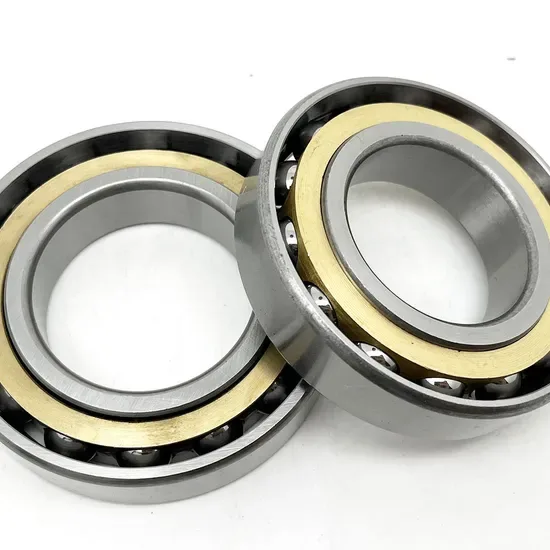
X&S 7213C 7213AC 7213B 7313B 7014C 7014AC 7218B 7218AC Angular Contact Ball Bearings — single-row configurations offering 15°, 25°, and 40° contact angles for precise axial load adaptation.
Three-point cross-reference alignment — verifying base number, contact angle suffix, and precision class prevents thermal binding in high-speed spindle replacements.
| Parameter | Value |
|---|---|
| Designation | 7213C 7213AC 7213B 7313B 7014C 7014AC 7218B 7218AC |
| Bearing Type | Angular Contact Ball Bearing |
| Number of Rows | Single |
| Contact Angle | 15° (C), 25° (AC), 40° (B) |
| Material Options | Available in stainless steel or standard bearing steel variants |
| Seal or Shield Type | Z, Zz, RS, 2RS, or Open |
| Precision Class | ABEC1, ABEC3, ABEC5, ABEC7 / P0, P6, P5, P4, UP, SP |
| Lubrication | Grease or Oil |
| Operating Temperature | Up to +120 ºC standard range |
| Origin | Shandong, China |
| Industry | Typical Applications |
|---|---|
| Machine Tool Manufacturing | High-speed spindle nose bearings, ball screw support units |
| Industrial Pump Systems | High-speed pump impeller shafts, boiler feed pump thrust collars |
| Robotics & Automation | Robotic arm joint actuators, precision rotary index tables |
Matching the basic bore and outside diameter is never enough for precision rotating assemblies. A significant share of catastrophic spindle failures stems from ignoring the contact angle and internal clearance during cross-brand substitution. When a 40° contact angle variant is forced into a high-speed application designed for 15°, the resulting axial stiffness generates excessive friction heat. This thermal expansion rapidly eliminates internal clearance, leading to severe raceway smearing and cage disintegration within hours of startup [NEED_CITE: rolling bearing failure mode classification per ISO 15243]. Sourcing the exact X&S 7213C 7213AC 7213B angular contact ball bearing configuration ensures the internal geometry perfectly matches the original equipment manufacturer’s thermal and load calculations.
Selecting the correct X&S 7213C 7213AC 7213B angular contact ball bearing requires understanding how axial load capacity trades off against maximum permissible speed. The 15° (C suffix) variants excel in high-speed, light-axial-load environments like grinding spindles, minimizing centrifugal forces on the rolling elements. Conversely, the 40° (B suffix) options provide the robust axial thrust capacity needed for heavy-duty turning centers or vertical pump shafts, where downward cutting forces or hydraulic thrust dominate the load profile.
High-speed spindles generate intense localized heat, demanding careful consideration of thermal expansion and lubrication strategies. Oil-air or oil-mist lubrication is typically mandatory for the highest speed limits, requiring open or lightly shielded configurations to allow oil flow without churning losses. In moderately paced robotic joints, sealed variants with factory-filled grease protect against particulate ingress while eliminating maintenance intervals. The operating temperature limit dictates the cage material and clearance class; exceeding standard thermal boundaries without upgrading to high-temperature grease or specialized cages accelerates lubricant degradation and premature wear [NEED_CITE: thermal limits of standard bearing lubricants].
The suffix string defines the operational boundaries of these single-row bearings. The contact angle designation (C for 15°, AC for 25°, B for 40°) dictates the load vector the raceways can safely transmit. Precision grades like P4 or ABEC7 control the dimensional and running accuracy, which is non-negotiable for minimizing vibration in machine tool spindles. Seal variants introduce a critical trade-off: RS contact seals offer superior contamination exclusion but generate friction heat at high RPMs, whereas Z non-contact shields provide basic dust protection without compromising the speed limit.
Installing a standard clearance bearing in a high-speed spindle designed for extra clearance inevitably causes thermal binding as the inner ring expands. This unplanned downtime halts production lines and often results in catastrophic damage to the expensive spindle housing and shaft. Furthermore, using an incorrect precision grade introduces unacceptable runout, ruining the surface finish of machined parts and voiding equipment warranties. Adhering to ISO 281 life calculation principles requires exact alignment of all internal design parameters to avoid these compounding financial losses [NEED_CITE: bearing life calculation methodologies per ISO 281].
Our technical review process catches cross-reference errors that automated systems miss, specifically checking if the replacement matches the original clearance and cage material requirements. We verify that the contact angle and precision suffixes of the requested designations align perfectly with your spindle’s thermal growth profile. Every shipment includes full batch traceability to the manufacturer, eliminating the risk of installing counterfeit components with soft inner rings. We provide comprehensive cross-brand interchange support, ensuring mixed-brand assemblies maintain matched preload and dimensional consistency.
To ensure accurate selection and cross-reference verification, please provide the exact radial and axial load profiles alongside the maximum operating RPM. Sharing the OEM equipment number or the original bearing’s full designation string allows our engineering team to validate the contact angle and precision requirements. Detailing the operating environment, including ambient temperature and contamination risks, helps us recommend the optimal seal type and material variant for your specific application.
Q: Why can’t I substitute a 40° (B) contact angle bearing for a 15° (C) variant if the base dimensions match?
A: The contact angle fundamentally alters the bearing’s load-carrying geometry and stiffness. A 40° angle generates significantly higher internal friction and axial preload under the same radial load, leading to rapid thermal expansion and seizure in high-speed spindles designed for the lower friction of a 15° angle.
Q: How do I choose between RS contact seals and Z shields for my robotic joint application?
A: RS contact seals provide excellent protection against dust and moisture but create friction that limits maximum RPM and generates heat. Z shields offer non-contact protection suitable for higher speeds but allow fine particulate ingress, making them better for cleaner environments where speed is the priority.
Q: What is the practical difference between ABEC and ISO P-grade precision classifications?
A: Both systems define dimensional and running accuracy tolerances, with ABEC7 roughly corresponding to ISO P4. In precision spindles, these tighter tolerances minimize radial and axial runout, reducing vibration and ensuring superior surface finishes on machined components compared to standard P0 or ABEC1 grades.
Q: How should single-row angular contact bearings be managed during the mounting process?
A: Single-row variants must be mounted in pairs or sets to handle bidirectional axial loads. It is critical to follow the manufacturer’s matching marks and apply the correct axial preload during assembly to eliminate internal clearance and ensure the rigid operation required for precision machining.
Our engineers will respond within 12 hours with a tailored solution.
Request Quote| Bearing Type | Angular Contact Ball Bearing |
| Brand | SKF |
| Quality Standard | ISO 9001 / TS 16949 |
| Precision Grade | P0 / P5 / P6 (custom) |
| Material | Chrome Steel / Stainless |
| Cage Material | Steel / Brass / Polyamide |
| Lubrication | Grease / Oil (specify) |
| Operating Temp. | -40°C to +200°C |
| Min. Order Qty | 1 pc (samples available) |
| Prototype Lead Time | 7 Working Days |
| Load Capacity | Contact for C0/Cr values |
| Speed Rating | Contact for ndm limit |
| Vibration Level | Z1 / Z2 / Z3 (custom) |
| Noise Level | V1 / V2 / V3 (custom) |
| Fatigue Life | L10h per ISO 281 |
| Sealing Options | Open / Z / 2Z / RS / 2RS |
Our engineering team can modify bearing dimensions, materials, seals, and clearances to meet your specific operating requirements. Submit your drawing or spec sheet for a tailored proposal.
Main shaft bearings, gearbox bearings, and generator bearings for onshore and offshore wind turbines.
Heavy-duty bearings for crushers, conveyors, and rotary equipment in extreme dust and shock-load environments.
High-temperature bearings for rolling mills, continuous casting, and furnace applications.
Wheel hub bearings, transmission bearings, and e-motor bearings for passenger and commercial vehicles.
Axle box bearings, traction motor bearings, and gearbox bearings meeting EN/UIC railway standards.
High-precision spindle bearings, angular contact bearings, and super-precision bearings for CNC and robotics.
Our engineers analyze your operating conditions -- load, speed, temperature, environment -- and select or design the optimal bearing solution to maximize service life and reduce total cost of ownership.
Need non-standard dimensions, special materials, or modified clearances? We can modify standard SKF bearings or manufacture fully custom solutions with a 7-day prototype turnaround.
When bearings fail prematurely, our team conducts root-cause analysis using advanced diagnostic tools to identify the failure mode and recommend corrective action.
We deploy vibration monitoring, thermal imaging, and oil analysis programs that detect bearing deterioration early -- reducing unplanned downtime by up to 40%.
Proper installation is critical to bearing performance. Our certified technicians provide on-site installation support, alignment verification, and operator training worldwide.
From initial selection through end-of-life, our dedicated account managers provide scheduled maintenance plans, re-lubrication programs, and replacement forecasting for enterprise clients.
NDA protected · Free samples for orders > $50K · Reply within 12 hours


