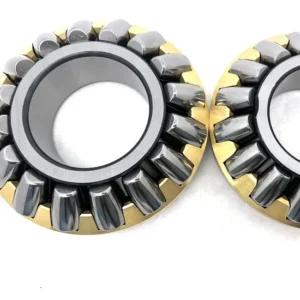
Thrust Roller Bearing

X&S 29426M Thrust Roller Bearing features a machined brass cage for exceptional structural strength under heavy axial loads in metallurgical rolling mills. Manufactured from Gcr15 chrome steel, it delivers reliable wear resistance in demanding industrial environments.
Verified via official app — Every X&S 29426M thrust roller bearing carries a scannable QR code linking directly to the manufacturer’s batch traceability database.
| Parameter | Value |
|---|---|
| Designation | 29426M |
| Bearing Type | Thrust Roller Bearing |
| Material | Chrome Steel Gcr15 |
| Cage Material | Machined Brass |
| Precision Class | P0, P5, P6 |
| Clearance Class | C0, C2, C3 |
| Load Type | Axial Load |
| Lubrication | Oil / Grease Lubrication |
| Origin | China |
| HS Code | 8482500090 |
| Industry | Typical Applications |
|---|---|
| Steel and Metallurgy | Rolling mill screw-down mechanisms, vertical stand adjustments |
| Heavy Machinery | Engineering machine vertical shafts, heavy-duty crane hooks |
| General Industrial | Machinery equipment requiring high axial load capacity |
Brass cage structural integrity dictates survival under extreme axial shock.
In metallurgical environments, axial shock loads often overwhelm standard stamped steel cages, leading to rapid fragmentation. Procurement engineers frequently match the base number but overlook the cage material suffix, resulting in catastrophic binding during peak rolling cycles. When an X&S 29426M thrust roller bearing is installed without verifying the machined brass designation, the entire screw-down assembly risks sudden seizure under thermal stress. [NEED_CITE: rolling bearing failure mode classification per ISO 15243]
Selecting the correct configuration requires balancing axial capacity with thermal expansion. The X&S 29426M thrust roller bearing provides the necessary load support for vertical adjustments, while our cross-reference review ensures the internal geometry aligns perfectly with your specific equipment housing. We verify that the selected clearance and cage combination will withstand the continuous vibration inherent to rolling operations.
Rolling mill screw-down mechanisms operate under intense heat radiating from the rolled billets, which drastically alters internal clearance and lubricant viscosity. Standard grease formulations often degrade rapidly in these conditions, necessitating reliable oil circulation or high-temperature synthetic alternatives to prevent metal-to-metal contact. Furthermore, heavy scale and coolant mist demand strict contamination control, as particulate ingress accelerates raceway spalling and compromises the machined brass cage. [NEED_CITE: impact of thermal gradients on bearing internal clearance]
The M suffix on this designation specifies a machined brass cage, which offers superior structural strength and damping characteristics compared to pressed steel alternatives under heavy axial loads. Choosing between C0, C2, and C3 clearance classes depends entirely on the operating temperature gradient; a C3 clearance is typically mandatory to accommodate thermal expansion and prevent internal preload buildup when the bearing reaches elevated temperatures. Precision grades ranging from P0 to P6 dictate the running accuracy, where tighter tolerances are reserved for precision positioning tasks rather than roughing mill adjustments.
Installing a bearing with an incorrect cage type or insufficient clearance inevitably leads to unplanned downtime and catastrophic damage to the surrounding housing. According to failure analysis frameworks outlined in ISO 281, thermal binding caused by inadequate internal clearance drastically reduces fatigue life and triggers premature failure. Warranty voidance is almost guaranteed when cross-reference errors ignore critical suffix parameters, leaving the maintenance team to manage the fallout of a seized mill stand. [NEED_CITE: bearing life calculation and failure modes per ISO 281]
Our authorization across major brands ensures that your mixed-brand requirements are fulfilled with complete batch traceability, eliminating the risk of counterfeit components with soft inner rings. We perform rigorous cross-reference checks that align not just the base number, but also the exact cage material and clearance suffixes to prevent field failures. Every X&S 29426M thrust roller bearing is backed by application-based selection reviews covering load, speed, and temperature, ensuring the specification matches your actual operating conditions.
To ensure accurate selection and L10 life calculation, please provide your specific axial load profiles, operating speeds, and maximum thermal exposure limits. Sharing the original OEM equipment number allows our engineering team to perform a comprehensive cross-reference check, verifying that the suffix parameters match your exact housing requirements. This technical review guarantees that the proposed configuration will withstand your specific metallurgical duty cycle without premature degradation.
Q: Why must cross-referencing include the cage and clearance suffixes?
A: Matching only the base designation ignores critical internal geometry. A standard cage might fail under the axial shock of a rolling mill, while incorrect clearance causes thermal binding. We verify the M suffix and specific clearance class to ensure the replacement survives the actual operating temperature and load profile.
Q: How does the machined brass cage handle heavy axial loads?
A: The machined brass cage provides superior structural rigidity and vibration damping compared to stamped steel. This prevents cage fragmentation under the severe axial shock and continuous vibration typical of metallurgical rolling mill screw-down mechanisms, ensuring stable roller guidance and extended service life.
Q: What dictates the choice between P0, P5, and P6 precision?
A: P0 is generally sufficient for heavy, low-speed structural adjustments where running accuracy is secondary to load capacity. P5 and P6 grades are selected when the vertical shaft requires tighter dimensional control to minimize axial runout and maintain precise thickness tolerances during high-speed rolling operations.
Q: How do I select the correct internal clearance for high temperatures?
A: Operating temperature dictates the choice. If the bearing experiences significant heat from the rolled material, a C3 clearance is necessary to compensate for thermal expansion and prevent internal preload. Standard C0 clearance is reserved for applications where the thermal gradient remains minimal and stable.
Q: Should I use oil or grease lubrication for this application?
A: Oil lubrication is typically preferred in rolling mills because it provides superior cooling and effectively flushes away contaminating scale particles. Grease may be used in slower, heavily sealed applications, provided the formulation can withstand the elevated ambient temperatures without degrading or channeling away from the rollers.
Our engineers will respond within 12 hours with a tailored solution.
Request Quote| Bearing Type | Thrust Roller Bearing |
| Brand | SKF |
| Quality Standard | ISO 9001 / TS 16949 |
| Precision Grade | P0 / P5 / P6 (custom) |
| Material | Chrome Steel / Stainless |
| Cage Material | Steel / Brass / Polyamide |
| Lubrication | Grease / Oil (specify) |
| Operating Temp. | -40°C to +200°C |
| Min. Order Qty | 1 pc (samples available) |
| Prototype Lead Time | 7 Working Days |
| Load Capacity | Contact for C0/Cr values |
| Speed Rating | Contact for ndm limit |
| Vibration Level | Z1 / Z2 / Z3 (custom) |
| Noise Level | V1 / V2 / V3 (custom) |
| Fatigue Life | L10h per ISO 281 |
| Sealing Options | Open / Z / 2Z / RS / 2RS |
Our engineering team can modify bearing dimensions, materials, seals, and clearances to meet your specific operating requirements. Submit your drawing or spec sheet for a tailored proposal.
Main shaft bearings, gearbox bearings, and generator bearings for onshore and offshore wind turbines.
Heavy-duty bearings for crushers, conveyors, and rotary equipment in extreme dust and shock-load environments.
High-temperature bearings for rolling mills, continuous casting, and furnace applications.
Wheel hub bearings, transmission bearings, and e-motor bearings for passenger and commercial vehicles.
Axle box bearings, traction motor bearings, and gearbox bearings meeting EN/UIC railway standards.
High-precision spindle bearings, angular contact bearings, and super-precision bearings for CNC and robotics.
Our engineers analyze your operating conditions -- load, speed, temperature, environment -- and select or design the optimal bearing solution to maximize service life and reduce total cost of ownership.
Need non-standard dimensions, special materials, or modified clearances? We can modify standard SKF bearings or manufacture fully custom solutions with a 7-day prototype turnaround.
When bearings fail prematurely, our team conducts root-cause analysis using advanced diagnostic tools to identify the failure mode and recommend corrective action.
We deploy vibration monitoring, thermal imaging, and oil analysis programs that detect bearing deterioration early -- reducing unplanned downtime by up to 40%.
Proper installation is critical to bearing performance. Our certified technicians provide on-site installation support, alignment verification, and operator training worldwide.
From initial selection through end-of-life, our dedicated account managers provide scheduled maintenance plans, re-lubrication programs, and replacement forecasting for enterprise clients.
NDA protected · Free samples for orders > $50K · Reply within 12 hours