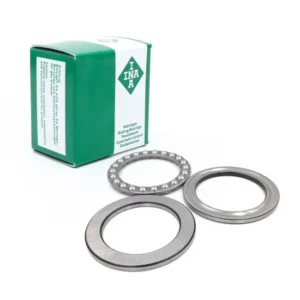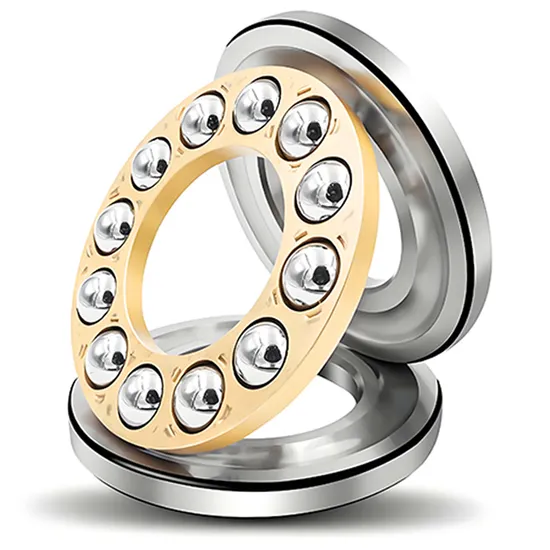
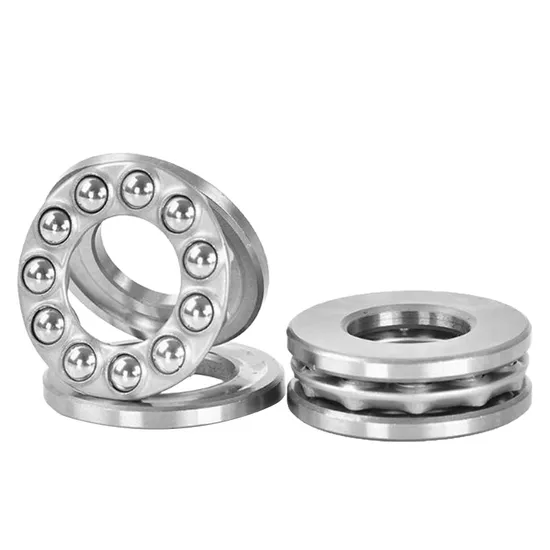
Thrust Ball Bearing
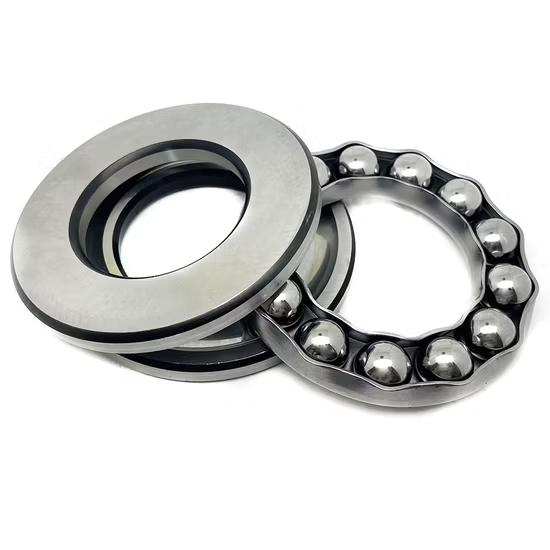
Xinsheng 51112 51210 52208 Thrust Ball Bearing — single and double-direction designs in bearing steel with bainite quenching for high impact resistance under heavy axial loads.
Authorized Multi-Brand Coverage — Sourcing the Xinsheng 51112 51210 52208 thrust ball bearing alongside SKF or FAG equivalents in a single consolidated shipment eliminates multi-vendor coordination delays.
| Parameter | Value |
|---|---|
| Designation | 51112 51210 52208 |
| Product Type | Thrust Ball Bearing |
| Directional Design | Single-direction (51112, 51210) / Double-direction (52208) |
| Material | Bearing Steel with Bainite Quenching |
| Precision Rating | P0, P6, P5, P4 |
| Clearance Class | C2, C0, C3, C4, C5 (Axial) |
| Vibration Acceleration | Z, Z1, Z2, Z3, Z4 |
| Vibration Tolerance | V, V1, V2, V3, V4 |
| Lubrication | Oil or Grease |
| Certification | ISO 9001 |
| Industry | Typical Applications |
|---|---|
| Engineering Machinery | Crane slewing mechanisms, excavator swivel joints, heavy-duty hydraulic press rams |
| Mining | Vibrating screen drive shafts, cone crusher vertical shafts, hoist winch drums |
| Automotive | Heavy-duty truck steering kingpins, transmission main shafts, clutch release mechanisms |
| Aviation | Landing gear actuation screw jacks, helicopter rotor swashplate controls |
Base numbers might match on a purchase order, but overlooking internal design differences between single-direction and double-direction thrust bearings leads to catastrophic axial load failures in the field.
Installing a single-direction 51112 where a double-direction 52208 is required guarantees immediate structural collapse under reversing axial loads.
Procurement engineers often focus solely on the bore and outside diameter, assuming all thrust ball bearings of a similar size handle bidirectional forces. When a crane slewing mechanism or a vibrating screen drive shaft experiences load reversal, a single-direction bearing loses contact between the rolling elements and the raceway. The resulting uncontrolled axial play causes severe impact damage to the cage and raceways [NEED_CITE: rolling bearing failure mode classification per ISO 15243]. Sourcing the correct Xinsheng 51112 51210 52208 thrust ball bearing requires strict verification of the directional capacity against the equipment’s operational profile.
Selecting the correct configuration from the Xinsheng 51112 51210 52208 thrust ball bearing range depends entirely on the axial load behavior of the target machinery. The 51112 and 51210 single-direction variants are engineered to absorb heavy, unidirectional axial loads, making them ideal for vertical shafts in hoists or hydraulic presses where gravity or constant hydraulic pressure dictates the force vector. Conversely, the 52208 double-direction design incorporates an intermediate shaft washer and two cage assemblies to manage reversing axial forces, a critical requirement for applications like crane slewing rings or automotive steering columns where the load vector shifts dynamically during operation.
Engineering machinery operates in environments characterized by heavy shock loads, particulate contamination, and fluctuating temperatures that severely test thrust bearing integrity. Under high axial loads combined with shock impacts, standard martensitic raceways can suffer from micro-spalling or brittle fracture. Furthermore, mining and construction equipment frequently experiences thermal cycling; if the axial clearance is not correctly matched to the housing’s thermal expansion rate, the bearing can either run too loose—causing destructive skidding—or preload internally, leading to rapid thermal runaway. Effective lubrication is equally critical, as grease degradation in high-vibration environments like vibrating screens starves the contact zones, while inadequate sealing allows abrasive silica dust to infiltrate the rolling elements [NEED_CITE: lubrication failure mechanisms in heavy machinery per ISO 281].
The defining metallurgical feature of this series is the bainite quenching heat treatment applied to the bearing steel. Unlike standard martensitic hardening, which maximizes surface hardness at the expense of brittleness, the bainitic microstructure yields a superior balance of high compressive strength and impact toughness. This makes the raceways exceptionally resistant to the shock loads typical in mining crushers and heavy presses. Equally important is the selection of the correct axial clearance class (C2 through C5). While C0 is standard, applications involving high operating temperatures or tight interference fits on the shaft require C3 or C4 clearance to compensate for thermal expansion and prevent internal binding. The vibration grading (Z and V series) further allows buyers to specify tighter geometric tolerances for noise-sensitive or high-speed automotive applications, ensuring smooth operation without excessive cage vibration.
Failing to align the bearing’s internal geometry and clearance with the actual operating parameters results in unplanned downtime that far exceeds the component’s purchase price. When a standard C0 clearance bearing is installed in a high-temperature gearbox without accounting for thermal expansion, the internal axial play vanishes, generating immense friction and rapid thermal seizure. Similarly, utilizing a bearing without adequate vibration tolerance grading in a high-speed application accelerates cage fatigue and rolling element skidding. These premature failures not only destroy the bearing but often score the mating shaft and housing surfaces, leading to catastrophic damage that requires extensive machining and extended production halts to rectify [NEED_CITE: economic impact of premature bearing failure per ISO 15243].
Sourcing the Xinsheng 51112 51210 52208 thrust ball bearing through our network guarantees that cross-reference matching extends beyond mere dimensional equivalence. We actively verify that the replacement bearing matches the OEM’s required clearance class and directional design, preventing the common error of substituting a single-direction unit into a bidirectional load path. Every shipment is backed by manufacturer-level batch traceability, ensuring the bainite quenching heat treatment is documented and verifiable. Furthermore, our technical team reviews application parameters—such as load vectors and thermal profiles—to confirm the selected suffix combination will survive the specific operational environment, eliminating the guesswork that typically plagues multi-brand MRO procurement.
To ensure the selected thrust bearing configuration perfectly matches your machinery, please provide detailed operational parameters including maximum axial loads, rotational speeds, and expected operating temperatures. Supplying the OEM equipment model number or the original bearing’s full designation allows our engineering team to execute a precise cross-reference and verify the required directional capacity. With this data, we can confirm the optimal clearance class, vibration tolerance, and lubrication strategy, delivering a technically validated solution rather than just a part number.
Q: What is the difference in axial load capacity between 511, 512, and 522 series thrust bearings?
A: The 511 and 512 series are single-direction thrust ball bearings designed to absorb heavy axial loads in one direction only, with the 512 series typically offering higher load capacity for a given bore size. The 522 series, such as the 52208, is a double-direction design featuring an intermediate shaft washer and two cage assemblies, allowing it to manage reversing axial loads in applications like crane slewing mechanisms.
Q: How does bainite quenching improve thrust bearing performance in heavy machinery?
A: Bainite quenching alters the steel’s microstructure to provide a superior balance of high compressive strength and impact toughness compared to standard martensitic hardening. This enhanced structural resilience prevents brittle fracture and micro-spalling when the thrust washers are subjected to the severe shock loads and heavy axial forces typical in mining crushers and hydraulic engineering machinery.
Q: Why is it critical to distinguish between radial and axial clearance when selecting thrust ball bearings?
A: Thrust ball bearings are designed exclusively to handle axial loads, meaning their internal geometry relies on axial clearance rather than radial clearance to function correctly. Selecting the appropriate axial clearance class, such as C3 or C4, is essential to accommodate thermal expansion and shaft interference fits; failing to do so can result in internal preloading, excessive friction, and rapid thermal seizure during operation.
Q: How to cross-reference thrust bearings correctly without missing precision and vibration suffixes?
A: Accurate cross-referencing requires matching not only the base dimensions but also the directional design, precision class, and vibration grading. Procurement engineers must verify that the replacement unit matches the OEM’s specific P-class precision and Z/V vibration tolerances to ensure smooth operation in high-speed or noise-sensitive applications, preventing premature cage fatigue caused by uncontrolled geometric deviations.
Q: What are the recommended lubrication methods for high-speed thrust applications?
A: For high-speed thrust applications, oil lubrication is generally preferred over grease because it provides superior heat dissipation and reduces churning friction within the cage assembly. Circulating oil systems or oil-air lubrication methods ensure a consistent supply of fresh lubricant to the rolling elements while effectively flushing away wear debris, thereby extending the operational lifespan of the bearing in demanding automotive or aviation environments.
Our engineers will respond within 12 hours with a tailored solution.
Request Quote| Bearing Type | Thrust Ball Bearing |
| Brand | SKF |
| Quality Standard | ISO 9001 / TS 16949 |
| Precision Grade | P0 / P5 / P6 (custom) |
| Material | Chrome Steel / Stainless |
| Cage Material | Steel / Brass / Polyamide |
| Lubrication | Grease / Oil (specify) |
| Operating Temp. | -40°C to +200°C |
| Min. Order Qty | 1 pc (samples available) |
| Prototype Lead Time | 7 Working Days |
| Load Capacity | Contact for C0/Cr values |
| Speed Rating | Contact for ndm limit |
| Vibration Level | Z1 / Z2 / Z3 (custom) |
| Noise Level | V1 / V2 / V3 (custom) |
| Fatigue Life | L10h per ISO 281 |
| Sealing Options | Open / Z / 2Z / RS / 2RS |
Our engineering team can modify bearing dimensions, materials, seals, and clearances to meet your specific operating requirements. Submit your drawing or spec sheet for a tailored proposal.
Main shaft bearings, gearbox bearings, and generator bearings for onshore and offshore wind turbines.
Heavy-duty bearings for crushers, conveyors, and rotary equipment in extreme dust and shock-load environments.
High-temperature bearings for rolling mills, continuous casting, and furnace applications.
Wheel hub bearings, transmission bearings, and e-motor bearings for passenger and commercial vehicles.
Axle box bearings, traction motor bearings, and gearbox bearings meeting EN/UIC railway standards.
High-precision spindle bearings, angular contact bearings, and super-precision bearings for CNC and robotics.
Our engineers analyze your operating conditions -- load, speed, temperature, environment -- and select or design the optimal bearing solution to maximize service life and reduce total cost of ownership.
Need non-standard dimensions, special materials, or modified clearances? We can modify standard SKF bearings or manufacture fully custom solutions with a 7-day prototype turnaround.
When bearings fail prematurely, our team conducts root-cause analysis using advanced diagnostic tools to identify the failure mode and recommend corrective action.
We deploy vibration monitoring, thermal imaging, and oil analysis programs that detect bearing deterioration early -- reducing unplanned downtime by up to 40%.
Proper installation is critical to bearing performance. Our certified technicians provide on-site installation support, alignment verification, and operator training worldwide.
From initial selection through end-of-life, our dedicated account managers provide scheduled maintenance plans, re-lubrication programs, and replacement forecasting for enterprise clients.
NDA protected · Free samples for orders > $50K · Reply within 12 hours