
![[WARN] draft identifier mismatch](https://skfip.com/wp-content/uploads/2026/09/warn-draft-identifier-mismatch-2bad00-300x300.webp)
ISO 9001 Certified
TS 16949
Genuine SKF
Need Technical Advice?
Reply within 12 hours · 15+ certified engineers on call
KOYO Bearing
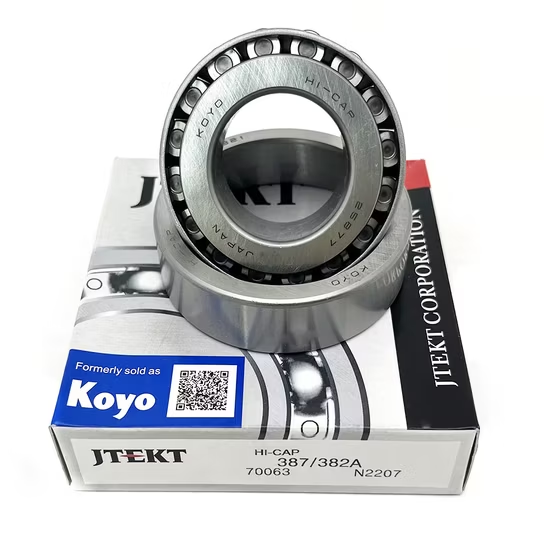
Koyo 32014 32015 32016 32017 32018 Tapered Roller Bearing for Mixer
Koyo 32014 32015 32016 32017 32018 Tapered Roller Bearing — engineered from bearing steel to manage combined radial and axial loads in mixers and industrial gearboxes.
- Cross-reference alignment strictly verifies clearance, cage, and precision suffixes to prevent thermal binding.
7
Day Prototype
vs. 8-12 wks standard
50+
Countries Served
Global logistics network
12h
Quote Response
Expert engineers on call
Typical Applications
Wind Power
Mining
Steel & Metallurgy
Automotive / EV
Rail Transit
Precision Machinery
Genuine SKF Bearings
NDA Protected
Free Sample for Orders > $50K
Global Shipping
Product Details
Verified via official app — Every Koyo 32014 32015 32016 32017 32018 tapered roller bearing we dispatch includes a scannable QR code linking directly to the manufacturer’s authentication database.
Technical Specifications
| Parameter | Value |
|---|---|
| Designation | Koyo 32014 32015 32016 32017 32018 |
| Bearing Type | Tapered Roller Bearing |
| Material | Bearing Steel |
| Precision Class | P0, P6, P5, P4, P2 |
| Number of Rows | Single, Double, Four |
| Origin | China |
Note: Specific dimensional parameters, dynamic and static load ratings, and limiting speeds vary across the 32014 to 32018 series; please consult the manufacturer’s catalog for the exact variant required.
Application Suitability
| Industry | Typical Applications |
|---|---|
| Construction & Mixing | Mixer equipment main shafts and planetary gear drives |
| Automotive & Heavy Transport | Truck axles, wheel hubs, and differential assemblies |
| General Industrial | Industrial gearboxes and marine drive reduction units |
When Basic Dimensions Pass but the Cage Fails
Matching the bore and outside diameter is only the first step in preventing catastrophic mixer downtime.
Sourcing a Koyo 32014 32015 32016 32017 32018 tapered roller bearing based solely on basic boundary dimensions often leads to severe field failures. In heavy mixing environments, procurement teams frequently approve replacements that fit the housing perfectly but lack the internal design required for continuous shock loading [NEED_CITE: rolling bearing failure mode classification per ISO 15243]. When the internal geometry or cage material is overlooked during cross-referencing, the result is usually thermal binding or sudden cage fragmentation under peak torque.
Aligning Internal Geometry with Mixing Loads
Selecting the correct Koyo 32014 32015 32016 32017 32018 tapered roller bearing requires looking past the stamped outer ring. Our technical team reviews the specific load spectrum of your mixer spindle to ensure the internal contact angle and roller profile can handle the combined radial and axial forces. This application-based selection review prevents the premature fatigue that occurs when a standard configuration is forced into a high-impact duty cycle.
The Reality of Shock Loading and Lubrication Breakdown
Mixer main shafts subject bearings to severe, irregular shock loads rather than smooth, continuous rotation. These sudden force spikes can rupture the lubricant film, leading to metal-to-metal contact and accelerated wear on the raceways [NEED_CITE: elastohydrodynamic lubrication breakdown under shock loads]. Furthermore, the intense friction generates localized heat, which alters the internal clearance. If the initial clearance class is not selected to accommodate this thermal expansion, the rollers will skew, generating excessive friction and ultimately seizing the assembly.
Decoding the Baseline Configuration
The designations 32014 through 32018 represent the fundamental metric dimension series for these tapered roller bearings. Because no specific suffixes are present in these base designations, they typically indicate the standard internal configuration and default cage material. In heavy-duty applications, relying on the default stamped steel cage can be risky, as it may lack the necessary rigidity to guide the rollers accurately during severe vibration. Understanding this baseline allows engineers to specify the exact precision class—from standard P0 up to P2—and the appropriate row configuration to match the machinery’s operational demands.
The True Cost of Overlooking Suffix Details
Installing a dimensionally correct but internally mismatched bearing inevitably leads to unplanned downtime and secondary damage to the mixer housing. According to failure analysis frameworks like ISO 15243, cage failure and smearing on the roller ends are direct consequences of improper internal clearance and inadequate shock resistance [NEED_CITE: bearing damage analysis per ISO 15243]. These failures void equipment warranties and force maintenance crews into emergency teardowns, costing far more in lost production than the initial price difference of a correctly specified component.
Why Technical Verification Matters Here
We supply authorized Koyo inventory with complete batch traceability, ensuring you receive genuine components rather than cloned replicas with soft inner rings. Our cross-brand interchange process strictly aligns clearance, cage design, and precision, preventing the dangerous assumption that a matching base number guarantees operational safety. Whether you need a single unit for an emergency breakdown or a bulk trial batch, our pre-shipment inspections verify that the physical product matches the exact technical requirements of your heavy machinery.
Documentation & Authenticity
- Certificate of Conformity confirming the specific Koyo production batch.
- Traceability documents linking the 32014-32018 series to the original manufacturing lot.
- QR verification codes scannable via the official brand application for instant authenticity checks.
- Material test reports validating the bearing steel composition and heat treatment.
- Dimensional and running accuracy inspection reports matching the requested P0-P2 precision class.
Storage, Handling & Mounting
- Store the Koyo units in original, unopened packaging to protect the factory-applied rust preventative from humidity.
- Handle the tapered roller bearings with clean gloves to prevent acidic skin oils from corroding the precision-ground raceways.
- Use controlled induction heating for mounting the inner rings, avoiding localized overheating that alters the bearing steel hardness.
- Adjust the axial clearance precisely during assembly to compensate for the thermal expansion generated during mixer operation.
- Apply the recommended high-viscosity gear oil or grease immediately if the open configuration is exposed during the mounting process.
Requesting a Technical Review
To ensure the selected configuration survives your specific operating environment, please provide the radial and axial load profiles, operating speeds, and typical temperature ranges of your mixer equipment. Sharing the OEM equipment number or the exact housing dimensions allows our engineering team to perform a comprehensive cross-reference check and L10 life calculation. This technical validation ensures the proposed bearing arrangement perfectly matches your mechanical and thermal requirements.
Frequently Asked Questions
Q: How do I verify the authenticity of the Koyo tapered roller bearings?
A: Every bearing we supply features a unique QR code that links directly to the manufacturer’s official authentication application. Scanning this code confirms the production batch, origin, and genuine status, effectively eliminating the risk of installing counterfeit components with soft inner rings that fail under heavy mixing loads.
Q: Why is cross-referencing more than just matching the base number?
A: Matching only the base designation often overlooks critical internal differences like cage material and precision class. A dimensionally identical bearing with a standard cage may shatter under high-impact mixer loads. We verify the complete internal specification to ensure the replacement handles your specific shock and thermal conditions safely.
Q: What do the different precision classes mean for mixer applications?
A: Standard P0 precision is generally sufficient for basic industrial gearboxes, but heavy mixer shafts often require tighter tolerances like P6 or P5 to minimize vibration and heat generation. Higher precision classes ensure smoother roller guidance, reducing friction and extending the operational lifespan under continuous, heavy radial and axial loads.
Q: How should I adjust the clearance during installation?
A: Tapered roller bearings require precise axial clearance adjustment during mounting to handle combined loads effectively. If set too tight, thermal expansion from mixer friction will cause the rollers to bind and overheat. If left too loose, the shaft will deflect, causing uneven load distribution and premature raceway spalling.
Product Summary
- Product Name
- Koyo 32014 32015 32016 32017 32018 Tapered Roller Bearing for Mixer
- Category
- KOYO Bearing
- Brand
- SKF
- Certification
- ISO 9001 · TS 16949
- Lead Time
- 7 Working Days
Get a Custom Quote
Our engineers will respond within 12 hours with a tailored solution.
Request QuoteGeneral Specifications
| Bearing Type | KOYO Bearing |
| Brand | SKF |
| Quality Standard | ISO 9001 / TS 16949 |
| Precision Grade | P0 / P5 / P6 (custom) |
| Material | Chrome Steel / Stainless |
| Cage Material | Steel / Brass / Polyamide |
| Lubrication | Grease / Oil (specify) |
| Operating Temp. | -40°C to +200°C |
| Min. Order Qty | 1 pc (samples available) |
| Prototype Lead Time | 7 Working Days |
Performance Parameters
| Load Capacity | Contact for C0/Cr values |
| Speed Rating | Contact for ndm limit |
| Vibration Level | Z1 / Z2 / Z3 (custom) |
| Noise Level | V1 / V2 / V3 (custom) |
| Fatigue Life | L10h per ISO 281 |
| Sealing Options | Open / Z / 2Z / RS / 2RS |
Custom Specifications Available
Our engineering team can modify bearing dimensions, materials, seals, and clearances to meet your specific operating requirements. Submit your drawing or spec sheet for a tailored proposal.
Wind Power
Main shaft bearings, gearbox bearings, and generator bearings for onshore and offshore wind turbines.
Mining & Quarrying
Heavy-duty bearings for crushers, conveyors, and rotary equipment in extreme dust and shock-load environments.
Steel & Metallurgy
High-temperature bearings for rolling mills, continuous casting, and furnace applications.
Automotive / EV
Wheel hub bearings, transmission bearings, and e-motor bearings for passenger and commercial vehicles.
Rail Transit
Axle box bearings, traction motor bearings, and gearbox bearings meeting EN/UIC railway standards.
Precision Machinery
High-precision spindle bearings, angular contact bearings, and super-precision bearings for CNC and robotics.
Application Design
EngineeringOur engineers analyze your operating conditions -- load, speed, temperature, environment -- and select or design the optimal bearing solution to maximize service life and reduce total cost of ownership.
Custom Modification
7-Day TurnaroundNeed non-standard dimensions, special materials, or modified clearances? We can modify standard SKF bearings or manufacture fully custom solutions with a 7-day prototype turnaround.
Failure Analysis
DiagnosticsWhen bearings fail prematurely, our team conducts root-cause analysis using advanced diagnostic tools to identify the failure mode and recommend corrective action.
Predictive Maintenance
Up to 40% Less DowntimeWe deploy vibration monitoring, thermal imaging, and oil analysis programs that detect bearing deterioration early -- reducing unplanned downtime by up to 40%.
On-site Installation
Global CoverageProper installation is critical to bearing performance. Our certified technicians provide on-site installation support, alignment verification, and operator training worldwide.
Lifecycle Support
Enterprise SLAFrom initial selection through end-of-life, our dedicated account managers provide scheduled maintenance plans, re-lubrication programs, and replacement forecasting for enterprise clients.
Why SKF China
The engineering partner advantage
7 Days
Prototype Lead Time
vs. 8-12 weeks via standard channels
15+
Certified Engineers
SKF-certified, on-call for your project
50+
Countries Delivered
Reliable global logistics network
Request a Quote
Get a custom quote for
Koyo 32014 32015 32016 32017 32018 Tapered Roller Bearing for Mixer
NDA protected · Free samples for orders > $50K · Reply within 12 hours
Related Products
More KOYO Bearing Products
![X&S Koyo Tapered Roller Bearing 30310 33112 32915 32309 31310 32213 30214 for Industrial Machine [WARN] draft identifier mismatch](https://skfip.com/wp-content/uploads/2026/09/xs-koyo-tapered-roller-bearing-30310-33112-32915-32309-31310-32213-30214-for-industrial-machine-warn-draft-identifier-mismatch-56feae-300x300.webp)
![Genuine Koyo Tapered Roller Bearings 31314-32219 for Marine Engines [WARN] draft identifier mismatch](https://skfip.com/wp-content/uploads/2026/09/genuine-koyo-tapered-roller-bearings-31314-32219-for-marine-engines-warn-draft-identifier-mismatch-3512fa-300x300.webp)