

ISO 9001 Certified
TS 16949
Genuine SKF
Need Technical Advice?
Reply within 12 hours · 15+ certified engineers on call
IKO Bearing
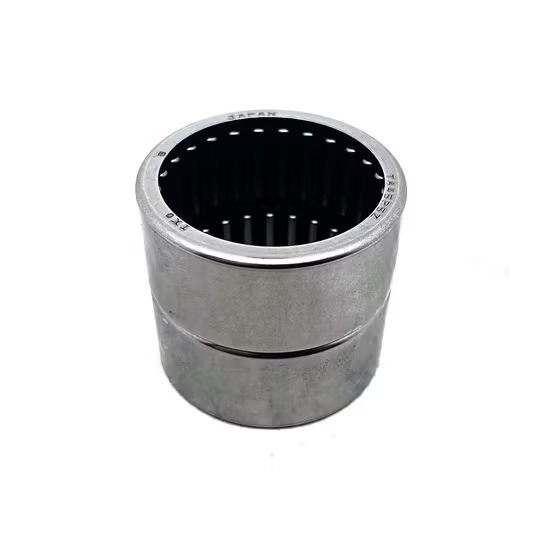
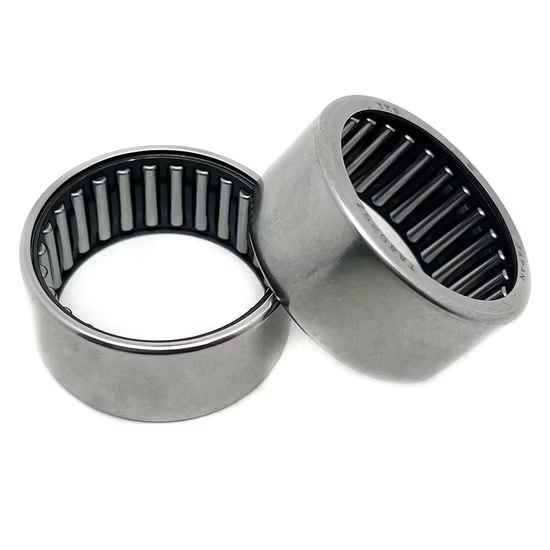
IKO TALM2820 TALM3020 TALM3520 KT151917 RNA69/32 Needle Roller Bearing
TALM2820 TALM3020 TALM3520 KT151917 RNA69/32 Needle Roller Bearing — machined outer rings without inner rings for compact radial installations.
- Single row bearing steel construction handles high radial loads in automotive powertrains and industrial gearboxes.
- Full batch traceability to the original manufacturer guarantees authentic material properties for every shipment.
7
Day Prototype
vs. 8-12 wks standard
50+
Countries Served
Global logistics network
12h
Quote Response
Expert engineers on call
Typical Applications
Wind Power
Mining
Steel & Metallurgy
Automotive / EV
Rail Transit
Precision Machinery
Genuine SKF Bearings
NDA Protected
Free Sample for Orders > $50K
Global Shipping
Product Details
Traceable Batch Origins — Every shipment includes lot-specific metallurgical records matching the manufacturer’s production facilities.
Technical Specifications
| Parameter | Value |
|---|---|
| Designation | TALM2820 TALM3020 TALM3520 KT151917 RNA69/32 |
| Bearing Type | Needle Roller Bearing |
| Cage Design | With Cage |
| Number of Rows | Single |
| Load Direction | Axial and Radial |
| Style Options | Without Inner Ring, With Inner Ring |
| Material | Bearing Steel |
| Type | Open |
| Separated | Separated |
| Clearance Class | C0, C2, C3, C4, C5 |
| Precision Class | P0, P6, P5, P4, P2 |
| Certification | TS16949, ISO9001 |
| Origin | Shandong, China |
Note: TALM and KT series prefixes are unverified suffixes requiring manufacturer catalog confirmation for exact dimensional boundaries.
Application Suitability
| Industry | Typical Applications |
|---|---|
| Automotive Powertrains | Engine connecting rod journals and transmission shaft supports |
| Industrial Gearboxes | Planetary gear sets and high-torque output shafts |
| Agricultural Machinery | Harvester drive pivots and heavy-duty PTO shaft joints |
| Material Handling | Forklift mast roller guides and conveyor drive pulleys |
Why Suffix Blind Spots Destroy Powertrain Reliability
Base numbers alone never guarantee survival in high-vibration engines.
Procurement teams often approve substitutions based solely on the primary dimension code, completely missing the internal geometry and cage material requirements. When a standard stamped steel cage replaces a machined brass or heavy-duty steel design in an engine connecting rod, the component cannot withstand the extreme oscillating loads. This cross-reference error leads to rapid cage fragmentation and catastrophic journal scoring [NEED_CITE: rolling bearing failure mode classification per ISO 15243]. Sourcing the correct IKO TALM2820 TALM3020 TALM3520 KT151917 RNA69/32 needle roller bearing requires verifying the exact internal design, not just the outer envelope dimensions.
Matching Internal Geometry to Oscillating Loads
Selecting the right configuration from this IKO TALM2820 TALM3020 TALM3520 KT151917 RNA69/32 needle roller bearing range depends entirely on the shaft hardness and available radial space. Our engineering review cross-checks the OEM equipment number against the required cage material and internal profile, ensuring the replacement handles the specific oscillating frequency of your powertrain without premature wear.
Thermal Expansion and Lubrication Starvation
In automotive and agricultural gearboxes, localized heat generation drastically reduces lubricant viscosity. If the internal clearance is not upgraded to C3 or C4 to compensate for thermal expansion, the rolling elements will skew and bind against the cage. Open-type designs in these environments also demand strict external lubrication schedules to prevent metallic contact and subsequent surface spalling under heavy radial loads [NEED_CITE: thermal binding mechanisms in radial roller bearings].
Decoding the Series Variations
The RNA69/32 designation specifies a machined outer ring without an inner ring, demanding that the shaft journal be hardened and ground to precise roughness tolerances to act as the inner raceway. Conversely, the TALM and KT series represent drawn cup and cage-assembly formats, which prioritize minimal radial space but require careful handling during installation to prevent lip deformation. Selecting between these structures dictates whether the housing bore and shaft surface must be precision-machined or can rely on the bearing’s integrated rings.
The Hidden Costs of Interchange Negligence
Ignoring the specific cage material or clearance class during replacement triggers a cascade of mechanical failures. A mismatched component will generate excessive friction heat, degrading the lubricant and accelerating fatigue across the entire gear set. This results in unplanned downtime, voided equipment warranties, and secondary damage to adjacent seals and housings, costing significantly more than the initial component price [NEED_CITE: economic impact of secondary mechanical damage].
Why Our Technical Verification Matters
We prevent field failures by aligning cross-references on three critical axes: base dimensions, internal clearance, and cage design. For high-vibration applications, we verify that the specified cage material matches the original equipment requirements, refusing to supply standard steel where heavy-duty brass is mandated. Every batch is traced back to the manufacturer’s production facilities, and we provide application-based selection reviews covering load, speed, and temperature to ensure long-term operational stability.
Documentation & Authenticity
- Certificate of Conformity verifying the specific metallurgical grade of the bearing steel.
- Batch and lot traceability linking each unit to its original heat treatment record.
- Official app QR verification to instantly rule out cloned codes and soft inner rings.
- Material test report confirming the absence of micro-cracks in the machined outer rings.
- Dimensional and running accuracy inspection report validating P4 or P2 tolerances.
- Country-of-origin documentation ensuring compliance with regional import regulations.
Storage, Handling & Mounting
- Keep open-type units in original vapor-corrosion inhibitor packaging until immediate mounting to prevent journal surface oxidation.
- Use induction heating for inner ring variants, strictly avoiding open flames that compromise the bearing steel hardness.
- Apply clean lint-free gloves when handling RNA series to prevent acidic sweat from etching the precision-ground outer raceway.
- Press drawn cup variants using a dedicated mandrel tool to avoid collapsing the thin outer shell during housing insertion.
- Verify shaft journal hardness and surface roughness before installing inner-ring-less configurations to prevent rapid wear.
Pre-Purchase Technical Alignment
To ensure exact fitment and operational longevity, provide your specific radial and axial load profiles, operating temperatures, and rotational speeds. Supplying the OEM equipment number or existing part markings allows our technical team to perform a comprehensive cross-reference check, verifying internal geometry and clearance requirements before finalizing the selection.
Frequently Asked Questions
Q: Why do basic dimension matches still result in premature cage failure?
A: Matching only the bore and outer diameter ignores critical internal variables like cage material and clearance. In high-vibration engines, substituting a machined brass cage with standard stamped steel leads to rapid fatigue and fragmentation. We verify the exact internal design and material specifications to ensure the replacement withstands the specific oscillating loads of your application.
Q: What are the shaft requirements for RNA series bearings without inner rings?
A: When using inner-ring-less designs, the shaft journal itself acts as the inner raceway. This requires the shaft surface to be hardened to appropriate levels and ground to a precise surface finish. If the shaft is too soft or rough, it will cause rapid wear and premature failure of the needle rollers and the outer ring raceway.
Q: How should clearance be selected for high-temperature gearbox applications?
A: In environments with significant heat generation, standard C0 clearance may close up due to thermal expansion of the shaft and housing, causing the rollers to bind and skid. Upgrading to C3 or C4 clearance provides the necessary internal gap to accommodate thermal growth, ensuring smooth rolling motion and preventing catastrophic thermal seizure during continuous operation.
Q: How can procurement teams verify the authenticity of high-load needle rollers?
A: Visual inspection is insufficient against sophisticated counterfeits with cloned packaging. We mandate official app QR verification for every batch, alongside reviewing the manufacturer’s material test reports and dimensional inspection data. This multi-layered approach confirms the metallurgical integrity and precise tolerances required for demanding powertrain applications.
Product Summary
- Product Name
- IKO TALM2820 TALM3020 TALM3520 KT151917 RNA69/32 Needle Roller Bearing
- Category
- IKO Bearing
- Brand
- SKF
- Certification
- ISO 9001 · TS 16949
- Lead Time
- 7 Working Days
Get a Custom Quote
Our engineers will respond within 12 hours with a tailored solution.
Request QuoteGeneral Specifications
| Bearing Type | IKO Bearing |
| Brand | SKF |
| Quality Standard | ISO 9001 / TS 16949 |
| Precision Grade | P0 / P5 / P6 (custom) |
| Material | Chrome Steel / Stainless |
| Cage Material | Steel / Brass / Polyamide |
| Lubrication | Grease / Oil (specify) |
| Operating Temp. | -40°C to +200°C |
| Min. Order Qty | 1 pc (samples available) |
| Prototype Lead Time | 7 Working Days |
Performance Parameters
| Load Capacity | Contact for C0/Cr values |
| Speed Rating | Contact for ndm limit |
| Vibration Level | Z1 / Z2 / Z3 (custom) |
| Noise Level | V1 / V2 / V3 (custom) |
| Fatigue Life | L10h per ISO 281 |
| Sealing Options | Open / Z / 2Z / RS / 2RS |
Custom Specifications Available
Our engineering team can modify bearing dimensions, materials, seals, and clearances to meet your specific operating requirements. Submit your drawing or spec sheet for a tailored proposal.
Wind Power
Main shaft bearings, gearbox bearings, and generator bearings for onshore and offshore wind turbines.
Mining & Quarrying
Heavy-duty bearings for crushers, conveyors, and rotary equipment in extreme dust and shock-load environments.
Steel & Metallurgy
High-temperature bearings for rolling mills, continuous casting, and furnace applications.
Automotive / EV
Wheel hub bearings, transmission bearings, and e-motor bearings for passenger and commercial vehicles.
Rail Transit
Axle box bearings, traction motor bearings, and gearbox bearings meeting EN/UIC railway standards.
Precision Machinery
High-precision spindle bearings, angular contact bearings, and super-precision bearings for CNC and robotics.
Application Design
EngineeringOur engineers analyze your operating conditions -- load, speed, temperature, environment -- and select or design the optimal bearing solution to maximize service life and reduce total cost of ownership.
Custom Modification
7-Day TurnaroundNeed non-standard dimensions, special materials, or modified clearances? We can modify standard SKF bearings or manufacture fully custom solutions with a 7-day prototype turnaround.
Failure Analysis
DiagnosticsWhen bearings fail prematurely, our team conducts root-cause analysis using advanced diagnostic tools to identify the failure mode and recommend corrective action.
Predictive Maintenance
Up to 40% Less DowntimeWe deploy vibration monitoring, thermal imaging, and oil analysis programs that detect bearing deterioration early -- reducing unplanned downtime by up to 40%.
On-site Installation
Global CoverageProper installation is critical to bearing performance. Our certified technicians provide on-site installation support, alignment verification, and operator training worldwide.
Lifecycle Support
Enterprise SLAFrom initial selection through end-of-life, our dedicated account managers provide scheduled maintenance plans, re-lubrication programs, and replacement forecasting for enterprise clients.
Why SKF China
The engineering partner advantage
7 Days
Prototype Lead Time
vs. 8-12 weeks via standard channels
15+
Certified Engineers
SKF-certified, on-call for your project
50+
Countries Delivered
Reliable global logistics network
Request a Quote
Get a custom quote for
IKO TALM2820 TALM3020 TALM3520 KT151917 RNA69/32 Needle Roller Bearing
NDA protected · Free samples for orders > $50K · Reply within 12 hours
Related Products
More IKO Bearing Products
![Genuine NK32/20 NK32/30 RNA49/28 RNA69/28 Needle Roller Bearing for Stamping Mould [WARN] draft identifier mismatch](https://skfip.com/wp-content/uploads/2026/09/genuine-nk32-20-nk32-30-rna49-28-rna69-28-needle-roller-bearing-for-stamping-mould-warn-draft-identifier-mismatch-9ecebd.avif)
![[WARN] draft identifier mismatch](https://skfip.com/wp-content/uploads/2026/09/warn-draft-identifier-mismatch-62f300.avif)