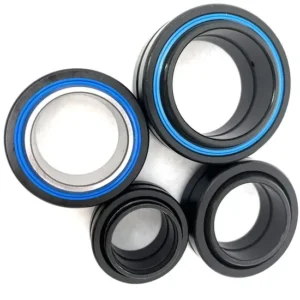
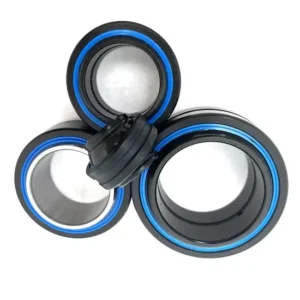
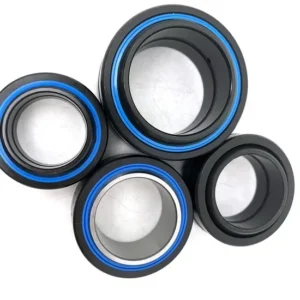
Spherical Plain Bearing

GE110XS/K GE115XS/K GE120XS/K GE130XS/K GE150XS/K Spherical Plain Bearings feature a single-slit outer ring for simplified mounting and self-lubricating capabilities to minimize maintenance in collaborative robots.
Single-Source Authorization — Procuring mixed batches of GE110XS/K spherical plain bearing units and larger sizes from one authorized channel eliminates multi-vendor coordination delays.
| Parameter | Value |
|---|---|
| Designation | GE110XS/K GE115XS/K GE120XS/K GE130XS/K GE150XS/K |
| Bearing Type | Spherical Plain Bearing |
| Outer Structure | Outer Ring of Single-Slit |
| Lubrication | Grease or Oil / Self-lubricating |
| Material | Standard or Customized |
| Certification | CE |
| Origin | Shandong, China |
Note: The XS and K suffixes are unverified and require manufacturer catalog confirmation for exact internal design and lubrication specifications.
| Industry | Typical Applications |
|---|---|
| Automation & Robotics | Collaborative robot articulation joints, automated assembly arm pivots |
| Heavy Engineering | Engineering hydraulic cylinder clevis mounts, forging machine linkages |
| Mobile Machinery | Construction machinery boom pivots, automobile shock absorber mounts |
Matching the base GE designation without verifying internal lubrication and structural suffixes leads to rapid joint seizure.
In precision automation, a base number match is never enough. I have seen collaborative robot joints freeze on site because the cross-reference overlooked the specific suffix requirements for micro-motion wear protection. When a standard grease-lubricated joint is installed in an application demanding self-lubricating properties, the friction heat builds up rapidly during slow oscillations [NEED_CITE: rolling bearing failure mode classification per ISO 15243]. This causes the inner ring coating to peel off, resulting in catastrophic downtime that a simple visual inspection could never predict.
Selecting the correct GE110XS/K spherical plain bearing for collaborative robots requires looking beyond basic dimensions. The single-slit outer ring design allows for simplified mounting into tight housing bores without requiring complex pressing equipment. By matching the exact lubrication type to the robot’s oscillation frequency, we ensure the joint maintains a stable friction coefficient throughout its operational life, preventing the micro-stuttering that ruins precision assembly tasks.
Collaborative robot joints operate under complex combined loads with very slow, continuous oscillations. This micro-motion prevents the formation of a full hydrodynamic lubricant film, making boundary lubrication critical. If the environmental temperature fluctuates, standard grease can stiffen or migrate away from the contact zone, leading to metal-to-metal contact. Self-lubricating structures mitigate this risk by providing a continuous transfer film. Furthermore, the single-slit outer ring must be oriented correctly during installation to maintain structural integrity under heavy radial loads [NEED_CITE: plain bearing friction and wear mechanisms].
The single-slit outer ring is a defining feature of this series, engineered to provide radial elasticity during installation. This allows the outer ring to compress slightly when pressed into the housing, ensuring a secure interference fit without cracking the ring. The lubrication options—ranging from standard grease to advanced self-lubricating liners—dictate the maintenance schedule. While grease-lubricated variants require periodic re-lubrication channels in the housing, self-lubricating options are maintenance-free, making them ideal for sealed robotic arms where access is restricted.
Installing a standard plain bearing in a high-cycle robotic joint inevitably leads to premature failure. The inner ring surface degrades, generating metallic debris that contaminates the entire joint mechanism. According to ISO 15243 frameworks, this abrasive wear rapidly escalates into severe surface spalling and eventual mechanical seizure [NEED_CITE: bearing damage analysis and failure modes]. The resulting unplanned downtime on an automated production line far exceeds the initial cost of specifying the correct self-lubricating variant from the start.
Sourcing these components requires more than just reading a catalog. We review your specific oscillation angles and load profiles to ensure the selected lubrication type matches the operational reality. Our cross-reference checks verify that the internal geometry and single-slit dimensions align perfectly with your OEM housing tolerances. We provide batch traceability for every unit, ensuring that the material properties of the inner and outer rings meet the rigorous demands of precision automation without relying on guesswork.
To ensure optimal joint performance, please provide the specific oscillation angle, cycle frequency, and maximum radial loads for your robotic application. If you are replacing an existing component, sharing the OEM equipment number allows us to verify the exact cross-reference and lubrication requirements. This technical review ensures the selected configuration matches your operational environment perfectly.
Q: What do the XS and K suffixes indicate on these plain bearings?
A: These suffixes denote specific internal design variations, lubrication types, or material treatments that differ from the standard GE series. Because they are unverified standard codes, we require the exact manufacturer catalog data to confirm if they represent specialized self-lubricating liners or specific clearance classes for your application.
Q: How do I verify cross-reference accuracy beyond the base GE number?
A: A true cross-reference must match the outer ring structure, lubrication method, and dimensional tolerances, not just the basic bore and outside diameter. We review the single-slit design and specific sliding surface materials to ensure the replacement will not cause thermal binding or premature wear in your specific housing.
Q: Why choose self-lubricating over grease-lubricated plain bearings for robots?
A: Collaborative robots often operate with slow, continuous oscillations that prevent standard grease from forming a protective hydrodynamic film. Self-lubricating liners provide continuous boundary lubrication, preventing micro-motion wear and eliminating the need for complex re-lubrication channels inside the robotic joint housing.
Q: How can I identify poor-quality inner rings in spherical plain bearings?
A: Counterfeit or substandard bearings often feature soft inner rings with inadequate surface treatments that peel under micro-motion stress. We provide material test reports and hardness verification for every batch, ensuring the inner ring can withstand the continuous friction of precision automation without degrading.
Our engineers will respond within 12 hours with a tailored solution.
Request Quote| Bearing Type | Spherical Plain Bearing |
| Brand | SKF |
| Quality Standard | ISO 9001 / TS 16949 |
| Precision Grade | P0 / P5 / P6 (custom) |
| Material | Chrome Steel / Stainless |
| Cage Material | Steel / Brass / Polyamide |
| Lubrication | Grease / Oil (specify) |
| Operating Temp. | -40°C to +200°C |
| Min. Order Qty | 1 pc (samples available) |
| Prototype Lead Time | 7 Working Days |
| Load Capacity | Contact for C0/Cr values |
| Speed Rating | Contact for ndm limit |
| Vibration Level | Z1 / Z2 / Z3 (custom) |
| Noise Level | V1 / V2 / V3 (custom) |
| Fatigue Life | L10h per ISO 281 |
| Sealing Options | Open / Z / 2Z / RS / 2RS |
Our engineering team can modify bearing dimensions, materials, seals, and clearances to meet your specific operating requirements. Submit your drawing or spec sheet for a tailored proposal.
Main shaft bearings, gearbox bearings, and generator bearings for onshore and offshore wind turbines.
Heavy-duty bearings for crushers, conveyors, and rotary equipment in extreme dust and shock-load environments.
High-temperature bearings for rolling mills, continuous casting, and furnace applications.
Wheel hub bearings, transmission bearings, and e-motor bearings for passenger and commercial vehicles.
Axle box bearings, traction motor bearings, and gearbox bearings meeting EN/UIC railway standards.
High-precision spindle bearings, angular contact bearings, and super-precision bearings for CNC and robotics.
Our engineers analyze your operating conditions -- load, speed, temperature, environment -- and select or design the optimal bearing solution to maximize service life and reduce total cost of ownership.
Need non-standard dimensions, special materials, or modified clearances? We can modify standard SKF bearings or manufacture fully custom solutions with a 7-day prototype turnaround.
When bearings fail prematurely, our team conducts root-cause analysis using advanced diagnostic tools to identify the failure mode and recommend corrective action.
We deploy vibration monitoring, thermal imaging, and oil analysis programs that detect bearing deterioration early -- reducing unplanned downtime by up to 40%.
Proper installation is critical to bearing performance. Our certified technicians provide on-site installation support, alignment verification, and operator training worldwide.
From initial selection through end-of-life, our dedicated account managers provide scheduled maintenance plans, re-lubrication programs, and replacement forecasting for enterprise clients.
NDA protected · Free samples for orders > $50K · Reply within 12 hours