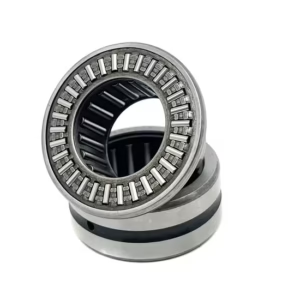
Needle Roller Bearing

X&S RNA4917 RNA6917 NK105/26 Needle Roller Bearing P0-P2 — open-type separated needle roller bearings constructed from bearing steel for automation equipment and machine tool spindles.
Every shipment includes full original factory batch traceability to guarantee authentic manufacturing origins.
Factory Batch Traceability — Every X&S RNA4917 RNA6917 NK105/26 needle roller bearing ships with verifiable lot documentation linking directly to the manufacturer’s production records.
| Parameter | Value |
|---|---|
| Designation | RNA4917 RNA6917 NK105/26 |
| Bearing Type | Needle Roller Bearing |
| Material | Bearing Steel |
| Type | Open |
| Separated | Separated |
| Precision Rating | P0, P6, P5, P4, P2 |
| Style Options | Without Outer Ring, With Outer Ring, Without Inner Ring, With Inner Ring |
| Origin | China |
| Industry | Typical Applications |
|---|---|
| Automation Equipment | Robotic joint actuators, linear guide carriages, pick-and-place mechanisms |
| Machine Tools | High-speed spindle supports, indexing table rotary drives |
| Industrial Gearboxes | Planetary gear shaft supports, high-torque transmission stages |
Matching the base designation while ignoring internal geometry causes catastrophic thermal binding.
Procurement teams often source replacements using only the core number, assuming dimensional equivalence guarantees functional interchangeability. In automated assembly lines, this oversight leads to severe operational failures. I once investigated a complete line stoppage caused by an NK105/26 replacement where the cage material was mismatched for the specific oscillating duty cycle, resulting in early fracture. When dealing with high-rigidity requirements in machine tool spindles, substituting a standard clearance unit where a specific precision class is required compromises the entire machining tolerance. [NEED_CITE: rolling bearing failure mode classification per ISO 15243]
Selecting the correct X&S RNA4917 RNA6917 NK105/26 needle roller bearing for automation requires evaluating the specific load vectors and spatial constraints of the robotic joint. Our technical review process verifies that the cross-reference alignment covers internal design and precision suffixes, not just the outer dimensions. This ensures the rolling elements maintain optimal contact stress distribution under the complex combined loads typical in multi-axis articulation.
Machine tool spindles generate significant friction heat, demanding careful consideration of thermal expansion and lubrication intervals. Open-type needle roller bearings rely on external oil-air or oil-jet lubrication systems to manage temperature gradients without the friction penalties of contact seals. The separated design allows the inner ring to be press-fitted to the shaft while the outer ring and roller assembly are mounted independently, accommodating the precise running clearances needed to prevent seizure at elevated operational speeds. [NEED_CITE: thermal expansion effects on bearing internal clearance per ISO 281]
The availability of P0 through P2 precision ratings dictates the running accuracy and vibration characteristics of the assembly. For high-speed spindles, P4 or P2 classes are essential to minimize radial runout and maintain surface finish quality. The separated construction means the shaft itself can serve as the inner raceway for styles without an inner ring, provided the shaft hardness and surface roughness meet strict metallurgical standards. This design maximizes the radial load capacity within a minimal cross-section, a critical factor for compact automation actuators.
Relying on superficial cross-references often results in unplanned downtime that far exceeds the initial component cost. Installing a unit with inadequate precision or incorrect internal geometry leads to premature cage wear and eventual seizure. According to failure analysis frameworks, a significant share of premature failures stems from application mismatch rather than manufacturing defects. When an automated cell stops due to a fractured cage, the resulting production delays and secondary damage to adjacent drive components create substantial financial liabilities. [NEED_CITE: economic impact of unplanned downtime in automated manufacturing]
We mitigate the risk of soft inner rings and cloned QR codes by providing full batch traceability for every shipment. Our cross-reference expertise ensures that when you request an interchange for the RNA4917 or RNA6917, we verify the exact clearance, cage material, and precision requirements of your specific application. We supply genuine products with verifiable documentation, preventing the installation of substandard units that pass casual visual inspections but fail under operational loads. Our technical team reviews your load and speed parameters to confirm the selected design variant matches the OEM equipment specifications.
To ensure the selected needle roller bearing perfectly matches your automation equipment, please provide the specific radial and axial load profiles, operational speeds, and thermal conditions. Sharing the OEM equipment designation or original part numbers allows our engineering team to perform a comprehensive cross-reference check and L10 life calculation. This technical validation guarantees the internal geometry and precision class align with your rigorous production demands.
Q: How do you verify cross-references beyond the base designation?
A: We evaluate the internal geometry, cage material, and precision class required by your specific application. Simply matching the base number ignores critical design variations that cause thermal binding or cage failure in the field, ensuring the replacement perfectly mirrors the original equipment specifications.
Q: Which precision class is required for machine tool spindles?
A: Machine tool spindles typically demand P4 or P2 precision classes to minimize radial runout and maintain tight machining tolerances. Standard P0 or P6 grades introduce unacceptable vibration levels, degrading the surface finish and accelerating wear in high-speed rotary applications.
Q: How should open-type needle bearings be lubricated in automation?
A: Open designs lack integral seals and grease reserves, requiring continuous external lubrication such as oil-air or oil-jet systems. This approach minimizes friction heat while flushing away wear debris, which is critical for maintaining the operational rigidity of high-speed robotic actuators.
Q: What causes cage failure in compact needle roller bearings?
A: Cage fractures often result from material mismatch for the specific duty cycle or inadequate lubrication causing excessive friction. In oscillating automation joints, selecting a cage material optimized for boundary lubrication conditions prevents the early structural fatigue that leads to complete line stoppages.
Our engineers will respond within 12 hours with a tailored solution.
Request Quote| Bearing Type | Needle Roller Bearing |
| Brand | SKF |
| Quality Standard | ISO 9001 / TS 16949 |
| Precision Grade | P0 / P5 / P6 (custom) |
| Material | Chrome Steel / Stainless |
| Cage Material | Steel / Brass / Polyamide |
| Lubrication | Grease / Oil (specify) |
| Operating Temp. | -40°C to +200°C |
| Min. Order Qty | 1 pc (samples available) |
| Prototype Lead Time | 7 Working Days |
| Load Capacity | Contact for C0/Cr values |
| Speed Rating | Contact for ndm limit |
| Vibration Level | Z1 / Z2 / Z3 (custom) |
| Noise Level | V1 / V2 / V3 (custom) |
| Fatigue Life | L10h per ISO 281 |
| Sealing Options | Open / Z / 2Z / RS / 2RS |
Our engineering team can modify bearing dimensions, materials, seals, and clearances to meet your specific operating requirements. Submit your drawing or spec sheet for a tailored proposal.
Main shaft bearings, gearbox bearings, and generator bearings for onshore and offshore wind turbines.
Heavy-duty bearings for crushers, conveyors, and rotary equipment in extreme dust and shock-load environments.
High-temperature bearings for rolling mills, continuous casting, and furnace applications.
Wheel hub bearings, transmission bearings, and e-motor bearings for passenger and commercial vehicles.
Axle box bearings, traction motor bearings, and gearbox bearings meeting EN/UIC railway standards.
High-precision spindle bearings, angular contact bearings, and super-precision bearings for CNC and robotics.
Our engineers analyze your operating conditions -- load, speed, temperature, environment -- and select or design the optimal bearing solution to maximize service life and reduce total cost of ownership.
Need non-standard dimensions, special materials, or modified clearances? We can modify standard SKF bearings or manufacture fully custom solutions with a 7-day prototype turnaround.
When bearings fail prematurely, our team conducts root-cause analysis using advanced diagnostic tools to identify the failure mode and recommend corrective action.
We deploy vibration monitoring, thermal imaging, and oil analysis programs that detect bearing deterioration early -- reducing unplanned downtime by up to 40%.
Proper installation is critical to bearing performance. Our certified technicians provide on-site installation support, alignment verification, and operator training worldwide.
From initial selection through end-of-life, our dedicated account managers provide scheduled maintenance plans, re-lubrication programs, and replacement forecasting for enterprise clients.
NDA protected · Free samples for orders > $50K · Reply within 12 hours