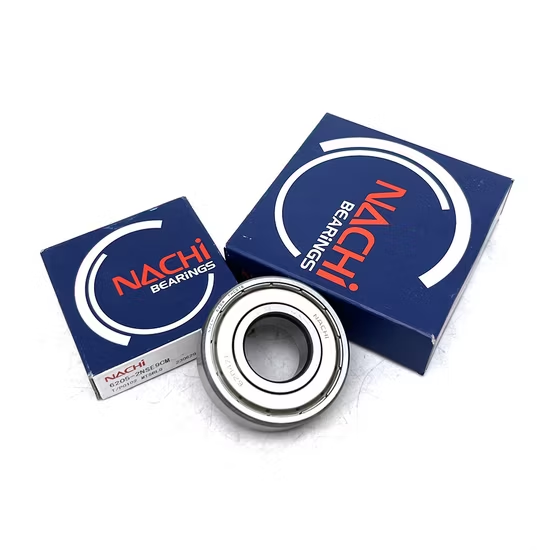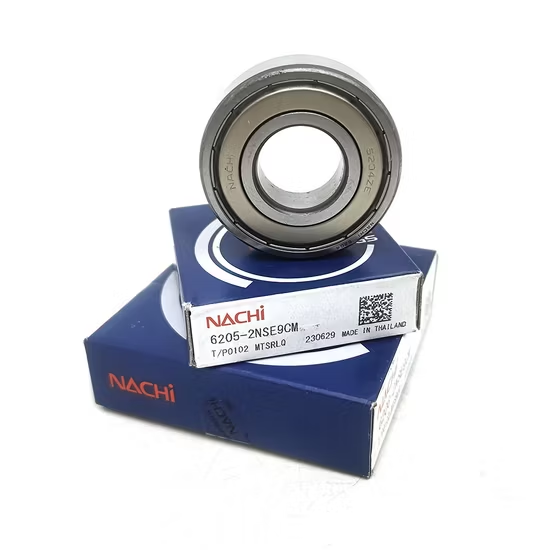
![NACHI P6 P5 P4 Deep Groove Ball Bearing 16004 16006 62206 C3 [WARN] draft identifier mismatch](https://skfip.com/wp-content/uploads/2026/09/warn-draft-identifier-mismatch-nachi-deep-groove-ball-bearing-638-639-6301-6303-6305-6307-for-motorcycle-8909ac-300x300.webp)
![X&S 6317 6318 6319 6320 Deep Groove Ball Bearing for Generator [WARN] draft identifier mismatch](https://skfip.com/wp-content/uploads/2026/09/xs-6317-6318-6319-6320-deep-groove-ball-bearing-for-generator-warn-draft-identifier-mismatch-9cbb79.avif)
ISO 9001 Certified
TS 16949
Genuine SKF
Need Technical Advice?
Reply within 12 hours · 15+ certified engineers on call
NACHI Bearing
X&S 6317 6318 6319 6320 Deep Groove Ball Bearing for Generator [WARN] draft identifier mismatch
X&S 6317 6318 6319 6320 Deep Groove Ball Bearings — engineered for generators and electric motors to manage radial loads with low friction.
- Bearing steel construction ensures durability in continuous industrial operation.
- Every shipment includes material test reports and dimensional inspection certificates.
7
Day Prototype
vs. 8-12 wks standard
50+
Countries Served
Global logistics network
12h
Quote Response
Expert engineers on call
Typical Applications
Wind Power
Mining
Steel & Metallurgy
Automotive / EV
Rail Transit
Precision Machinery
Genuine SKF Bearings
NDA Protected
Free Sample for Orders > $50K
Global Shipping
Product Details
Cross-Reference Alignment Verified — We match clearance, cage material, and precision suffixes rather than just the base number to prevent thermal binding in generator applications.
Technical Specifications
| Parameter | Value |
|---|---|
| Designation | 6317 6318 6319 6320 |
| Bearing Type | Deep Groove Ball Bearing |
| Material | Bearing Steel |
| Precision Class | P0, P6, P5, P4 |
| Vibration Level | Z1V1, Z2V2, Z3V3, Z4V4 |
| Seal or Shield Type | Open, Zz, 2RS |
| Lubrication | Grease or Oil |
| Origin | Shandong Province, China |
| HS Code | 8482102000 |
Application Suitability
| Industry | Typical Applications |
|---|---|
| Power Generation | Generator rotor shaft support, exciter machine bearings |
| Electric Motors | Large industrial motor drive-end and non-drive-end positions |
| Industrial Pumps | Heavy-duty centrifugal pump impeller shaft support |
Why Base Numbers Mislead Generator Procurement Teams
Matching the base designation without verifying internal geometry guarantees premature failure under thermal load.
Procurement engineers often source the X&S 6317 6318 6319 6320 deep groove ball bearing by matching the base number on the old nameplate, completely overlooking critical internal variations. In high-output generator sets, this oversight leads to catastrophic thermal binding when standard clearance is installed in an application demanding expanded clearance for heat dissipation. [NEED_CITE: rolling bearing failure mode classification per ISO 15243] We routinely see inner rings exhibiting severe blue discoloration from overheating, a direct result of ignoring suffix requirements during the sourcing phase.
Aligning Bearing Geometry with Generator Operating Profiles
Selecting the correct X&S 6317 6318 6319 6320 deep groove ball bearing requires a thorough review of the specific generator operating parameters. Our technical team evaluates the expected thermal expansion, rotational speed, and load characteristics to recommend the precise combination of internal clearance and cage material. This application-based selection review ensures the bearing maintains optimal internal geometry and lubrication film thickness throughout the equipment’s operational cycle.
Thermal Expansion and Contamination Challenges in Power Plants
Generator environments subject rotating components to significant temperature gradients that directly impact internal bearing geometry. If the internal clearance is insufficient to accommodate the differential thermal expansion between the shaft and the housing, the rolling elements will experience excessive preload, leading to rapid temperature spikes and lubricant degradation. Furthermore, power generation facilities often contain airborne particulates that necessitate robust sealing solutions, requiring a careful balance between contact seal friction and non-contact shield protection to maintain operational efficiency. [NEED_CITE: bearing life calculation methodologies per ISO 281]
Decoding Precision and Vibration Suffixes for Rotating Equipment
The distinction between standard P0 and higher P5 or P4 precision classes dictates the running accuracy and vibration characteristics of the assembly. For high-speed generator rotors, specifying Z3V3 or Z4V4 vibration grades ensures that the internal raceway geometry and rolling element sphericity are tightly controlled, minimizing resonant frequencies and structural noise transmission. The choice between brass and steel cages also plays a critical role; machined brass cages offer superior stability and heat dissipation under continuous heavy radial loads, whereas pressed steel cages are suitable for standard duty cycles where weight and cost are primary considerations.
The Hidden Financial Impact of Suffix Misalignment
Installing a bearing with incorrect internal clearance or cage design inevitably results in unplanned downtime and severe secondary damage to the generator housing. When thermal binding occurs, the resulting friction can weld the inner ring to the shaft, necessitating extensive machining and complete rotor rebalancing. Such catastrophic failures void equipment warranties and force facility managers into emergency procurement scenarios, incurring massive logistical premiums and lost production revenue while waiting for replacement components. [NEED_CITE: economic impact of unplanned industrial downtime]
Securing Authentic Components Through Authorized Channels
Sourcing the X&S 6317 6318 6319 6320 deep groove ball bearing through authorized distribution channels eliminates the risk of receiving counterfeit units with soft inner rings and cloned verification codes. We provide comprehensive cross-reference alignment that verifies not just the base number, but the exact clearance, cage material, and precision suffixes required for your specific machinery. Our inventory management ensures full batch traceability back to the manufacturer’s production facilities, supported by official app QR verification for every unit shipped. Furthermore, we supply complete dimensional and running accuracy inspection reports alongside material test reports, giving your maintenance team absolute confidence in the component’s integrity before installation.
Documentation & Authenticity
- Certificate of Conformity detailing the exact precision class and vibration grade for each unit.
- Full batch and lot traceability linking the bearing to the original manufacturing run.
- Official app QR verification codes to instantly confirm authenticity on the shop floor.
- Material test reports validating the metallurgical composition of the bearing steel and cage.
- Dimensional and running accuracy inspection reports confirming tolerance compliance before dispatch.
- Country-of-origin documentation required for international customs and project compliance.
Storage, Handling & Mounting Protocols
- Retain original factory packaging until installation to protect the Zz shielded surfaces from humidity and particulate ingress.
- Store P4 precision variants in a climate-controlled environment to prevent thermal distortion of the tightly tolerated raceways.
- Use induction heaters with automated temperature monitoring when mounting large 6317 to 6320 bore sizes to avoid localized overheating.
- Never attempt to wash or relubricate 2RS sealed units, as this compromises the factory-applied grease fill and seal lip integrity.
- Ensure mounting tools are clean and free of carbon steel debris to prevent surface contamination on the precision-ground raceways.
Engineering Support and Technical Verification
To ensure optimal performance and longevity, we require detailed operational parameters including radial and axial loads, continuous operating speeds, and expected temperature ranges. Providing this data allows our engineering team to perform rigorous L10 life calculations and verify the selected clearance and cage configuration. Alternatively, supplying the exact OEM equipment number enables us to conduct a comprehensive cross-reference check, ensuring all internal design nuances match the original equipment manufacturer’s specifications.
Frequently Asked Questions
Q: How do cross-reference errors in clearance and precision suffixes cause field failures?
A: Matching only the base number often results in installing standard CN clearance where C3 or C4 is required for thermal expansion. In generator applications, this lack of internal clearance causes the rolling elements to bind as the shaft expands under heat, leading to rapid temperature spikes, lubricant failure, and eventual seizure of the inner ring to the shaft.
Q: What are the practical differences between P0, P6, P5, and P4 precision classes for generator applications?
A: While P0 is sufficient for general industrial use, P5 and P4 classes feature strictly controlled dimensional and running accuracy tolerances. In high-speed generators, these tighter tolerances minimize shaft runout, reduce operational vibration, and prevent uneven load distribution across the rolling elements, which is critical for maintaining rotor stability and extending service life.
Q: How to choose between Open, Zz (shielded), and 2RS (sealed) variants based on operating environment?
A: Open bearings are ideal when the housing provides external lubrication and sealing. Zz metal shields offer non-contact protection against large dust particles without adding friction, making them suitable for high-speed applications. 2RS rubber contact seals provide superior exclusion of fine moisture and contaminants but generate higher friction, making them better suited for moderate-speed or heavily contaminated environments.
Q: What documentation should accompany a genuine bearing delivery?
A: A genuine delivery must include a Certificate of Conformity, batch traceability records, and official QR codes for app-based verification. Additionally, buyers should demand material test reports and dimensional inspection reports to confirm that the physical attributes, such as precision class and internal clearance, strictly match the technical requirements of the purchase order.
Q: How does vibration grading (Z1V1 to Z4V4) impact the operational lifespan of high-speed electric motors?
A: Higher vibration grades like Z3V3 or Z4V4 indicate superior geometric accuracy of the raceways and rolling elements, resulting in significantly lower operational noise and vibration. This reduction in dynamic vibration minimizes structural fatigue on the motor housing and prevents the degradation of the lubricant film, directly contributing to a smoother operation and a noticeably extended service lifespan.
Product Summary
- Product Name
- X&S 6317 6318 6319 6320 Deep Groove Ball Bearing for Generator [WARN] draft identifier mismatch
- Category
- NACHI Bearing
- Brand
- SKF
- Certification
- ISO 9001 · TS 16949
- Lead Time
- 7 Working Days
Get a Custom Quote
Our engineers will respond within 12 hours with a tailored solution.
Request QuoteGeneral Specifications
| Bearing Type | NACHI Bearing |
| Brand | SKF |
| Quality Standard | ISO 9001 / TS 16949 |
| Precision Grade | P0 / P5 / P6 (custom) |
| Material | Chrome Steel / Stainless |
| Cage Material | Steel / Brass / Polyamide |
| Lubrication | Grease / Oil (specify) |
| Operating Temp. | -40°C to +200°C |
| Min. Order Qty | 1 pc (samples available) |
| Prototype Lead Time | 7 Working Days |
Performance Parameters
| Load Capacity | Contact for C0/Cr values |
| Speed Rating | Contact for ndm limit |
| Vibration Level | Z1 / Z2 / Z3 (custom) |
| Noise Level | V1 / V2 / V3 (custom) |
| Fatigue Life | L10h per ISO 281 |
| Sealing Options | Open / Z / 2Z / RS / 2RS |
Custom Specifications Available
Our engineering team can modify bearing dimensions, materials, seals, and clearances to meet your specific operating requirements. Submit your drawing or spec sheet for a tailored proposal.
Wind Power
Main shaft bearings, gearbox bearings, and generator bearings for onshore and offshore wind turbines.
Mining & Quarrying
Heavy-duty bearings for crushers, conveyors, and rotary equipment in extreme dust and shock-load environments.
Steel & Metallurgy
High-temperature bearings for rolling mills, continuous casting, and furnace applications.
Automotive / EV
Wheel hub bearings, transmission bearings, and e-motor bearings for passenger and commercial vehicles.
Rail Transit
Axle box bearings, traction motor bearings, and gearbox bearings meeting EN/UIC railway standards.
Precision Machinery
High-precision spindle bearings, angular contact bearings, and super-precision bearings for CNC and robotics.
Application Design
EngineeringOur engineers analyze your operating conditions -- load, speed, temperature, environment -- and select or design the optimal bearing solution to maximize service life and reduce total cost of ownership.
Custom Modification
7-Day TurnaroundNeed non-standard dimensions, special materials, or modified clearances? We can modify standard SKF bearings or manufacture fully custom solutions with a 7-day prototype turnaround.
Failure Analysis
DiagnosticsWhen bearings fail prematurely, our team conducts root-cause analysis using advanced diagnostic tools to identify the failure mode and recommend corrective action.
Predictive Maintenance
Up to 40% Less DowntimeWe deploy vibration monitoring, thermal imaging, and oil analysis programs that detect bearing deterioration early -- reducing unplanned downtime by up to 40%.
On-site Installation
Global CoverageProper installation is critical to bearing performance. Our certified technicians provide on-site installation support, alignment verification, and operator training worldwide.
Lifecycle Support
Enterprise SLAFrom initial selection through end-of-life, our dedicated account managers provide scheduled maintenance plans, re-lubrication programs, and replacement forecasting for enterprise clients.
Why SKF China
The engineering partner advantage
7 Days
Prototype Lead Time
vs. 8-12 weeks via standard channels
15+
Certified Engineers
SKF-certified, on-call for your project
50+
Countries Delivered
Reliable global logistics network
Request a Quote
Get a custom quote for
X&S 6317 6318 6319 6320 Deep Groove Ball Bearing for Generator [WARN] draft identifier mismatch
NDA protected · Free samples for orders > $50K · Reply within 12 hours
Related Products
More NACHI Bearing Products
![Genuine NACHI Deep Groove Ball Bearings 6202 6000 6206 6205-2RS 6204 [WARN] draft identifier mismatch](https://skfip.com/wp-content/uploads/2026/09/genuine-nachi-deep-groove-ball-bearings-6202-6000-6206-6205-2rs-6204-warn-draft-identifier-mismatch-dc3e6c.avif)