
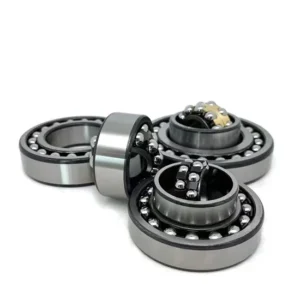
Self-Aligning Ball Bearing

X&S 2312 2317 2316 2315 2314 2313 Self-Aligning Ball Bearing — these units offer HRC58-62 hardness with selectable steel, brass, or nylon cages and C2 to C5 clearances for electric motors.
Original Batch Traceability — Every X&S 2312 2317 2316 2315 2314 2313 self-aligning ball bearing ships with manufacturer lot documentation for direct QR verification.
| Parameter | Value |
|---|---|
| Designation | 2312 2317 2316 2315 2314 2313 |
| Bearing Type | Self-Aligning Ball Bearing |
| Hardness | HRC58-62 [NEED_CITE: standard martensitic bearing steel hardness range] |
| Lubrication | Grease or Oil |
| Cage Material | Steel Cage, Brass Cage, Nylon Cage |
| Limiting Speed | 5600-18000 r/Min |
| Vibration Level | V1, V2, V3, V4 |
| Clearance Class | C2, C0, C3, C4, C5 |
| Origin | Shandong, China |
| Industry | Typical Applications |
|---|---|
| Electric Motors | Rotor shaft support in high-speed industrial drive motors |
| Automotive | Steering column joints and alternator shaft assemblies |
| Tractor | Front axle pivot points and PTO shaft support brackets |
| Construction Machinery | Vibratory screen eccentric shafts and conveyor idler rollers |
Ignoring thermal expansion variables during selection is the primary reason rotor shafts seize unexpectedly. When workshop technicians replace original components using only the base number, they frequently install standard internal clearance where expanded clearance was engineered to absorb operational heat. This mismatch eliminates the necessary internal play once the motor reaches its working temperature, forcing the rolling elements against the raceway and generating catastrophic friction. [NEED_CITE: rolling bearing failure mode classification per ISO 15243].
Exact clearance and cage alignment prevents sudden thermal seizure in continuous duty cycles.
In my years inspecting failed units from motor assembly lines, the damage pattern is always identical: severe smearing on the inner ring and a discolored, overheated cage. The base dimension matched the housing perfectly, but the internal geometry was entirely wrong for the thermal load. Procurement teams often focus solely on the outer dimensions to secure a quick replacement, completely overlooking the suffix requirements that dictate how the bearing behaves under sustained electromagnetic heating.
Selecting the correct X&S 2312 2317 2316 2315 2314 2313 self-aligning ball bearing requires looking past the basic envelope dimensions to evaluate the actual operating environment. Our technical review process cross-references your specific radial loads, rotational speeds, and ambient temperatures against the available internal geometries. This ensures the selected configuration provides adequate self-alignment capacity to handle minor shaft deflections without inducing edge loading on the raceways.
Electric motor applications subject components to continuous radial loads combined with high rotational velocities, demanding precise internal clearance to accommodate shaft thermal growth. If the operating temperature rises significantly, a standard clearance will collapse, necessitating a C3 or C4 configuration to maintain the optimal lubricant film thickness. The choice between grease and oil lubrication further dictates the sealing arrangement, where non-contact shields minimize friction heat while contact seals provide superior protection against conductive dust ingress in harsh construction environments. [NEED_CITE: lubrication selection criteria for dynamic bearing applications].
The cage material fundamentally dictates the speed capability and vibration profile of the assembly. Stamped steel cages offer excellent structural rigidity and are highly effective for standard industrial motor speeds, maintaining low noise levels under steady radial loads. For applications involving higher speeds or elevated temperatures, machined brass cages provide superior guidance and thermal stability, resisting deformation under continuous centrifugal forces. Nylon cages deliver the lowest friction coefficients and are ideal for high-speed automotive alternators where minimizing parasitic energy loss is critical, though their use is bounded by the thermal limits of the polymer matrix.
Installing a component with the wrong internal geometry rarely results in immediate, obvious failure; instead, it initiates a cycle of accelerated degradation. The excessive friction generates localized heat that degrades the lubricant, leading to metal-to-metal contact and premature spalling on the raceways. According to ISO 281 fatigue life calculations, operating with insufficient internal clearance drastically reduces the calculated service life, transforming a multi-year maintenance interval into an unplanned downtime event. This cascade of failures often voids equipment warranties and causes secondary damage to adjacent housing components and shaft seals. [NEED_CITE: ISO 281 dynamic load rating and life calculation principles].
Sourcing the X&S 2312 2317 2316 2315 2314 2313 self-aligning ball bearing through our authorized channels guarantees that the internal clearance and cage materials strictly match your engineering requirements. We actively prevent the common cross-reference error where suppliers supply a standard clearance unit simply because the base number aligns with your request. Every batch is backed by manufacturer lot traceability, allowing your quality team to verify the metallurgical origin directly. Our application-based selection review ensures that the vibration grade and limiting speed parameters are fully validated against your specific motor or tractor operating conditions.
To ensure optimal performance and longevity, please provide detailed operating parameters including continuous radial and axial loads, maximum rotational speed, and expected operating temperature ranges. This data allows our engineering team to calculate the required internal clearance and recommend the most suitable cage material for your specific electric motor or construction machinery application. Supplying original equipment manufacturer part numbers enables precise cross-reference verification, ensuring the replacement geometry perfectly matches the initial design intent without compromising system reliability.
Q: How do I verify the authenticity of these bearings using official traceability tools?
A: Every unit features a unique QR code linked to the manufacturer’s production database. By scanning this code with the official brand application, procurement and quality teams can instantly verify the batch origin, production date, and specific configuration. This digital traceability prevents the integration of counterfeit components that often feature soft inner rings and fail prematurely under load.
Q: Why must clearance class and cage material be matched alongside the base designation?
A: The base number only defines the outer dimensions. The internal clearance dictates how the bearing handles thermal expansion during operation, while the cage material determines speed limits and friction characteristics. Matching only the base number risks installing a standard clearance unit in a high-heat motor, leading to thermal binding, cage failure, and unplanned equipment downtime.
Q: What are the operational boundaries for choosing between steel, brass, and nylon cages?
A: Stamped steel cages provide excellent rigidity for standard speeds and steady loads. Machined brass cages offer superior thermal stability and guidance for high-speed or high-vibration environments, resisting deformation under heavy centrifugal forces. Nylon cages deliver the lowest friction for high-speed automotive applications but are restricted by the thermal limits of the polymer material.
Q: How do I select the correct clearance for electric motor thermal expansion?
A: Standard clearance is suitable for applications with minimal temperature differentials between the shaft and housing. For electric motors where the rotor generates significant heat, a C3 or C4 clearance is typically required to maintain internal play at operating temperature. Providing your specific thermal profile allows us to calculate the exact expansion and recommend the optimal class.
Q: What mounting practices are recommended to preserve the self-aligning capability?
A: Proper mounting requires verifying shaft and housing alignment before pressing the bearing into place. For cylindrical bores, induction heating ensures uniform expansion without stressing the rings or cage. Avoid applying mounting forces through the rolling elements, as this can permanently brinell the raceways and destroy the precise spherical geometry required for self-alignment.
Our engineers will respond within 12 hours with a tailored solution.
Request Quote| Bearing Type | Self-Aligning Ball Bearing |
| Brand | SKF |
| Quality Standard | ISO 9001 / TS 16949 |
| Precision Grade | P0 / P5 / P6 (custom) |
| Material | Chrome Steel / Stainless |
| Cage Material | Steel / Brass / Polyamide |
| Lubrication | Grease / Oil (specify) |
| Operating Temp. | -40°C to +200°C |
| Min. Order Qty | 1 pc (samples available) |
| Prototype Lead Time | 7 Working Days |
| Load Capacity | Contact for C0/Cr values |
| Speed Rating | Contact for ndm limit |
| Vibration Level | Z1 / Z2 / Z3 (custom) |
| Noise Level | V1 / V2 / V3 (custom) |
| Fatigue Life | L10h per ISO 281 |
| Sealing Options | Open / Z / 2Z / RS / 2RS |
Our engineering team can modify bearing dimensions, materials, seals, and clearances to meet your specific operating requirements. Submit your drawing or spec sheet for a tailored proposal.
Main shaft bearings, gearbox bearings, and generator bearings for onshore and offshore wind turbines.
Heavy-duty bearings for crushers, conveyors, and rotary equipment in extreme dust and shock-load environments.
High-temperature bearings for rolling mills, continuous casting, and furnace applications.
Wheel hub bearings, transmission bearings, and e-motor bearings for passenger and commercial vehicles.
Axle box bearings, traction motor bearings, and gearbox bearings meeting EN/UIC railway standards.
High-precision spindle bearings, angular contact bearings, and super-precision bearings for CNC and robotics.
Our engineers analyze your operating conditions -- load, speed, temperature, environment -- and select or design the optimal bearing solution to maximize service life and reduce total cost of ownership.
Need non-standard dimensions, special materials, or modified clearances? We can modify standard SKF bearings or manufacture fully custom solutions with a 7-day prototype turnaround.
When bearings fail prematurely, our team conducts root-cause analysis using advanced diagnostic tools to identify the failure mode and recommend corrective action.
We deploy vibration monitoring, thermal imaging, and oil analysis programs that detect bearing deterioration early -- reducing unplanned downtime by up to 40%.
Proper installation is critical to bearing performance. Our certified technicians provide on-site installation support, alignment verification, and operator training worldwide.
From initial selection through end-of-life, our dedicated account managers provide scheduled maintenance plans, re-lubrication programs, and replacement forecasting for enterprise clients.
NDA protected · Free samples for orders > $50K · Reply within 12 hours


