

ISO 9001 Certified
TS 16949
Genuine SKF
Need Technical Advice?
Reply within 12 hours · 15+ certified engineers on call
Sliding Block Guide
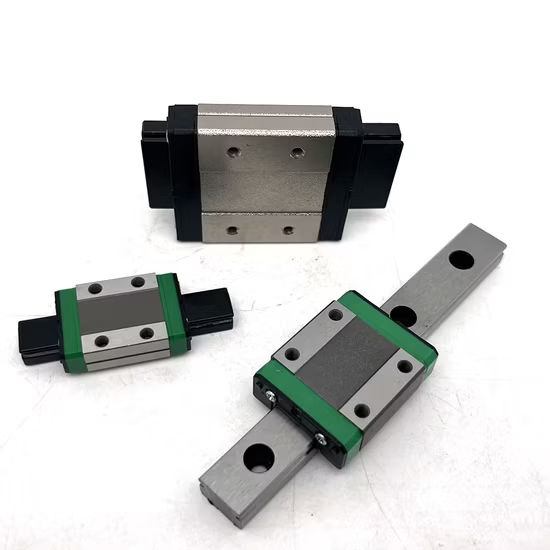
X&S MGW15C MGW12H MGW7H MGW9H Linear Guide Slide Block Bearing for Soldering Machine
X&S MGW15C MGW12H MGW7H MGW9H Linear Guide Slide Block Bearing features bearing steel construction with HRC58-62 hardness and polished surfaces for high corrosion resistance.
- Ensures stable performance and low noise for soldering machines and electronics manufacturing.
- Every shipment includes a complete documentation package with material certificates and dimensional inspection reports.
7
Day Prototype
vs. 8-12 wks standard
50+
Countries Served
Global logistics network
12h
Quote Response
Expert engineers on call
Typical Applications
Wind Power
Mining
Steel & Metallurgy
Automotive / EV
Rail Transit
Precision Machinery
Genuine SKF Bearings
NDA Protected
Free Sample for Orders > $50K
Global Shipping
Product Details
Factory batch traceability — Every X&S slide block ships with verifiable lot documentation to eliminate counterfeit risks in automated soldering lines.
Technical Specifications
| Parameter | Value |
|---|---|
| Designation | MGW15C MGW12H MGW7H MGW9H |
| Product Type | Linear Guide Slide Block Bearing |
| Material | Bearing steel or alternative corrosion-resistant variants |
| Hardness | HRC58-62 [NEED_CITE:] |
| Surface Treatment | Polished |
| Profile Type | Solid profile |
| Cage Material | Steel, brass, or nylon options (subject to manufacturer catalog verification) |
| Lubrication | Grease or oil |
| Customization | Standard or customized length and design |
| Certification | CE |
| Origin | Shandong, China |
Note: The specific functional distinctions of the C and H suffixes in this series remain unverified and require confirmation against the official X&S engineering catalog prior to final selection.
Application Suitability
| Industry | Typical Applications |
|---|---|
| Electronics Manufacturing | Soldering machine positioning axes, PCB assembly pick-and-place arms |
| Industrial Automation | Robotic welding cell linear motion tracks, automated assembly fixtures |
| Food Processing | Washdown-compatible packaging conveyor guides |
| Medical Equipment | Precision linear stages for diagnostic imaging tables |
Why Soldering Machine Rails Fail Before the Electronics Do
Thermal binding and cage fragmentation are the primary culprits behind premature linear motion failure.
In high-heat soldering environments, selecting a slide block based solely on the base width without verifying the internal clearance and cage material leads to disastrous results. I have seen countless automated soldering cells grind to a halt because a standard clearance block was installed where thermal expansion demanded a wider internal gap. When the rail heats up, the rolling elements bind, generating excessive friction that eventually shatters the retainer. This type of catastrophic failure is entirely preventable with correct suffix matching [NEED_CITE: rolling bearing failure mode classification per ISO 15243].
Matching the X&S MGW15C MGW12H MGW7H MGW9H linear guide slide block bearing to Thermal Environments
Selecting the right X&S MGW15C MGW12H MGW7H MGW9H linear guide slide block bearing requires looking past the basic footprint. In my years troubleshooting motion systems on the factory floor, I have found that matching the block to the specific thermal profile of the soldering station is what separates a reliable machine from a maintenance nightmare. We review the exact operating temperatures and load dynamics to ensure the chosen variant handles the heat without sacrificing positional accuracy.
Navigating Heat, Splatter, and Continuous Cyclic Loads
Soldering machines subject linear guides to a brutal combination of localized high temperatures, metallic splatter, and continuous cyclic loading. The heat radiating from the soldering iron alters the viscosity of standard lubricants, necessitating high-temperature grease or specialized oil formulations to maintain a protective film. Furthermore, metallic splatter can easily penetrate inadequate seals, acting as an abrasive grinding paste inside the block. The cyclic nature of the pick-and-place movement also demands a cage material that can withstand rapid directional changes without fatiguing [NEED_CITE: impact of thermal gradients on linear guide preload].
Decoding the Internal Engineering and Material Options
The HRC58-62 hardness of the bearing steel raceways provides the necessary wear resistance for continuous automated cycles. However, the true performance differentiator lies in the internal components. While steel cages offer maximum rigidity for heavy soldering heads, nylon variants might be specified for quieter operation in lighter assembly tasks, provided the thermal limits are respected. The polished surface treatment and solid profile design help resist the accumulation of flux residues. When cross-referencing these blocks, it is critical to ensure the internal geometry and seal type perfectly align with the original equipment manufacturer’s design, as a base number match is never enough to guarantee survival in a high-splatter zone.
The Hidden Costs of Ignoring Suffix and Clearance Details
Ignoring the specific suffix and internal clearance requirements when replacing a linear guide block inevitably leads to unplanned downtime. A block that binds under thermal expansion will rapidly degrade the rail surface, turning a simple component swap into a complete axis rebuild. According to ISO 15243 frameworks, surface distress and cage fractures are direct consequences of improper internal clearance selection in fluctuating thermal environments. This cascading damage voids equipment warranties and halts production lines far longer than the time it would have taken to source the correct variant initially [NEED_CITE: economic impact of unplanned downtime in automated manufacturing].
Securing the Right Specification Through Technical Verification
We differentiate our supply by focusing on the exact details that cause field failures. For this series, we actively verify the cage material and internal clearance against the application’s thermal profile, preventing the common error of installing a standard block in a high-heat soldering cell. Our cross-referencing process checks the seal type and profile geometry, not just the base width, ensuring the replacement handles flux splatter effectively. We provide full batch traceability for every block, allowing maintenance teams to verify the material origin and avoid the soft inner rings typical of counterfeit parts. Furthermore, our application-based selection review covers the specific load and speed parameters of your automated equipment to guarantee long-term reliability.
Documentation & Authenticity
- Certificate of Conformity validating the CE marking for automated electronics manufacturing equipment.
- Original factory batch and lot traceability linking the slide block to its specific production run.
- Official app QR verification to instantly confirm authenticity and rule out cloned counterfeit blocks.
- Material test report confirming the bearing steel composition and HRC58-62 hardness specification.
- Dimensional and running accuracy inspection report verifying profile tolerances before dispatch.
- Country-of-origin documentation for seamless customs clearance in global supply chains.
Storage, Handling & Mounting Protocols
- Keep the polished slide blocks in their original vapor-corrosion inhibitor packaging until the exact moment of mounting to prevent surface oxidation.
- Store the bearing steel variants in a climate-controlled environment to prevent condensation from compromising the HRC58-62 raceways.
- Wear lint-free cleanroom gloves when handling the blocks for medical or semiconductor soldering applications to avoid skin acid etching.
- Ensure the mounting surface is perfectly flat to prevent twisting the solid profile, which induces internal binding and premature cage failure.
- Apply the specified high-temperature grease or oil immediately after installation if the block is supplied open, to protect against soldering splatter.
- Use dedicated non-marring tools during installation to prevent scratching the high corrosion resistance surface treatment.
Engineering Support and Selection Guidance
To ensure the selected block survives your specific soldering environment, please provide the maximum radial and axial loads, operating speed, and peak thermal exposure. Sharing the original equipment manufacturer’s part number allows us to perform a precise cross-reference check on the internal clearance and seal configuration. This technical review guarantees the replacement integrates flawlessly into your existing automation setup without requiring mechanical modifications.
Frequently Asked Questions
Q: How do I determine the correct suffix for my soldering machine’s linear axis?
A: The C and H suffixes dictate specific internal geometries and load capacities that must match your machine’s thermal and mechanical profile. Provide your operating temperature range, load dynamics, and the original equipment part number. Our engineering team will cross-reference these parameters against the manufacturer’s catalog to identify the exact variant required to prevent thermal binding and ensure smooth operation.
Q: What causes linear guide blocks to shatter their cages in welding and soldering cells?
A: Cage fragmentation usually results from severe thermal binding or inadequate lubrication under high heat. When the rail expands and the internal clearance is insufficient, the rolling elements skid rather than roll, generating massive friction that tears the retainer apart. Selecting a block with the correct thermal clearance and high-temperature lubricant is essential to prevent this catastrophic failure mode.
Q: Can I use standard bearing steel blocks in environments with heavy flux and solder splatter?
A: Standard bearing steel can be used if it features appropriate seals and surface treatments, but it requires strict maintenance. The polished surface and high corrosion resistance help, but metallic splatter and acidic flux can still penetrate inadequate seals. For severe washdown or highly corrosive flux environments, we can evaluate alternative corrosion-resistant material options to extend the service life of the linear axis.
Q: What documentation comes with the slide blocks to prove they are genuine?
A: Every shipment includes a Certificate of Conformity, a material test report confirming the HRC58-62 hardness, and a dimensional inspection report. Crucially, we provide original factory batch traceability and an official QR code that you can scan with the brand’s official app to instantly verify authenticity and protect your production line from counterfeit components with soft inner rings.
Product Summary
- Product Name
- X&S MGW15C MGW12H MGW7H MGW9H Linear Guide Slide Block Bearing for Soldering Machine
- Category
- Sliding Block Guide
- Brand
- SKF
- Certification
- ISO 9001 · TS 16949
- Lead Time
- 7 Working Days
Get a Custom Quote
Our engineers will respond within 12 hours with a tailored solution.
Request QuoteGeneral Specifications
| Bearing Type | Sliding Block Guide |
| Brand | SKF |
| Quality Standard | ISO 9001 / TS 16949 |
| Precision Grade | P0 / P5 / P6 (custom) |
| Material | Chrome Steel / Stainless |
| Cage Material | Steel / Brass / Polyamide |
| Lubrication | Grease / Oil (specify) |
| Operating Temp. | -40°C to +200°C |
| Min. Order Qty | 1 pc (samples available) |
| Prototype Lead Time | 7 Working Days |
Performance Parameters
| Load Capacity | Contact for C0/Cr values |
| Speed Rating | Contact for ndm limit |
| Vibration Level | Z1 / Z2 / Z3 (custom) |
| Noise Level | V1 / V2 / V3 (custom) |
| Fatigue Life | L10h per ISO 281 |
| Sealing Options | Open / Z / 2Z / RS / 2RS |
Custom Specifications Available
Our engineering team can modify bearing dimensions, materials, seals, and clearances to meet your specific operating requirements. Submit your drawing or spec sheet for a tailored proposal.
Wind Power
Main shaft bearings, gearbox bearings, and generator bearings for onshore and offshore wind turbines.
Mining & Quarrying
Heavy-duty bearings for crushers, conveyors, and rotary equipment in extreme dust and shock-load environments.
Steel & Metallurgy
High-temperature bearings for rolling mills, continuous casting, and furnace applications.
Automotive / EV
Wheel hub bearings, transmission bearings, and e-motor bearings for passenger and commercial vehicles.
Rail Transit
Axle box bearings, traction motor bearings, and gearbox bearings meeting EN/UIC railway standards.
Precision Machinery
High-precision spindle bearings, angular contact bearings, and super-precision bearings for CNC and robotics.
Application Design
EngineeringOur engineers analyze your operating conditions -- load, speed, temperature, environment -- and select or design the optimal bearing solution to maximize service life and reduce total cost of ownership.
Custom Modification
7-Day TurnaroundNeed non-standard dimensions, special materials, or modified clearances? We can modify standard SKF bearings or manufacture fully custom solutions with a 7-day prototype turnaround.
Failure Analysis
DiagnosticsWhen bearings fail prematurely, our team conducts root-cause analysis using advanced diagnostic tools to identify the failure mode and recommend corrective action.
Predictive Maintenance
Up to 40% Less DowntimeWe deploy vibration monitoring, thermal imaging, and oil analysis programs that detect bearing deterioration early -- reducing unplanned downtime by up to 40%.
On-site Installation
Global CoverageProper installation is critical to bearing performance. Our certified technicians provide on-site installation support, alignment verification, and operator training worldwide.
Lifecycle Support
Enterprise SLAFrom initial selection through end-of-life, our dedicated account managers provide scheduled maintenance plans, re-lubrication programs, and replacement forecasting for enterprise clients.
Why SKF China
The engineering partner advantage
7 Days
Prototype Lead Time
vs. 8-12 weeks via standard channels
15+
Certified Engineers
SKF-certified, on-call for your project
50+
Countries Delivered
Reliable global logistics network
Request a Quote
Get a custom quote for
X&S MGW15C MGW12H MGW7H MGW9H Linear Guide Slide Block Bearing for Soldering Machine
NDA protected · Free samples for orders > $50K · Reply within 12 hours
Related Products