

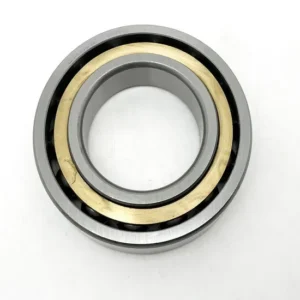
Angular Contact Ball Bearing

78/1000X2AC S718/1180 3934D 3944D S7692 S71892AC Angular Contact Ball Bearing — engineered with stainless steel construction and a 25° contact angle (AC) to handle combined radial and axial loads in travel motors.
Cross-reference alignment — We verify contact angle, precision class, and internal design suffixes to ensure the replacement matches the original equipment requirements perfectly.
| Parameter | Value |
|---|---|
| Designation | 78/1000X2AC S718/1180 3934D 3944D S7692 S71892AC |
| Bearing Type | Angular Contact Ball Bearing |
| Number of Rows | Single |
| Load Direction | Radial and Axial (Combined) |
| Material | Stainless Steel |
| Lubrication | Grease or Oil |
| Seal or Shield Type | Z / ZZ / RS / 2RS |
| Precision Class | ABEC1 / ABEC3 / ABEC5 / ABEC7 (P0 / P6 / P5 / P4 / UP / SP) |
| Contact Angle | 25° (AC suffix) |
| Operating Temperature Range | Lower Than +120 ºC |
| Origin | Shandong, China |
| HS Code | 848210300 |
Note: Suffixes 2AC, S, D, and c are non-standard or unverified designations that require manufacturer catalog confirmation for exact internal design or pairing specifics.
| Industry | Typical Applications |
|---|---|
| Heavy Machinery | Travel motor final drive assemblies and slew mechanisms |
| Precision Manufacturing | High-speed machine tool spindles and precision grinding heads |
| Fluid Power | High-speed hydraulic pumps and robotic joint actuators |
Matching the base number is never enough; the internal clearance and precision grade dictate survival under shock loads.
When procurement teams source replacements for heavy equipment travel motors, they often focus solely on the primary designation. However, installing a standard clearance bearing where a specific thermal expansion allowance was required leads to rapid heat buildup. I have seen countless instances where a misconfigured angular contact bearing seized within hours of operation because the precision suffix was overlooked during cross-referencing [NEED_CITE: bearing failure modes related to incorrect internal clearance selection]. A reliable X&S 78/1000X2AC S718/1180 angular contact ball bearing must be evaluated not just by its outer dimensions, but by its exact internal geometry and cage design to withstand the brutal vibration of off-highway applications.
Selecting the right X&S 78/1000X2AC S718/1180 angular contact ball bearing for precision equipment requires a strict alignment of the ABEC rating with the application’s rotational speed. While standard industrial gearboxes might tolerate ABEC1 or ABEC3, high-speed spindles demand ABEC5 or ABEC7 to minimize vibration and runout. Our technical review process ensures that the precision class specified on the purchase order exactly matches the operational demands of the machinery, preventing the subtle micro-vibrations that degrade surface finish quality in machining operations.
Travel motors and outdoor hydraulic pumps operate in environments saturated with abrasive dust and moisture. The choice between non-contact metallic shields (Z/ZZ) and contact rubber seals (RS/2RS) fundamentally alters the friction profile and contamination defense. Furthermore, the operating temperature directly impacts the lubricant’s viscosity and the bearing’s internal clearance. If the ambient heat combined with operational friction pushes the internal temperature beyond the thermal limit of standard bearing steel, the selected stainless steel variant and high-temperature grease must compensate to prevent cage deformation and premature fatigue [NEED_CITE: thermal degradation of bearing lubricants in heavy machinery].
The "AC" suffix in this designation signifies a 25° contact angle, which is engineered to optimize the balance between radial support and axial thrust capacity. In travel motor applications, the shaft experiences significant axial thrust during directional changes and braking. A 25° contact angle provides a robust load-carrying zone that absorbs these directional shifts without overloading the raceway shoulders. Combined with the stainless steel material option, this configuration offers substantial resistance to the corrosive elements frequently encountered in construction and mining sites, ensuring structural integrity even when exposed to moisture.
Substituting a bearing based purely on dimensional equivalence while ignoring the cage material or precision suffix invites catastrophic damage. A polyamide cage might fail under the high-temperature shock loads of a travel motor, whereas a machined brass cage would endure. According to ISO 15243 standards, a significant share of premature failures stems from these subtle specification mismatches rather than manufacturing defects [NEED_CITE: rolling bearing failure mode classification per ISO 15243]. The resulting unplanned downtime and secondary damage to the surrounding housing far exceed the initial cost of sourcing the correctly specified component.
Sourcing these specific designations requires more than just checking a stock list; it demands rigorous cross-brand interchange expertise. We verify that the replacement matches the original equipment’s contact angle and seal configuration, not just the basic bore and outer diameter. Our batch traceability ensures that every stainless steel component can be tracked back to its raw material origin. Furthermore, we provide application-based selection reviews, checking your load and speed parameters against the specific ABEC precision grade to guarantee operational stability.
To ensure the selected designation perfectly aligns with your travel motor or high-speed machinery, please provide the exact radial and axial load profiles, operating speeds, and thermal conditions. Sharing the original OEM equipment number allows our engineering team to perform a comprehensive cross-reference check, verifying that the internal clearance and precision suffixes match the factory specifications. This technical review guarantees that the proposed solution addresses your specific operational challenges.
Q: Why do bearings with the same base number fail prematurely in travel motors?
A: Base numbers only define external dimensions. Premature failure often occurs when the internal clearance, cage material, or precision suffix differs from the OEM requirement. For instance, installing a standard clearance bearing in a high-heat travel motor application causes thermal binding. We cross-reference the complete designation, including unverified suffixes, to ensure the internal design matches the specific shock load and thermal expansion demands of your equipment.
Q: How does the 25° contact angle affect travel motor performance?
A: The 25° contact angle, denoted by the AC suffix, provides an optimal balance for handling combined radial and axial loads. In travel motors, heavy axial thrust occurs during braking and directional shifts. This specific angle widens the load-carrying zone on the raceway, preventing edge loading and reducing the risk of premature spalling under the intense, fluctuating directional forces typical of heavy off-highway machinery operations.
Q: What is the difference between ABEC3 and ABEC7 for these applications?
A: ABEC3 (P6) is generally sufficient for standard industrial gearboxes where minor runout is acceptable. ABEC7 (P4) is strictly required for high-speed machine tool spindles and precision robotics to minimize vibration and ensure tight dimensional tolerances. Using a lower precision grade in a high-speed application generates excessive heat and noise, while over-specifying precision for a travel motor yields no operational benefit and unnecessarily increases procurement costs.
Q: How should I choose between Z/ZZ shields and RS/2RS seals?
A: Metallic shields (Z/ZZ) are non-contact, offering lower friction and higher speed capabilities, making them ideal for high-speed spindles. Rubber seals (RS/2RS) provide superior protection against abrasive dust and moisture but generate more frictional heat. For travel motors operating in muddy or dusty environments, the enhanced contamination defense of contact seals is usually prioritized over the slight speed limitation, provided the thermal limits are monitored.
Our engineers will respond within 12 hours with a tailored solution.
Request Quote| Bearing Type | Angular Contact Ball Bearing |
| Brand | SKF |
| Quality Standard | ISO 9001 / TS 16949 |
| Precision Grade | P0 / P5 / P6 (custom) |
| Material | Chrome Steel / Stainless |
| Cage Material | Steel / Brass / Polyamide |
| Lubrication | Grease / Oil (specify) |
| Operating Temp. | -40°C to +200°C |
| Min. Order Qty | 1 pc (samples available) |
| Prototype Lead Time | 7 Working Days |
| Load Capacity | Contact for C0/Cr values |
| Speed Rating | Contact for ndm limit |
| Vibration Level | Z1 / Z2 / Z3 (custom) |
| Noise Level | V1 / V2 / V3 (custom) |
| Fatigue Life | L10h per ISO 281 |
| Sealing Options | Open / Z / 2Z / RS / 2RS |
Our engineering team can modify bearing dimensions, materials, seals, and clearances to meet your specific operating requirements. Submit your drawing or spec sheet for a tailored proposal.
Main shaft bearings, gearbox bearings, and generator bearings for onshore and offshore wind turbines.
Heavy-duty bearings for crushers, conveyors, and rotary equipment in extreme dust and shock-load environments.
High-temperature bearings for rolling mills, continuous casting, and furnace applications.
Wheel hub bearings, transmission bearings, and e-motor bearings for passenger and commercial vehicles.
Axle box bearings, traction motor bearings, and gearbox bearings meeting EN/UIC railway standards.
High-precision spindle bearings, angular contact bearings, and super-precision bearings for CNC and robotics.
Our engineers analyze your operating conditions -- load, speed, temperature, environment -- and select or design the optimal bearing solution to maximize service life and reduce total cost of ownership.
Need non-standard dimensions, special materials, or modified clearances? We can modify standard SKF bearings or manufacture fully custom solutions with a 7-day prototype turnaround.
When bearings fail prematurely, our team conducts root-cause analysis using advanced diagnostic tools to identify the failure mode and recommend corrective action.
We deploy vibration monitoring, thermal imaging, and oil analysis programs that detect bearing deterioration early -- reducing unplanned downtime by up to 40%.
Proper installation is critical to bearing performance. Our certified technicians provide on-site installation support, alignment verification, and operator training worldwide.
From initial selection through end-of-life, our dedicated account managers provide scheduled maintenance plans, re-lubrication programs, and replacement forecasting for enterprise clients.
NDA protected · Free samples for orders > $50K · Reply within 12 hours

![X&S B7013E.T.P4S B7014C.T.P4S Angular Contact Ball Bearing for Motorcycle [WARN] draft identifier mismatch](https://skfip.com/wp-content/uploads/2026/09/xs-b7013e-t-p4s-b7014c-t-p4s-angular-contact-ball-bearing-for-motorcycle-warn-draft-identifier-mismatch-827656-300x300.webp)