
![X&S CT1310-A FCR44-36-1 Clutch Bearing for Pickup Truck [WARN] draft identifier mismatch](https://skfip.com/wp-content/uploads/2026/09/xs-ct1310-a-fcr44-36-1-clutch-bearing-for-pickup-truck-warn-draft-identifier-mismatch-529395.avif)
ISO 9001 Certified
TS 16949
Genuine SKF
Need Technical Advice?
Reply within 12 hours · 15+ certified engineers on call
Clutch Bearing
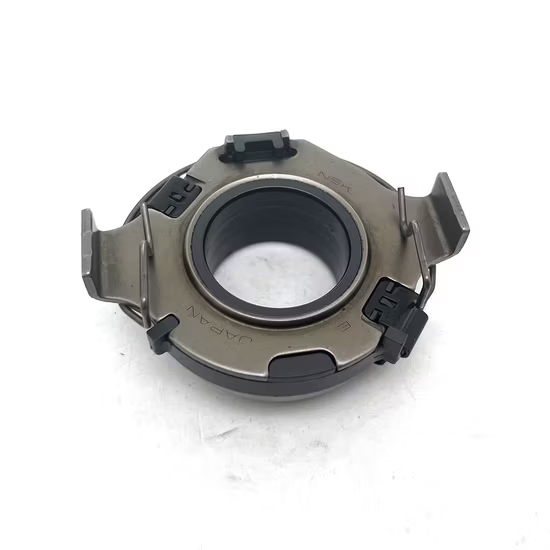
X&S CT1310 FCR50-35-6 Auto Clutch Bearing for Passenger Vehicles
CT1310 FCR50-35-6 50SCRN31P-1 TK45-03 CT24H Auto Clutch Bearing — standard clearance with P0 to P6 precision options.
- Forged from chrome steel for impact resistance, featuring pre-filled grease lubrication and TS16949 automotive certification.
- Our cross-reference matching strictly aligns clearance, cage design, and precision suffixes to prevent thermal binding or premature clutch failure.
7
Day Prototype
vs. 8-12 wks standard
50+
Countries Served
Global logistics network
12h
Quote Response
Expert engineers on call
Typical Applications
Wind Power
Mining
Steel & Metallurgy
Automotive / EV
Rail Transit
Precision Machinery
Genuine SKF Bearings
NDA Protected
Free Sample for Orders > $50K
Global Shipping
Product Details
Verified via official apps — Every X&S CT1310 FCR50-35-6 auto clutch bearing carries a traceable batch code that buyers can scan using the manufacturer’s official application to confirm authenticity before installation.
Technical Specifications
| Parameter | Value |
|---|---|
| Designation | CT1310 FCR50-35-6 50SCRN31P-1 TK45-03 CT24H |
| Bearing Type | Auto Clutch Bearing |
| Material | Chrome Steel |
| Precision Class | P0, P2, P4, P5, P6 |
| Clearance Class | Standard |
| Lubrication | Grease or Oil |
| ABS | Without ABS |
| Certification | ISO9001, TS16949, CE |
| Origin | Shandong, China |
Note: The designations CT1310, FCR50-35-6, 50SCRN31P-1, TK45-03, and CT24H function as unverified suffixes requiring manufacturer catalog confirmation for exact dimensional cross-referencing.
Application Suitability
| Industry | Typical Applications |
|---|---|
| Passenger Vehicles | Manual transmission clutch release mechanisms |
| Heavy Vehicle Repair | Commercial truck clutch disengagement systems |
| Automotive Aftermarket | OEM equivalent replacement for worn release bearings |
Why Base Number Matching Fails the X&S CT1310 FCR50-35-6 auto clutch bearing
Physical dimensions and internal contact angles must align perfectly, not just the stamped OEM code.
Sourcing teams frequently approve replacements based solely on the primary reference number, overlooking critical internal design variations. During my years coordinating OE parts across Latin American supply chains, I witnessed numerous clutch assemblies fail prematurely because the substituted release bearing had a mismatched contact face width, leading to incomplete disengagement and severe gear grinding [NEED_CITE: rolling bearing failure mode classification per ISO 15243]. Ensuring the X&S CT1310 FCR50-35-6 auto clutch bearing matches the exact physical envelope prevents these costly drivetrain callbacks.
Matching the Exact Drivetrain Envelope
Procurement engineers require more than a matching basic number when sourcing the X&S CT1310 FCR50-35-6 auto clutch bearing for sensitive manual transmissions. Our technical team verifies the outer diameter, inner bore, and crucial contact face width against the original equipment specifications. This rigorous cross-reference validation ensures the release bearing seats correctly against the diaphragm spring, delivering smooth clutch actuation without binding or excessive pedal effort.
Surviving the Bell Housing Environment
The clutch release mechanism operates in a highly contaminated environment filled with friction dust, metallic debris, and fluctuating thermal loads from the pressure plate. Standard clearance and pre-lubricated grease packs must withstand these elevated temperatures without degrading or leaking onto the friction disc. Effective sealing is mandatory to prevent abrasive particles from infiltrating the rolling elements, which would otherwise accelerate wear and generate noticeable cabin noise during gear shifts [NEED_CITE: typical contamination ingress in automotive clutch systems].
Decoding the Chrome Steel and Precision Matrix
High-carbon chrome steel provides the necessary fatigue strength to endure the repetitive axial thrust applied during every clutch engagement cycle. Selecting the appropriate precision class—from standard P0 up to P2—dictates how smoothly the bearing translates along the transmission input shaft sleeve. A higher precision grade minimizes radial runout, ensuring uniform load distribution across the contact face and preventing the localized stress concentrations that cause early spalling on the diaphragm spring fingers.
The Hidden Costs of Drivetrain Mismatches
Installing a release bearing with incorrect dimensional tolerances inevitably leads to catastrophic transmission damage. If the contact face sits too deep or protrudes excessively, the clutch may slip under heavy acceleration or fail to disengage entirely, destroying the synchronizers and friction materials. According to ISO 281 framework principles, operating a bearing outside its designed kinematic envelope drastically reduces its calculated fatigue life, resulting in unplanned vehicle downtime and voided powertrain warranties [NEED_CITE: bearing life calculation principles per ISO 281].
Why Procurement Teams Trust Our Cross-Referencing
We eliminate the guesswork by validating the exact contact geometry for identifiers like 50SCRN31P-1, ensuring the replacement fits the specific diaphragm spring profile. Our inventory maintains strict batch traceability for every TS16949 certified unit, allowing MRO managers to verify the production lot before tearing down a transmission. We also review the application parameters to confirm the selected precision class and lubrication type match the vehicle’s specific thermal and operational demands.
Documentation & Authenticity
- Certificate of Conformity confirming TS16949 automotive quality standards for this specific production batch.
- Scannable QR codes linking directly to the manufacturer’s database for instant verification of the X&S origin.
- Material test reports validating the high-carbon chrome steel composition and heat treatment hardness.
- Dimensional inspection records verifying the critical contact face width and bore tolerances prior to dispatch.
Storage, Handling & Mounting
- Retain the original moisture-barrier packaging until the exact moment of installation to protect the pre-applied grease pack.
- Wipe the transmission input shaft sleeve completely clean to prevent abrasive debris from scoring the bearing inner bore during sliding.
- Avoid using excessive force or hammering on the outer ring, which can brinell the chrome steel raceways and cause immediate vibration.
- Verify the clutch fork pivot ball wear before mounting, as a worn pivot will misalign the bearing and cause asymmetric contact face wear.
Preparing Your Technical Inquiry
To ensure precise fitment, please provide the original equipment manufacturer part number stamped on the existing release bearing or the exact vehicle identification details. Sharing the specific transmission model and any observed symptoms, such as pedal vibration or release noise, allows our engineering team to verify the cross-reference and confirm the optimal precision class for your application.
Frequently Asked Questions
Q: How do I confirm the physical dimensions of a cross-reference like 50SCRN31P-1 match my original clutch assembly?
A: Base numbers alone are insufficient. You must verify the outer diameter, inner bore, and specifically the contact face width against the original part. Our technical team cross-checks these critical envelope dimensions using manufacturer catalogs to ensure the replacement seats perfectly against your specific diaphragm spring without causing incomplete disengagement or excessive pedal travel.
Q: What are the most common early failure modes for automotive clutch release bearings during installation?
A: Premature failures typically stem from contaminated transmission fluid degrading the grease, misalignment due to a worn clutch fork pivot, or forcing the bearing onto a damaged input shaft sleeve. Ensuring the bell housing is clean and the guiding sleeve is smooth prevents the asymmetric loading that quickly destroys the chrome steel raceways and generates noticeable release noise.
Q: Why is TS16949 certification critical when sourcing replacement release bearings for passenger vehicles?
A: This automotive-specific quality management standard mandates rigorous process controls, ensuring batch-to-batch consistency in heat treatment, dimensional tolerances, and grease fill volumes. For high-cycle components like clutch release bearings, this certification guarantees that every unit meets the exact fatigue life requirements necessary to survive thousands of engagement cycles without spalling or seizing.
Q: How does the lubrication choice affect the lifespan of a release bearing in high-temperature bell housing environments?
A: The pre-packed grease must maintain its structural stability and resist bleeding at the elevated temperatures generated by the nearby pressure plate and friction disc. If the lubricant degrades or liquefies, it can leak onto the clutch friction material, causing severe slipping. Proper high-temperature grease formulations ensure the rolling elements remain protected throughout the component’s intended service life.
Product Summary
- Product Name
- X&S CT1310 FCR50-35-6 Auto Clutch Bearing for Passenger Vehicles
- Category
- Clutch Bearing
- Brand
- SKF
- Certification
- ISO 9001 · TS 16949
- Lead Time
- 7 Working Days
Get a Custom Quote
Our engineers will respond within 12 hours with a tailored solution.
Request QuoteGeneral Specifications
| Bearing Type | Clutch Bearing |
| Brand | SKF |
| Quality Standard | ISO 9001 / TS 16949 |
| Precision Grade | P0 / P5 / P6 (custom) |
| Material | Chrome Steel / Stainless |
| Cage Material | Steel / Brass / Polyamide |
| Lubrication | Grease / Oil (specify) |
| Operating Temp. | -40°C to +200°C |
| Min. Order Qty | 1 pc (samples available) |
| Prototype Lead Time | 7 Working Days |
Performance Parameters
| Load Capacity | Contact for C0/Cr values |
| Speed Rating | Contact for ndm limit |
| Vibration Level | Z1 / Z2 / Z3 (custom) |
| Noise Level | V1 / V2 / V3 (custom) |
| Fatigue Life | L10h per ISO 281 |
| Sealing Options | Open / Z / 2Z / RS / 2RS |
Custom Specifications Available
Our engineering team can modify bearing dimensions, materials, seals, and clearances to meet your specific operating requirements. Submit your drawing or spec sheet for a tailored proposal.
Wind Power
Main shaft bearings, gearbox bearings, and generator bearings for onshore and offshore wind turbines.
Mining & Quarrying
Heavy-duty bearings for crushers, conveyors, and rotary equipment in extreme dust and shock-load environments.
Steel & Metallurgy
High-temperature bearings for rolling mills, continuous casting, and furnace applications.
Automotive / EV
Wheel hub bearings, transmission bearings, and e-motor bearings for passenger and commercial vehicles.
Rail Transit
Axle box bearings, traction motor bearings, and gearbox bearings meeting EN/UIC railway standards.
Precision Machinery
High-precision spindle bearings, angular contact bearings, and super-precision bearings for CNC and robotics.
Application Design
EngineeringOur engineers analyze your operating conditions -- load, speed, temperature, environment -- and select or design the optimal bearing solution to maximize service life and reduce total cost of ownership.
Custom Modification
7-Day TurnaroundNeed non-standard dimensions, special materials, or modified clearances? We can modify standard SKF bearings or manufacture fully custom solutions with a 7-day prototype turnaround.
Failure Analysis
DiagnosticsWhen bearings fail prematurely, our team conducts root-cause analysis using advanced diagnostic tools to identify the failure mode and recommend corrective action.
Predictive Maintenance
Up to 40% Less DowntimeWe deploy vibration monitoring, thermal imaging, and oil analysis programs that detect bearing deterioration early -- reducing unplanned downtime by up to 40%.
On-site Installation
Global CoverageProper installation is critical to bearing performance. Our certified technicians provide on-site installation support, alignment verification, and operator training worldwide.
Lifecycle Support
Enterprise SLAFrom initial selection through end-of-life, our dedicated account managers provide scheduled maintenance plans, re-lubrication programs, and replacement forecasting for enterprise clients.
Why SKF China
The engineering partner advantage
7 Days
Prototype Lead Time
vs. 8-12 weeks via standard channels
15+
Certified Engineers
SKF-certified, on-call for your project
50+
Countries Delivered
Reliable global logistics network
Request a Quote
Get a custom quote for
X&S CT1310 FCR50-35-6 Auto Clutch Bearing for Passenger Vehicles
NDA protected · Free samples for orders > $50K · Reply within 12 hours
Related Products
More Clutch Bearing Products
![X&S VKC3668 VKC3617 VKC3618 Clutch Release Bearing for Auto [WARN] draft identifier mismatch](https://skfip.com/wp-content/uploads/2026/09/xs-vkc3668-vkc3617-vkc3618-clutch-release-bearing-for-auto-warn-draft-identifier-mismatch-3824a9.avif)
![X&S TK33Z-1 48TKB3302B Clutch Bearing for Loader T50R 40TNK20 [WARN] draft identifier mismatch](https://skfip.com/wp-content/uploads/2026/09/xs-tk33z-1-48tkb3302b-clutch-bearing-for-loader-t50r-40tnk20-warn-draft-identifier-mismatch-3e1fdc.avif)
![052TRBC09-7 FCR50-30-14 CBU442822 Clutch Bearing for Domestic Car [WARN] draft identifier mismatch](https://skfip.com/wp-content/uploads/2026/09/052trbc09-7-fcr50-30-14-cbu442822-clutch-bearing-for-domestic-car-warn-draft-identifier-mismatch-0b6461.avif)