
Others Imported Brand Bearing
![X&S 61815 61814 61813 61812 61811 Deep Groove Ball Bearing for Motor [WARN] draft identifier mismatch](https://skfip.com/wp-content/uploads/2026/09/xs-61815-61814-61813-61812-61811-deep-groove-ball-bearing-for-motor-warn-draft-identifier-mismatch-f4dc13.avif)
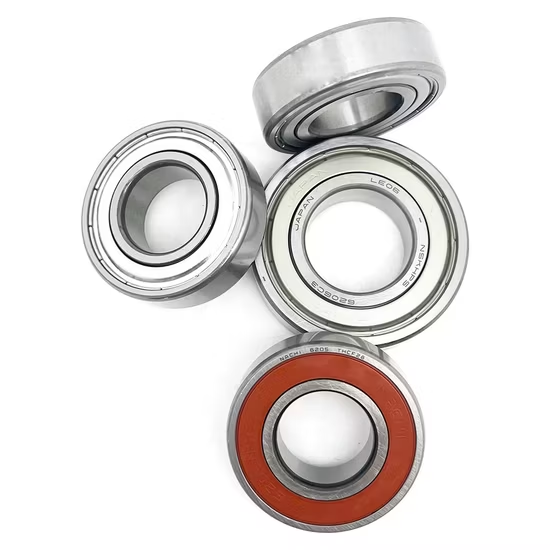
X&S 61815 61814 61813 61812 61811 Deep Groove Ball Bearings P0-P4 — engineered for electric motors with bearing steel construction.
Cross-Reference Tri-Point Alignment — we verify base numbers, clearance suffixes, and cage materials simultaneously to prevent thermal binding in motor applications.
| Parameter | Value |
|---|---|
| Designation | 61815 61814 61813 61812 61811 |
| Product Type | Deep Groove Ball Bearing |
| Material | Bearing Steel |
| Precision Class | P0, P6, P5, P4 |
| Vibration Level | Z1V1, Z2V2, Z3V3, Z4V4 |
| Seal or Shield Type | Zz, 2RS, Open |
| Lubrication | Grease or Oil |
| Origin | Shandong Province, China |
| Industry | Typical Applications |
|---|---|
| Electric Motors | Rotor shaft support, stator end-shields, cooling fan drives |
| Industrial Gearboxes | High-speed input shafts, auxiliary take-off bearings |
| Household Appliances | Washing machine drum supports, HVAC blower motors |
Matching the base number while ignoring the C3 clearance requirement guarantees thermal binding at operating temperature.
I have seen entire production lines halt because a maintenance crew installed standard clearance bearings in high-temperature motor housings. When the inner ring expands faster than the outer ring, the radial internal clearance vanishes, leading to catastrophic cage failure. Procurement teams often focus solely on the dimensional envelope, overlooking how seal friction and thermal gradients dictate the necessary internal geometry. This oversight transforms a simple replacement into a critical downtime event [NEED_CITE: rolling bearing failure mode classification per ISO 15243].
Selecting the correct variant from this series requires looking beyond the bore and outside diameter. Electric motors demand low vibration and precise radial support to maintain the air gap between the rotor and stator. By aligning the specific vibration grade and precision class with the motor’s operational speed, we ensure the bearing sustains the radial loads without generating excessive acoustic noise or heat.
Motor environments present a unique combination of high rotational speeds and elevated internal temperatures. The thermal expansion of the shaft necessitates specific internal clearance classes to prevent the rolling elements from skidding. Furthermore, the choice between contact seals and non-contact shields dictates the friction profile; contact seals offer superior contamination exclusion but generate additional heat, which can degrade the lubricant prematurely in continuous-duty applications [NEED_CITE: thermal limits of standard bearing grease in enclosed motors].
The available precision classes ranging from P0 to P4 directly influence the running accuracy of the motor shaft, which is critical for preventing vibration transfer to the driven equipment. Coupled with vibration levels from Z1V1 up to Z4V4, these specifications define the acoustic and dynamic behavior of the assembly. Higher precision and stricter vibration controls minimize the harmonic resonance that typically accelerates fatigue in high-speed electric motor applications.
Installing a bearing with incorrect internal geometry or mismatched seal types leads to rapid lubricant starvation and raceway spalling. According to ISO 281 frameworks, the calculated life of a bearing drops exponentially when operating clearance is compromised by thermal expansion or improper mounting fits. This results in unplanned downtime, catastrophic damage to the motor windings from shaft displacement, and immediate warranty voidance by the equipment manufacturer [NEED_CITE: bearing life calculation adjustments per ISO 281].
Our approach focuses on preventing the specific cross-reference errors that plague thin-section bearings like the 618 series. We verify that the replacement matches not just the basic designation, but also the exact seal friction and clearance requirements of the original equipment. Every batch is traced back to the manufacturer’s production facilities, ensuring the metallurgical consistency required for high-speed motor applications. We provide application-based selection reviews to confirm that the chosen variant can withstand the specific thermal and load profiles of your machinery.
To ensure optimal performance, please share your motor’s radial and axial load profiles, operating speeds, and expected thermal gradients. Providing the original equipment manufacturer part numbers allows us to execute a precise cross-reference check, verifying that all suffixes align with your specific application requirements. Our engineering team will review these parameters to confirm the L10 life and recommend the appropriate seal and clearance configuration.
Q: Why does a matched base number still result in motor failure?
A: A matching base number only confirms the physical dimensions. If the original equipment required a C3 clearance for thermal expansion and a standard CN is installed, the bearing will bind as the motor reaches operating temperature. We verify clearance, cage design, and seal friction to ensure complete functional equivalence, preventing premature thermal seizure.
Q: How do Z1V1 to Z4V4 vibration levels affect motor performance?
A: These designations indicate the strictness of the vibration and acoustic noise limits tested during manufacturing. Higher levels, such as Z3V3 or Z4V4, are essential for precision electric motors where shaft vibration could transfer to the driven load or cause acoustic complaints in household appliances. Selecting the correct level ensures smooth, quiet operation at high speeds.
Q: When should I choose 2RS contact seals over Zz shields?
A: Choose 2RS contact seals when the motor operates in environments with heavy dust or moisture, as the rubber lip provides superior contamination exclusion. However, for very high-speed applications where seal friction could generate excessive heat and degrade the grease, Zz non-contact metallic shields are preferred to maintain lower operating temperatures and extend lubrication life.
Q: What is the risk of using P0 precision in a high-speed spindle motor?
A: P0 is the standard precision class suitable for general-purpose applications. In high-speed spindle motors, the dimensional and running accuracy deviations of P0 can cause excessive vibration, uneven load distribution across the rolling elements, and accelerated fatigue. Upgrading to P5 or P4 precision ensures tighter tolerances, maintaining rotor stability and extending the operational lifespan of the spindle.
Our engineers will respond within 12 hours with a tailored solution.
Request Quote| Bearing Type | Others Imported Brand Bearing |
| Brand | SKF |
| Quality Standard | ISO 9001 / TS 16949 |
| Precision Grade | P0 / P5 / P6 (custom) |
| Material | Chrome Steel / Stainless |
| Cage Material | Steel / Brass / Polyamide |
| Lubrication | Grease / Oil (specify) |
| Operating Temp. | -40°C to +200°C |
| Min. Order Qty | 1 pc (samples available) |
| Prototype Lead Time | 7 Working Days |
| Load Capacity | Contact for C0/Cr values |
| Speed Rating | Contact for ndm limit |
| Vibration Level | Z1 / Z2 / Z3 (custom) |
| Noise Level | V1 / V2 / V3 (custom) |
| Fatigue Life | L10h per ISO 281 |
| Sealing Options | Open / Z / 2Z / RS / 2RS |
Our engineering team can modify bearing dimensions, materials, seals, and clearances to meet your specific operating requirements. Submit your drawing or spec sheet for a tailored proposal.
Main shaft bearings, gearbox bearings, and generator bearings for onshore and offshore wind turbines.
Heavy-duty bearings for crushers, conveyors, and rotary equipment in extreme dust and shock-load environments.
High-temperature bearings for rolling mills, continuous casting, and furnace applications.
Wheel hub bearings, transmission bearings, and e-motor bearings for passenger and commercial vehicles.
Axle box bearings, traction motor bearings, and gearbox bearings meeting EN/UIC railway standards.
High-precision spindle bearings, angular contact bearings, and super-precision bearings for CNC and robotics.
Our engineers analyze your operating conditions -- load, speed, temperature, environment -- and select or design the optimal bearing solution to maximize service life and reduce total cost of ownership.
Need non-standard dimensions, special materials, or modified clearances? We can modify standard SKF bearings or manufacture fully custom solutions with a 7-day prototype turnaround.
When bearings fail prematurely, our team conducts root-cause analysis using advanced diagnostic tools to identify the failure mode and recommend corrective action.
We deploy vibration monitoring, thermal imaging, and oil analysis programs that detect bearing deterioration early -- reducing unplanned downtime by up to 40%.
Proper installation is critical to bearing performance. Our certified technicians provide on-site installation support, alignment verification, and operator training worldwide.
From initial selection through end-of-life, our dedicated account managers provide scheduled maintenance plans, re-lubrication programs, and replacement forecasting for enterprise clients.
NDA protected · Free samples for orders > $50K · Reply within 12 hours
![X&S 6205 6026 6207 6208 6209 Deep Groove Ball Bearing for Wheel [WARN] draft identifier mismatch](https://skfip.com/wp-content/uploads/2026/09/xs-6205-6026-6207-6208-6209-deep-groove-ball-bearing-for-wheel-warn-draft-identifier-mismatch-770c93.avif)

