![INA NJ2204 NJ204 NJ303 Cylindrical Roller Bearing for Motor [WARN] draft identifier mismatch](https://skfip.com/wp-content/uploads/2026/09/ina-nj2204-nj204-nj303-cylindrical-roller-bearing-for-motor-warn-draft-identifier-mismatch-103562.avif)
ISO 9001 Certified
TS 16949
Genuine SKF
Need Technical Advice?
Reply within 12 hours · 15+ certified engineers on call
INA Bearing
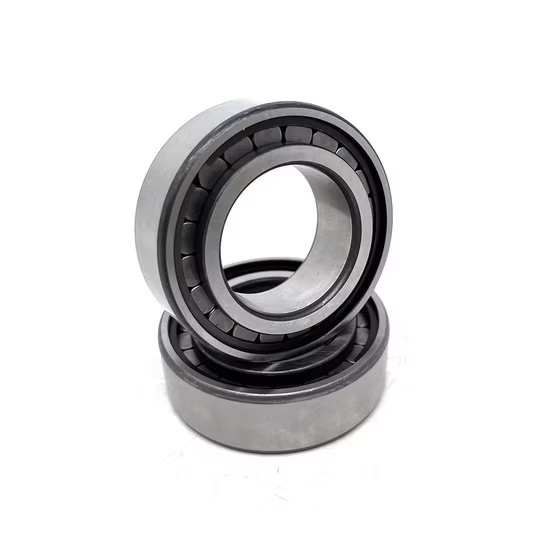
INA H7012C-2RZ-P4 Angular Contact Ball Bearing for Automotive Transmission and Forklift
H7012C-2RZ-P4 B706C. T. P4S B706E. T. P4S Angular Contact Ball Bearing P4 — featuring a 15° contact angle for optimized axial load support and P4 precision for strict dimensional accuracy in automotive transmission systems.
- Verify batch authenticity instantly through the official brand app QR scanning channel.
7
Day Prototype
vs. 8-12 wks standard
50+
Countries Served
Global logistics network
12h
Quote Response
Expert engineers on call
Typical Applications
Wind Power
Mining
Steel & Metallurgy
Automotive / EV
Rail Transit
Precision Machinery
Genuine SKF Bearings
NDA Protected
Free Sample for Orders > $50K
Global Shipping
Product Details
Verified via official app — Every INA H7012C-2RZ-P4 B706C.T.P4S angular contact ball bearing shipped includes a scannable QR code linking directly to the manufacturer’s authentication database.
Technical Specifications
| Parameter | Value |
|---|---|
| Designation | H7012C-2RZ-P4 B706C. T. P4S B706E. T. P4S |
| Bearing Type | Angular Contact Ball Bearing |
| Bore Diameter (d) | 60 mm (Code 12) |
| Contact Angle | 15° (C suffix) |
| Precision Class | P4 |
| Material Options | Stainless Steel |
| Hardness | 60-64 HRC [NEED_CITE: standard hardness range for martensitic bearing steel] |
| Cage Material Options | Brass, Steel |
| Clearance Class Options | C0, C1, C2, C3, C4, C5 |
| Vibration Level Options | Z1V1, Z2V2, Z3V3 |
| Seal or Shield Type | 2RZ (Non-contact seals) |
| Origin | Shandong, China |
Note: Suffixes H, 70, 2RZ, B, 706, T, P4S, and E require manufacturer catalog confirmation for exact dimensional and design specifics.
Application Suitability
| Industry | Typical Applications |
|---|---|
| Automotive | Transmission shaft support, differential pinion bearings |
| Material Handling | Forklift mast roller guides, heavy-duty steering columns |
Suffix Decoding Prevents Catastrophic Thermal Binding
Matching the base number is never enough when sourcing an INA H7012C-2RZ-P4 B706C.T.P4S angular contact ball bearing for precision drivetrains.
I transitioned into trading after spending years in failure analysis in Shenzhen, where I repeatedly saw P0 grade components mistakenly pressed into high-speed spindles. The resulting vibration exceeded acceptable limits and forced complete line shutdowns. When procurement teams rely on superficial cross-references, they overlook critical internal design differences. A mismatched contact angle or an incorrect clearance class rapidly generates excess friction heat, leading to thermal expansion that the housing cannot accommodate [NEED_CITE: thermal binding failure modes in precision rolling bearings].
Matching High-Rigidity Demands in Drivetrains
Automotive transmissions and forklift steering systems demand exceptional rigidity and tight tolerance control. The 15° contact angle inherent in the C suffix provides an optimal balance between radial load capacity and axial thrust handling. By strictly verifying the P4 precision class against application requirements, we ensure the INA H7012C-2RZ-P4 B706C.T.P4S angular contact ball bearing maintains rotational accuracy under combined loading conditions.
Navigating Contamination and Speed Constraints
Forklifts operate in environments heavily laden with particulate matter, while automotive transmissions demand high-speed endurance. The non-contact seal design minimizes friction heat generation compared to contact seals, making it suitable for elevated rotational speeds. However, selecting the correct clearance from the C0 to C5 range is vital; insufficient clearance in a high-temperature transmission environment causes the rolling elements to bind, while excessive clearance induces destructive vibration [NEED_CITE: influence of radial internal clearance on bearing operational temperature].
Engineering Details Behind the Designation
The 15° contact angle dictates how axial loads are transferred through the raceways, requiring precise preload management during assembly. Stainless steel construction offers substantially higher resistance to corrosive transmission fluids or outdoor moisture compared to standard chrome steel. Furthermore, the availability of brass or steel cage options allows engineers to optimize for either high-speed stability or heavy shock load resistance. Selecting the appropriate vibration level, up to Z3V3, ensures smooth operation in sensitive automotive NVH (Noise, Vibration, and Harshness) applications.
The Hidden Costs of Dimensional Assumptions
Assuming a base number match guarantees interchangeability leads to severe operational penalties. Installing a standard clearance component where thermal expansion dictates a C3 or C4 requirement results in unplanned downtime and catastrophic raceway spalling. According to ISO 15243 failure mode classifications, improper internal geometry selection is a primary driver of premature fatigue [NEED_CITE: rolling bearing failure mode classification per ISO 15243]. Such errors routinely void equipment warranties and escalate maintenance budgets.
Why Procurement Engineers Trust Our Verification Process
We do not merely ship boxes; we engineer procurement safety. Our cross-reference protocol aligns the contact angle, precision suffix, and seal type simultaneously, eliminating the risk of receiving a base-match component with incompatible internal geometry. Every batch is traced back to the manufacturer’s production facilities, providing complete transparency. We actively review application parameters to catch clearance mismatches before they reach the assembly line, ensuring the specific non-contact seal design meets your exact contamination and speed profile.
Documentation & Authenticity
- Certificate of Conformity validating the P4 precision class for transmission applications.
- Batch traceability records linking the specific 15° contact angle components to the original melt.
- Official app QR verification to instantly rule out cloned codes and soft inner rings.
- Material test reports confirming the stainless steel alloy and 60-64 HRC hardness.
- Dimensional and running accuracy inspection reports verifying P4 tolerances pre-shipment.
- Country-of-origin documentation for customs compliance in automotive supply chains.
Storage, Handling & Mounting
- Retain original vacuum packaging until installation to protect the stainless steel surfaces from ambient humidity.
- Use dedicated clean gloves to prevent acidic skin oils from compromising the non-contact seal lips.
- Verify the exact P4 precision tolerances with calibrated gauges before pressing into the transmission housing.
- Apply induction heating for inner ring mounting, strictly avoiding open flames that degrade the cage material.
- Store brass cage variants away from corrosive chemicals that could accelerate dezincification over time.
Requesting Technical Validation
To ensure the selected configuration perfectly matches your drivetrain or steering system, please provide the specific radial and axial load profiles, operational speeds, and expected thermal gradients. Sharing the exact OEM equipment number allows our engineering team to perform a comprehensive cross-reference check, verifying that the internal geometry and seal type align with your original design intent.
Frequently Asked Questions
Q: Why must clearance and precision suffixes be verified alongside the base number?
A: A base number only defines the outer dimensions. The internal geometry, including the 15° contact angle and P4 precision, dictates how the bearing handles thermal expansion and load. Missing these suffixes during cross-referencing often results in installing a component that binds under operating temperatures or fails to maintain the required rotational accuracy for automotive transmissions.
Q: How do non-contact seals differ from contact seals in these applications?
A: Non-contact seals maintain a microscopic gap between the seal lip and the inner ring, drastically reducing friction and heat generation at high speeds. While they offer slightly less protection against fine dust than rubber contact seals, they are essential for preventing thermal runaway in high-speed automotive transmissions where friction heat must be strictly minimized.
Q: What is the best way to verify the authenticity of the received components?
A: Beyond visual inspection, which cannot detect soft inner rings, you should scan the provided QR code using the brand’s official mobile application. This digital handshake confirms the batch origin directly from the manufacturer’s database, effectively neutralizing the risk of sophisticated counterfeits that mimic physical packaging and printed labels.
Q: How does the 15° contact angle affect installation and preload?
A: A 15° contact angle provides high radial load capacity while accommodating moderate axial thrust. During installation, this geometry requires precise axial positioning to establish the correct internal clearance or preload. Over-tightening the housing or shaft nuts will eliminate the necessary clearance, leading to immediate thermal binding and premature failure under operational speeds.
Product Summary
- Product Name
- INA H7012C-2RZ-P4 Angular Contact Ball Bearing for Automotive Transmission and Forklift
- Category
- INA Bearing
- Brand
- SKF
- Certification
- ISO 9001 · TS 16949
- Lead Time
- 7 Working Days
Get a Custom Quote
Our engineers will respond within 12 hours with a tailored solution.
Request QuoteGeneral Specifications
| Bearing Type | INA Bearing |
| Brand | SKF |
| Quality Standard | ISO 9001 / TS 16949 |
| Precision Grade | P0 / P5 / P6 (custom) |
| Material | Chrome Steel / Stainless |
| Cage Material | Steel / Brass / Polyamide |
| Lubrication | Grease / Oil (specify) |
| Operating Temp. | -40°C to +200°C |
| Min. Order Qty | 1 pc (samples available) |
| Prototype Lead Time | 7 Working Days |
Performance Parameters
| Load Capacity | Contact for C0/Cr values |
| Speed Rating | Contact for ndm limit |
| Vibration Level | Z1 / Z2 / Z3 (custom) |
| Noise Level | V1 / V2 / V3 (custom) |
| Fatigue Life | L10h per ISO 281 |
| Sealing Options | Open / Z / 2Z / RS / 2RS |
Custom Specifications Available
Our engineering team can modify bearing dimensions, materials, seals, and clearances to meet your specific operating requirements. Submit your drawing or spec sheet for a tailored proposal.
Wind Power
Main shaft bearings, gearbox bearings, and generator bearings for onshore and offshore wind turbines.
Mining & Quarrying
Heavy-duty bearings for crushers, conveyors, and rotary equipment in extreme dust and shock-load environments.
Steel & Metallurgy
High-temperature bearings for rolling mills, continuous casting, and furnace applications.
Automotive / EV
Wheel hub bearings, transmission bearings, and e-motor bearings for passenger and commercial vehicles.
Rail Transit
Axle box bearings, traction motor bearings, and gearbox bearings meeting EN/UIC railway standards.
Precision Machinery
High-precision spindle bearings, angular contact bearings, and super-precision bearings for CNC and robotics.
Application Design
EngineeringOur engineers analyze your operating conditions -- load, speed, temperature, environment -- and select or design the optimal bearing solution to maximize service life and reduce total cost of ownership.
Custom Modification
7-Day TurnaroundNeed non-standard dimensions, special materials, or modified clearances? We can modify standard SKF bearings or manufacture fully custom solutions with a 7-day prototype turnaround.
Failure Analysis
DiagnosticsWhen bearings fail prematurely, our team conducts root-cause analysis using advanced diagnostic tools to identify the failure mode and recommend corrective action.
Predictive Maintenance
Up to 40% Less DowntimeWe deploy vibration monitoring, thermal imaging, and oil analysis programs that detect bearing deterioration early -- reducing unplanned downtime by up to 40%.
On-site Installation
Global CoverageProper installation is critical to bearing performance. Our certified technicians provide on-site installation support, alignment verification, and operator training worldwide.
Lifecycle Support
Enterprise SLAFrom initial selection through end-of-life, our dedicated account managers provide scheduled maintenance plans, re-lubrication programs, and replacement forecasting for enterprise clients.
Why SKF China
The engineering partner advantage
7 Days
Prototype Lead Time
vs. 8-12 weeks via standard channels
15+
Certified Engineers
SKF-certified, on-call for your project
50+
Countries Delivered
Reliable global logistics network
Request a Quote
Get a custom quote for
INA H7012C-2RZ-P4 Angular Contact Ball Bearing for Automotive Transmission and Forklift
NDA protected · Free samples for orders > $50K · Reply within 12 hours
Related Products
More INA Bearing Products
![INA B7016E.T.P4S Angular Contact Ball Bearing for Water Pump Rotors Engine Parts [WARN] draft identifier mismatch](https://skfip.com/wp-content/uploads/2026/09/ina-b7012e-t-p4s-b7013c-t-p4s-angular-contact-ball-bearing-for-rolling-mills-warn-draft-identifier-mismatch-7dd577-300x300.webp)