

Tapered Roller Bearing
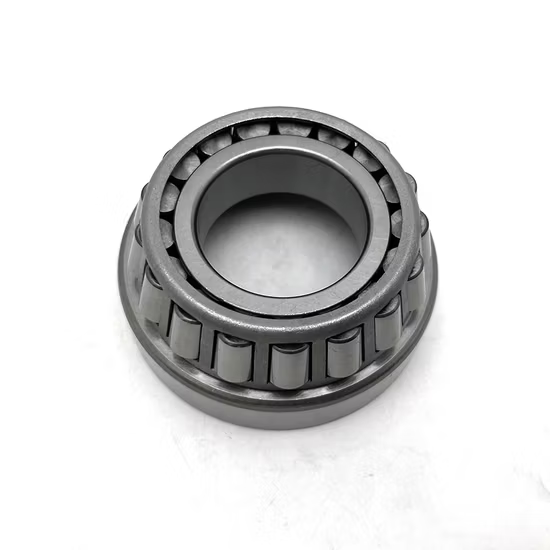
32320J2 32321J2 32322 Tapered Roller Bearing C0/C2/C3/C4 — Multiple clearance options accommodate thermal expansion in vibratory rollers, while HRC58-62 hardness ensures wear resistance under heavy loads.
Full Batch Traceability — Every 32320J2, 32321J2, and 32322 unit ships with verifiable lot documentation linking directly to the manufacturer’s production records.
| Parameter | Value |
|---|---|
| Designation | 32320J2, 32321J2, 32322 |
| Bearing Type | Tapered Roller Bearing |
| Clearance Class | C0, C2, C3, C4 |
| Material Hardness | HRC58-62 [NEED_CITE: standard bearing steel hardness range] |
| Origin | Shandong, China |
| HS Code | 8482500090 |
Note: J2 is an unverified suffix — requires manufacturer catalog confirmation.
| Industry | Typical Applications |
|---|---|
| Construction & Earthmoving | Vibratory roller exciter mechanisms and drum drive assemblies |
| Mining & Quarrying | Heavy-duty crusher drive gearboxes and conveyor pulley shafts |
| Material Handling | High-load stacker and reclaimer travel drives |
When sourcing a 32320J2 32321J2 32322 tapered roller bearing, matching the base designation is never enough to survive high-frequency vibration.
Internal clearance and cage design dictate survival under continuous shock loading.
I have walked through Latin American mining sites and construction yards where heavy machinery sat idle because a procurement team only checked the base numbers. A standard replacement might fit the shaft, but without the correct internal geometry and cage material, the component tears itself apart under high-amplitude shaking. Ignoring these specific suffix variations leads to rapid cage fragmentation and catastrophic journal damage [NEED_CITE: rolling bearing failure mode classification per ISO 15243].
Selecting the right 32320J2 32321J2 32322 tapered roller bearing requires looking past the basic dimensions to evaluate how the internal components handle dynamic forces. Our technical review process ensures that the selected clearance class and cage configuration align perfectly with the specific vibratory roller operating conditions, preventing the thermal binding that plagues incorrectly specified replacements.
Exciter shafts in vibratory rollers generate relentless radial and axial shock loads that challenge standard component limits. The continuous high-frequency shaking demands a cage design that maintains roller alignment without fatiguing, while the friction from heavy loads generates substantial internal heat. Selecting the appropriate clearance class is critical here, as it accommodates the thermal expansion of the shaft and housing, ensuring the rollers maintain optimal contact with the raceways even as operating temperatures climb [NEED_CITE: thermal expansion effects on bearing internal clearance].
The availability of C0 through C4 clearance classes allows maintenance teams to compensate for the specific interference fits and thermal gradients found in vibratory equipment. A C3 or C4 clearance is frequently necessary to prevent the internal components from binding as the exciter shaft heats up during continuous compaction work. Furthermore, the verified HRC58-62 hardness ensures the raceways and rolling elements resist surface spalling and abrasive wear under extreme contact stresses. Understanding these internal parameters is what separates a temporary fix from a long-term reliability upgrade.
Installing a component with standard clearance in an application demanding C3 or C4 results in thermal binding, quickly escalating to unplanned downtime and severe shaft scoring. Conversely, using a standard cage instead of the correct vibration-resistant design leads to early fatigue and cage fragmentation. These failures void equipment warranties and force emergency rebuilds, costing significantly more in lost production time than the initial price difference of the correctly specified part [NEED_CITE: economic impact of unplanned machinery downtime per ISO 14224].
Procuring mixed-brand requirements through a single authorized channel eliminates the coordination delays of dealing with multiple suppliers. We verify cross-brand interchanges based on exact clearance, cage material, and precision suffixes, not just the base designation. This prevents the common error of installing a standard unit where a vibration-specific design is required. Every shipment includes batch traceability to the manufacturer, verified via official apps, ensuring you receive genuine products rather than counterfeits with cloned markings. Our application-based selection review catches internal design mismatches before the order ships.
To ensure the selected configuration matches your exact machinery requirements, please provide the operating radial and axial loads, shaft speed, and expected temperature range. Sharing the OEM equipment number or the specific vibratory roller model allows our engineering team to perform a precise cross-reference check. We will then confirm the optimal clearance class and cage design to maximize service life in your specific compaction or crushing environment.
Q: Why must clearance and suffix details be matched during cross-referencing?
A: Matching only the base numbers ignores critical internal differences. A standard clearance unit will thermally bind in a hot vibratory roller, while an incorrect cage will shatter under high-frequency shock loads. Exact suffix alignment ensures the internal geometry survives the specific operating environment.
Q: How do I verify the authenticity of the delivered components?
A: Every unit ships with batch traceability documentation. You can scan the packaging QR codes using the manufacturer’s official mobile application to instantly verify the production lot, origin, and technical specifications, effectively eliminating the risk of installing counterfeit parts.
Q: What clearance class is typically required for vibratory roller applications?
A: Vibratory equipment usually generates significant internal heat and requires C3 or C4 clearance to accommodate thermal expansion and heavy interference fits. We review your specific operating temperatures and shaft tolerances to recommend the exact clearance class needed to prevent thermal binding.
Q: What does the unverified J2 suffix imply for my application?
A: An unverified suffix means the specific design modification is not universally standardized across all catalogs. It requires direct confirmation with the manufacturer’s technical documentation to ensure the cage design and internal geometry perfectly match the high-vibration demands of your specific machinery.
Q: Which mounting practices protect the internal geometry during installation?
A: Always use controlled induction heating for the inner ring rather than open flames, which can locally overheat and soften the hardened steel. Press the component squarely onto the shaft to avoid brinelling the raceways, and ensure the final assembly maintains the selected internal clearance.
Our engineers will respond within 12 hours with a tailored solution.
Request Quote| Bearing Type | Tapered Roller Bearing |
| Brand | SKF |
| Quality Standard | ISO 9001 / TS 16949 |
| Precision Grade | P0 / P5 / P6 (custom) |
| Material | Chrome Steel / Stainless |
| Cage Material | Steel / Brass / Polyamide |
| Lubrication | Grease / Oil (specify) |
| Operating Temp. | -40°C to +200°C |
| Min. Order Qty | 1 pc (samples available) |
| Prototype Lead Time | 7 Working Days |
| Load Capacity | Contact for C0/Cr values |
| Speed Rating | Contact for ndm limit |
| Vibration Level | Z1 / Z2 / Z3 (custom) |
| Noise Level | V1 / V2 / V3 (custom) |
| Fatigue Life | L10h per ISO 281 |
| Sealing Options | Open / Z / 2Z / RS / 2RS |
Our engineering team can modify bearing dimensions, materials, seals, and clearances to meet your specific operating requirements. Submit your drawing or spec sheet for a tailored proposal.
Main shaft bearings, gearbox bearings, and generator bearings for onshore and offshore wind turbines.
Heavy-duty bearings for crushers, conveyors, and rotary equipment in extreme dust and shock-load environments.
High-temperature bearings for rolling mills, continuous casting, and furnace applications.
Wheel hub bearings, transmission bearings, and e-motor bearings for passenger and commercial vehicles.
Axle box bearings, traction motor bearings, and gearbox bearings meeting EN/UIC railway standards.
High-precision spindle bearings, angular contact bearings, and super-precision bearings for CNC and robotics.
Our engineers analyze your operating conditions -- load, speed, temperature, environment -- and select or design the optimal bearing solution to maximize service life and reduce total cost of ownership.
Need non-standard dimensions, special materials, or modified clearances? We can modify standard SKF bearings or manufacture fully custom solutions with a 7-day prototype turnaround.
When bearings fail prematurely, our team conducts root-cause analysis using advanced diagnostic tools to identify the failure mode and recommend corrective action.
We deploy vibration monitoring, thermal imaging, and oil analysis programs that detect bearing deterioration early -- reducing unplanned downtime by up to 40%.
Proper installation is critical to bearing performance. Our certified technicians provide on-site installation support, alignment verification, and operator training worldwide.
From initial selection through end-of-life, our dedicated account managers provide scheduled maintenance plans, re-lubrication programs, and replacement forecasting for enterprise clients.
NDA protected · Free samples for orders > $50K · Reply within 12 hours


