

ISO 9001 Certified
TS 16949
Genuine SKF
Need Technical Advice?
Reply within 12 hours · 15+ certified engineers on call
ASAHI Bearing
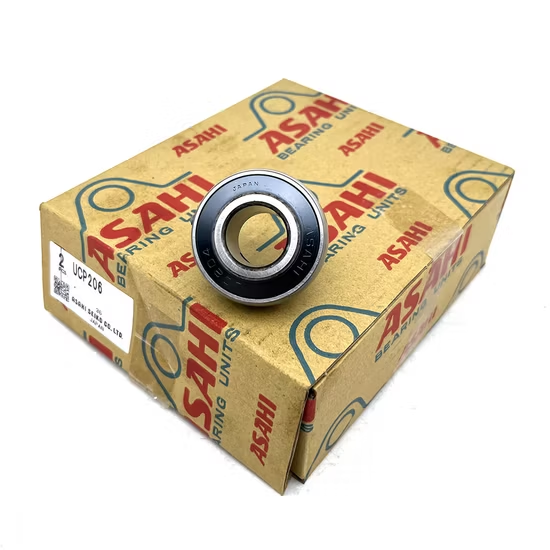
X&S UCT 203-208 UC Take-Up Unit Bearing for Auto Parts
X&S UCT 203 UCT 204 UCT 205 UCT 206 UCT 207 UCT 208 UC Take-Up Unit Bearing — featuring UC insert bearings with set screw locking for secure shaft mounting in UCT take-up housings, ideal for belt tensioning in automotive and agricultural machinery.
- Verify cross-reference alignment across clearance, cage material, and precision suffixes to prevent thermal binding during high-speed operation.
7
Day Prototype
vs. 8-12 wks standard
50+
Countries Served
Global logistics network
12h
Quote Response
Expert engineers on call
Typical Applications
Wind Power
Mining
Steel & Metallurgy
Automotive / EV
Rail Transit
Precision Machinery
Genuine SKF Bearings
NDA Protected
Free Sample for Orders > $50K
Global Shipping
Product Details
Cross-Reference Alignment — Matching base numbers without verifying seal suffixes and clearance classes leads to thermal binding in slider assemblies.
Technical Specifications
| Parameter | Value |
|---|---|
| Designation | UCT 203 UCT 204 UCT 205 UCT 206 UCT 207 UCT 208 UC |
| Product Type | Take-Up Unit / Insert Bearing |
| Bearing Type | Deep Groove Raceway |
| Housing Model | C (Take-up unit) |
| Locking Mechanism | Set screw locking (UC) |
| Rows Number | Single |
| Material | Bearing Steel |
| Seal or Shield Type | ZZ, RS, or Open options |
| Lubrication | Grease or Oil |
| Precision Class | P0, P6, P5, P4, P2 |
| Vibration Level | Z1V1, Z2V2, Z3V3, Z4V4 |
| Customization | OEM or ODM |
| Origin | Shandong, China |
Application Suitability
| Industry | Typical Applications |
|---|---|
| Agricultural Machinery | Conveyor belt tensioning systems, seed drill metering drives, harvester track adjusters |
| Automotive and Heavy Vehicle Repair | Assembly line transfer mechanisms, chassis alignment rigs, heavy-duty lifting sliders |
Why Suffix Accuracy Matters for the X&S UCT 203 UCT 204 UCT 205 UCT 206 UCT 207 UCT 208 UC take-up unit bearing
Ignoring suffix details causes premature slider seizure.
Purchasing teams often approve replacements based solely on the base housing number, overlooking critical internal variations. A standard clearance insert installed in a high-temperature conveyor environment will expand and bind, while an open bearing placed in a dusty harvester mechanism will fail rapidly due to particulate ingress. [NEED_CITE: rolling bearing failure mode classification per ISO 15243]. These cross-reference errors bypass the actual operating conditions, turning a simple maintenance swap into a recurring breakdown.
Aligning Specifications with Tensioning Demands
Selecting the correct X&S UCT 203 UCT 204 UCT 205 UCT 206 UCT 207 UCT 208 UC take-up unit bearing requires matching the seal and clearance to the specific tensioning load. Our technical review process verifies that the chosen insert bearing suffix aligns with the equipment’s thermal expansion profile and contamination exposure. This prevents the common field failure where a visually identical replacement fails within weeks due to mismatched internal geometry.
Field Contamination and Thermal Expansion Challenges
Take-up units in agricultural and automotive environments face severe particulate contamination and fluctuating thermal loads. Dust ingress destroys raceway finishes, making the choice between contact RS seals and non-contact ZZ shields critical for balancing friction and protection. Furthermore, conveyor systems exposed to direct sunlight or engine heat require adequate internal clearance to accommodate shaft expansion. Inadequate lubrication retention in these sliders accelerates wear, especially when vibration levels exceed standard thresholds [NEED_CITE: impact of contamination on bearing fatigue life].
Decoding the Housing and Insert Suffixes
The UCT prefix designates a take-up unit housing guided by a C-model frame, engineered specifically for linear sliding adjustment rather than static mounting. The UC suffix confirms an insert bearing with set screw locking, securing the inner ring to the shaft without requiring complex adapters. The numeric sequence from 203 to 208 indicates the light normal duty series with progressive bore diameter codes, allowing engineers to scale the load capacity while maintaining the same slider footprint. Available precision grades up to P2 and vibration controls up to Z4V4 ensure smooth operation in sensitive automotive assembly rigs.
The Hidden Costs of Mismatched Replacements
Installing an incorrect insert into a take-up housing leads to unplanned downtime and catastrophic damage to the guiding rails. When clearance is insufficient for the operating temperature, the bearing generates excessive heat, resulting in premature failure and potential shaft scoring. These cascading failures often void equipment warranties and force emergency procurement at premium costs. Relying on ISO 281 frameworks for life calculation requires exact parameter matching, which is impossible when internal designs differ from the original specification [NEED_CITE: bearing life calculation methodologies per ISO 281].
Procurement Advantages for Slider Assemblies
We supply the X&S UCT 203 UCT 204 UCT 205 UCT 206 UCT 207 UCT 208 UC take-up unit bearing with full cross-brand interchange expertise, ensuring the seal and clearance match your exact application. Our batch traceability confirms the metallurgical integrity of the bearing steel, eliminating the risk of soft inner rings common in counterfeit market supplies. Every shipment includes verification support to confirm the locking mechanism and housing dimensions meet the rigorous demands of heavy-duty tensioning systems.
Documentation & Authenticity
- Certificate of Conformity verifying the specific precision class and vibration grade of the delivered batch.
- Batch and lot traceability linking the take-up housing and insert to the manufacturer’s production facilities.
- QR verification via brand official apps confirming the authenticity of the UC set screw locking mechanism.
- Material test report validating the bearing steel composition and corrosion-resistant heat treatment.
- Dimensional and running accuracy inspection report confirming C-model housing guideway tolerances.
Storage, Handling & Mounting
- Store the ZZ or RS sealed units in original packaging to prevent dust ingress before installation in agricultural harvesters.
- Apply induction heating for press-fit installations to avoid damaging the deep groove raceway and bearing steel structure.
- Verify the set screw locking torque on the UC insert to prevent shaft fretting in high-vibration automotive assembly rigs.
- Keep open-type variants sealed until mounting to allow proper external grease or oil lubrication filling.
- Avoid using carbon steel tools on corrosion-resistant treated surfaces to prevent localized rusting in humid environments.
Engineering Review and Selection Guidance
To ensure optimal performance, provide your specific radial and axial loads, operating speeds, and ambient temperature ranges for a comprehensive L10 life calculation. Sharing the original OEM equipment number allows our engineering team to perform a precise cross-reference review, verifying that the seal type and internal clearance match the factory design. This technical validation guarantees the selected take-up assembly will withstand your exact tensioning and sliding requirements.
Frequently Asked Questions
Q: What is the functional difference between UCT take-up units and UCP pillow blocks?
A: UCT units feature a C-model housing designed to slide within a guideway for belt or chain tensioning, whereas UCP pillow blocks are stationary and bolt directly to a base. Substituting one for the other compromises the mechanical adjustment mechanism and alters the load distribution across the raceway.
Q: Why must clearance and seal suffixes be verified during cross-referencing?
A: Base numbers only define the physical envelope. Ignoring clearance can cause thermal binding in hot environments, while mismatched seals lead to rapid contamination ingress or excessive friction. Verifying these suffixes ensures the internal geometry survives the actual operating conditions.
Q: How do I choose between ZZ shields and RS seals for agricultural machinery?
A: ZZ shields offer low friction and high-speed capability but provide limited protection against fine dust and moisture. RS contact seals deliver superior contamination exclusion for dirty harvester environments, though they generate slightly more friction and have lower limiting speed thresholds.
Q: What precision and vibration grades are suitable for automotive assembly equipment?
A: Standard P0 and Z1V1 grades suffice for general material handling. However, precision automotive alignment rigs or high-speed transfer mechanisms require tighter P5 or P4 tolerances combined with Z3V3 or Z4V4 vibration controls to minimize noise and ensure smooth linear sliding.
Product Summary
- Product Name
- X&S UCT 203-208 UC Take-Up Unit Bearing for Auto Parts
- Category
- ASAHI Bearing
- Brand
- SKF
- Certification
- ISO 9001 · TS 16949
- Lead Time
- 7 Working Days
Get a Custom Quote
Our engineers will respond within 12 hours with a tailored solution.
Request QuoteGeneral Specifications
| Bearing Type | ASAHI Bearing |
| Brand | SKF |
| Quality Standard | ISO 9001 / TS 16949 |
| Precision Grade | P0 / P5 / P6 (custom) |
| Material | Chrome Steel / Stainless |
| Cage Material | Steel / Brass / Polyamide |
| Lubrication | Grease / Oil (specify) |
| Operating Temp. | -40°C to +200°C |
| Min. Order Qty | 1 pc (samples available) |
| Prototype Lead Time | 7 Working Days |
Performance Parameters
| Load Capacity | Contact for C0/Cr values |
| Speed Rating | Contact for ndm limit |
| Vibration Level | Z1 / Z2 / Z3 (custom) |
| Noise Level | V1 / V2 / V3 (custom) |
| Fatigue Life | L10h per ISO 281 |
| Sealing Options | Open / Z / 2Z / RS / 2RS |
Custom Specifications Available
Our engineering team can modify bearing dimensions, materials, seals, and clearances to meet your specific operating requirements. Submit your drawing or spec sheet for a tailored proposal.
Wind Power
Main shaft bearings, gearbox bearings, and generator bearings for onshore and offshore wind turbines.
Mining & Quarrying
Heavy-duty bearings for crushers, conveyors, and rotary equipment in extreme dust and shock-load environments.
Steel & Metallurgy
High-temperature bearings for rolling mills, continuous casting, and furnace applications.
Automotive / EV
Wheel hub bearings, transmission bearings, and e-motor bearings for passenger and commercial vehicles.
Rail Transit
Axle box bearings, traction motor bearings, and gearbox bearings meeting EN/UIC railway standards.
Precision Machinery
High-precision spindle bearings, angular contact bearings, and super-precision bearings for CNC and robotics.
Application Design
EngineeringOur engineers analyze your operating conditions -- load, speed, temperature, environment -- and select or design the optimal bearing solution to maximize service life and reduce total cost of ownership.
Custom Modification
7-Day TurnaroundNeed non-standard dimensions, special materials, or modified clearances? We can modify standard SKF bearings or manufacture fully custom solutions with a 7-day prototype turnaround.
Failure Analysis
DiagnosticsWhen bearings fail prematurely, our team conducts root-cause analysis using advanced diagnostic tools to identify the failure mode and recommend corrective action.
Predictive Maintenance
Up to 40% Less DowntimeWe deploy vibration monitoring, thermal imaging, and oil analysis programs that detect bearing deterioration early -- reducing unplanned downtime by up to 40%.
On-site Installation
Global CoverageProper installation is critical to bearing performance. Our certified technicians provide on-site installation support, alignment verification, and operator training worldwide.
Lifecycle Support
Enterprise SLAFrom initial selection through end-of-life, our dedicated account managers provide scheduled maintenance plans, re-lubrication programs, and replacement forecasting for enterprise clients.
Why SKF China
The engineering partner advantage
7 Days
Prototype Lead Time
vs. 8-12 weeks via standard channels
15+
Certified Engineers
SKF-certified, on-call for your project
50+
Countries Delivered
Reliable global logistics network
Request a Quote
Get a custom quote for
X&S UCT 203-208 UC Take-Up Unit Bearing for Auto Parts
NDA protected · Free samples for orders > $50K · Reply within 12 hours
Related Products
More ASAHI Bearing Products