
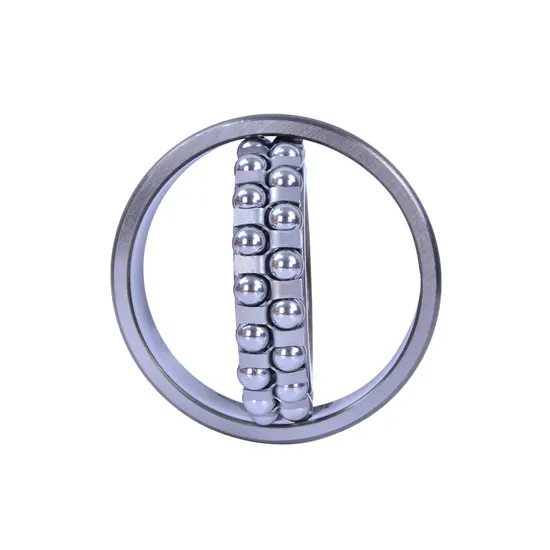
Self-Aligning Ball Bearing

X&S 1218 2219 1320 Self-Aligning Ball Bearings feature chrome steel construction to tolerate shaft misalignment and reduce edge loading in auto repair applications.
Full Brand Authorization — Consolidate mixed OEM requirements into a single shipment without juggling multiple vendors.
| Parameter | Value |
|---|---|
| Designation | 1218 2219 1320 |
| Bearing Type | Self-Aligning Ball Bearing |
| Bore Diameter (d) | Standard sizes for 1218, 2219, 1320 |
| Outside Diameter (D) | Standard sizes for 1218, 2219, 1320 |
| Width (B) | Standard sizes for 1218, 2219, 1320 |
| Limiting Speed | 5600-18000 r/min |
| Vibration Class | V1, V2, V3, V4 |
| Clearance Class | C2, C0 (CN), C3, C4, C5 |
| Material | Chrome Steel |
| Lubrication | Grease or Oil |
| Origin | China |
| Industry | Typical Applications |
|---|---|
| Auto Repair | Alternator shafts, steering column joints, transmission idler pulleys |
| Industrial Gearboxes | Input/output shafts subject to housing deflection and misalignment |
| Electric Motors | Rotor shafts in medium-duty AC/DC motors with belt-driven loads |
| Material Handling | Conveyor roller drive ends experiencing frame flexing |
| Textile Machines | Spindle drives and yarn guide rollers requiring low vibration |
Matching the base designation is only the first step; ignoring internal clearances guarantees a comeback.
Sourcing an X&S 1218 2219 1320 self-aligning ball bearing based solely on the stamped numbers often leads to catastrophic field failures. I have seen entire batches of 1218 bearings seize in high-temperature engine bays simply because the procurement team ordered standard CN clearance when the thermal expansion demanded C3. When cross-referencing for auto repair or industrial gearboxes, assuming the internal geometry matches the OEM requirement without verifying the exact clearance and cage design is a costly gamble [NEED_CITE: bearing failure root cause analysis per ISO 15243].
The primary advantage of this self-aligning architecture is its ability to tolerate static misalignment between the shaft and housing. In auto repair and conveyor applications, frame flexing or slight installation errors generate edge loading that destroys rigid bearing types. By specifying the correct X&S 1218 2219 1320 self-aligning ball bearing variant, maintenance teams ensure the inner ring and ball assembly can pivot freely within the sphered outer ring raceway, neutralizing the bending moments that typically cause premature cage fracture.
Operating conditions in automotive and textile environments fluctuate wildly, demanding precise clearance selection. A standard CN clearance might bind when the shaft expands under continuous belt-driven friction, whereas a C3 or C4 clearance accommodates that thermal growth. Furthermore, the choice between grease and oil lubrication must align with the 5600-18000 r/min limiting speed envelope. High-speed electric motor applications require low-viscosity oil or specialized high-speed grease to prevent churning losses and overheating [NEED_CITE: thermal limits of rolling bearing lubricants].
Because the base designations 1218, 2219, and 1320 lack explicit suffixes, they represent the open, standard-clearance baseline. This absence of suffixes is exactly where procurement errors occur. A 1218 with a machined brass cage handles heavy vibration far better than one with a pressed steel cage, yet both might share the same base number. Similarly, selecting the correct vibration class (V1 through V4) is critical for electric motors to prevent resonance-induced noise. Understanding that the base number is merely a dimensional envelope ensures you request the exact internal configuration required for the specific load and speed profile.
Relying on unverified cross-references or visually identical counterfeit parts introduces severe operational risks. Soft inner rings found in counterfeit batches fail to maintain interference fits, leading to inner ring creep and shaft scoring. According to ISO 281 frameworks, even minor deviations in raceway hardness or dimensional accuracy drastically reduce the calculated L10 life. In auto repair, this translates to warranty voidance, unplanned vehicle downtime, and severe reputational damage for the workshop [NEED_CITE: rolling bearing failure mode classification per ISO 15243].
Our distribution model eliminates the guesswork from mixed-brand orders. We provide authorized coverage across all major international brands, allowing you to consolidate the X&S 1218 2219 1320 self-aligning ball bearing alongside other SKU requirements in a single shipment. Every batch is strictly traced to the manufacturer, and our technical team reviews your application parameters to ensure the cross-reference matches not just the base number, but the critical clearance and cage specifications. This prevents the all-too-common scenario where a dimensionally correct bearing fails internally due to a mismatched design variant.
To ensure the selected configuration perfectly matches your operational reality, provide our engineering team with your specific radial and axial loads, operating speeds, and ambient temperature ranges. Sharing the exact OEM equipment numbers or previous failure modes allows us to perform a comprehensive cross-reference check and L10 life calculation. This technical validation ensures the internal geometry, clearance, and lubrication strategy are optimized for your specific auto repair or industrial application before the order is finalized.
Q: How do I verify the authenticity of these self-aligning ball bearings upon delivery?
A: Every bearing we supply features batch traceability. You can scan the manufacturer’s QR code using the official brand application on your smartphone. This instantly verifies the production lot, origin, and authenticity, ensuring you are installing genuine chrome steel components rather than visually similar counterfeits with soft inner rings that cause premature shaft damage.
Q: Why is it dangerous to rely only on the base designation during cross-referencing?
A: The base number only defines the outer dimensions. If your application requires C3 clearance for thermal expansion but receives standard CN, the bearing will bind and seize at operating temperature. We cross-reference the base designation alongside your specific clearance, cage material, and precision requirements to guarantee internal design compatibility with your equipment’s actual working conditions.
Q: What are the application boundaries between CN, C3, and C4 clearance classes?
A: CN is standard for normal temperatures and loads. C3 provides greater internal clearance for applications where the inner ring runs hotter than the outer ring, causing thermal expansion. C4 is reserved for extreme temperature differentials or heavy interference fits. Selecting the wrong class leads to either excessive vibration or thermal binding and catastrophic cage failure.
Q: How should I choose between grease and oil lubrication for these models?
A: The choice depends on your operating speed and temperature. Grease is ideal for sealed or moderately paced applications, offering simple maintenance and contamination exclusion. Oil is necessary for high-speed electric motors approaching the upper limiting speeds, as it dissipates heat more effectively and reduces churning friction, provided the housing design supports oil circulation or regular replenishment.
Q: What mounting practices prevent damage to the sphered outer ring?
A: Never apply pressing force through the rolling elements or the outer ring, as this will brinell the sphered raceway and destroy the self-aligning capability. Always apply force directly to the inner ring when pressing onto the shaft. For the outer ring, ensure the housing bore is clean and lightly oiled, allowing it to slide in smoothly without cocking or binding.
Our engineers will respond within 12 hours with a tailored solution.
Request Quote| Bearing Type | Self-Aligning Ball Bearing |
| Brand | SKF |
| Quality Standard | ISO 9001 / TS 16949 |
| Precision Grade | P0 / P5 / P6 (custom) |
| Material | Chrome Steel / Stainless |
| Cage Material | Steel / Brass / Polyamide |
| Lubrication | Grease / Oil (specify) |
| Operating Temp. | -40°C to +200°C |
| Min. Order Qty | 1 pc (samples available) |
| Prototype Lead Time | 7 Working Days |
| Load Capacity | Contact for C0/Cr values |
| Speed Rating | Contact for ndm limit |
| Vibration Level | Z1 / Z2 / Z3 (custom) |
| Noise Level | V1 / V2 / V3 (custom) |
| Fatigue Life | L10h per ISO 281 |
| Sealing Options | Open / Z / 2Z / RS / 2RS |
Our engineering team can modify bearing dimensions, materials, seals, and clearances to meet your specific operating requirements. Submit your drawing or spec sheet for a tailored proposal.
Main shaft bearings, gearbox bearings, and generator bearings for onshore and offshore wind turbines.
Heavy-duty bearings for crushers, conveyors, and rotary equipment in extreme dust and shock-load environments.
High-temperature bearings for rolling mills, continuous casting, and furnace applications.
Wheel hub bearings, transmission bearings, and e-motor bearings for passenger and commercial vehicles.
Axle box bearings, traction motor bearings, and gearbox bearings meeting EN/UIC railway standards.
High-precision spindle bearings, angular contact bearings, and super-precision bearings for CNC and robotics.
Our engineers analyze your operating conditions -- load, speed, temperature, environment -- and select or design the optimal bearing solution to maximize service life and reduce total cost of ownership.
Need non-standard dimensions, special materials, or modified clearances? We can modify standard SKF bearings or manufacture fully custom solutions with a 7-day prototype turnaround.
When bearings fail prematurely, our team conducts root-cause analysis using advanced diagnostic tools to identify the failure mode and recommend corrective action.
We deploy vibration monitoring, thermal imaging, and oil analysis programs that detect bearing deterioration early -- reducing unplanned downtime by up to 40%.
Proper installation is critical to bearing performance. Our certified technicians provide on-site installation support, alignment verification, and operator training worldwide.
From initial selection through end-of-life, our dedicated account managers provide scheduled maintenance plans, re-lubrication programs, and replacement forecasting for enterprise clients.
NDA protected · Free samples for orders > $50K · Reply within 12 hours


