Angular Contact Ball Bearing
![X&S B7020E.T.P4S B7021C Angular Contact Ball Bearing for Spindle [WARN] draft identifier mismatch](https://skfip.com/wp-content/uploads/2026/09/xs-b7020e-t-p4s-b7021c-angular-contact-ball-bearing-for-spindle-warn-draft-identifier-mismatch-3255e1.avif)
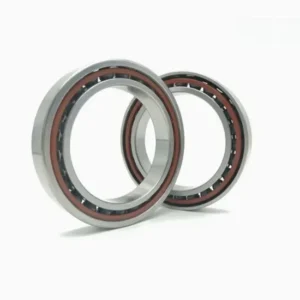
X&S B7020E.T.P4S B7021C.T.P4S B7021E.T.P4S B7022C.T.P4 Angular Contact Ball Bearings — C and E suffixes denote 15° and 25° contact angles for optimized spindle rigidity, while P4 precision guarantees strict running accuracy.
Three-way cross-reference alignment — matching the base number, contact angle suffix, and precision class prevents thermal binding in high-speed spindles.
| Parameter | Value |
|---|---|
| Designation | B7020E.T.P4S B7021C.T.P4S B7021E.T.P4S B7022C.T.P4 |
| Bearing Type | Angular Contact Ball Bearing |
| Contact Angle | 15° (C suffix) or 25° (E suffix) |
| Precision Class | P4, P4S |
| Seal or Shield Type | Z, Zz, RS, 2RS options |
| Material | Available in stainless steel or standard bearing steel variants |
| Lubrication | Grease or Oil |
| Operating Temperature | Up to elevated thermal limits of standard bearing steel |
| Origin | Shandong, China |
Note: The B, .T., and P4S suffixes are unverified and require manufacturer catalog confirmation for exact internal design specifics.
| Industry | Typical Applications |
|---|---|
| Machine Tool Manufacturing | High-speed machining center spindles, precision grinding headstocks |
| Robotics & Automation | High-precision rotary joints, articulated arm pivot bearings |
| Industrial Pumps | High-speed centrifugal pump shafts, precision metering pumps |
| General Precision Equipment | Optical measuring devices, high-frequency vibration test rigs |
Ignoring the difference between a 15° and 25° contact angle during cross-referencing turns a precision component into a spindle killer.
When procurement teams match only the base designation of an X&S B7020E.T.P4S angular contact ball bearing while overlooking the contact angle and precision suffixes, the resulting mismatch in axial stiffness and thermal expansion tolerances leads to rapid heat accumulation. I have seen machine tool spindles seize completely because a standard P0 grade was installed where a P4S was required, causing the internal clearance to vanish under high-speed rotation. The resulting unplanned downtime and catastrophic damage to the spindle housing cost far more than the bearing itself [NEED_CITE: rolling bearing failure mode classification per ISO 15243].
Selecting the correct X&S B7020E.T.P4S angular contact ball bearing variant depends entirely on the specific machining operation. The 15° contact angle (C suffix) is optimized for ultra-high-speed, light-load milling spindles where minimizing friction heat is paramount. Conversely, the 25° contact angle (E suffix) provides the necessary axial rigidity for heavy-duty turning or grinding spindles that experience significant thrust loads. Our technical review ensures the selected angle perfectly aligns with your equipment’s original engineering intent.
High-speed spindle environments generate immense friction heat, demanding strict control over lubrication and thermal expansion. Oil-air or oil-jet lubrication is typically required to manage the thermal load, as standard grease would quickly degrade and cause cage failure. The operating temperature directly impacts the required internal clearance; if the thermal gradient between the inner and outer rings is not accounted for, the bearing will preload itself into destruction. Furthermore, non-contact shields are often preferred over contact seals in these applications to eliminate additional friction heat while still providing basic contamination defense [NEED_CITE: thermal displacement effects on bearing internal clearance per ISO 281].
The precision class is the defining characteristic of these spindle bearings. While P4 ensures tight dimensional and running accuracy suitable for most precision machinery, the P4S designation demands even stricter tolerances on running accuracy to minimize vibration at extreme RPMs. The 15° (C) and 25° (E) contact angles dictate how the bearing handles combined loads, but without the corresponding P4 or P4S precision, the spindle will suffer from chatter and poor surface finish. The availability of stainless steel variants also offers a solution for spindles operating in environments with high humidity or mild corrosive coolants, preventing raceway corrosion that would otherwise destroy the running accuracy.
Substituting a standard clearance or lower precision grade in a high-speed spindle does not just reduce bearing life; it risks the entire machine assembly. According to failure analysis frameworks like ISO 15243, improper internal clearance leads to excessive sliding friction, resulting in smearing and eventual cage disintegration. This catastrophic failure often sends metallic debris through the spindle housing, destroying the labyrinth seals and ruining the motor rotor. The resulting warranty voidance and multi-week lead times for replacement spindle components turn a minor procurement saving into a massive operational loss [NEED_CITE: catastrophic spindle failure mechanisms per ISO 15243].
We focus on the exact suffix alignment that general traders overlook. When sourcing the B7021C.T.P4S or B7022C.T.P4, we verify that the contact angle and precision class match your OEM specifications, not just the base bore and outside diameter. Our cross-brand interchange expertise ensures that if we supply an equivalent from SKF, FAG, or NSK, the internal geometry and preload characteristics remain identical. We provide full batch traceability for every X&S bearing shipped, allowing you to verify the exact production lot. Furthermore, our application-based selection review catches potential thermal binding issues before the order is placed, and we maintain stock of less common suffix combinations to eliminate long lead times.
To ensure the selected bearing variant perfectly matches your spindle design, please provide the specific radial and axial loads, maximum operating RPM, and expected thermal gradients. If you are replacing an existing component, sharing the exact OEM equipment number allows us to perform a rigorous cross-reference check against the original suffix requirements. This technical data enables our engineering team to verify the L10 life calculation and confirm that the chosen contact angle and precision class will withstand your specific machining environment.
Q: Why must the contact angle suffix be matched during cross-referencing?
A: The contact angle (15° for C, 25° for E) determines the bearing’s axial stiffness and load distribution. Installing a 25° variant in a spindle designed for 15° increases friction heat and alters the preload, leading to thermal binding and premature failure at high speeds.
Q: What is the practical difference between P4 and P4S precision?
A: While both denote high precision, P4S typically enforces stricter tolerances on running accuracy and vibration levels compared to standard P4. This distinction is critical for ultra-high-speed spindles where even minor runout causes severe chatter and poor surface finishes.
Q: How do I verify the authenticity of the X&S bearings received?
A: Every shipment includes batch traceability documentation and a unique QR code. You can scan this code using the brand’s official application to verify the manufacturing origin, precision class, and material specifications directly against the factory database.
Q: Can I use standard grease for high-speed spindle applications?
A: Standard grease is generally unsuitable for high-speed spindles due to rapid thermal degradation and churning losses. These applications typically require specialized high-speed spindle grease or oil-air lubrication systems to manage friction heat and maintain the required P4S running accuracy.
Our engineers will respond within 12 hours with a tailored solution.
Request Quote| Bearing Type | Angular Contact Ball Bearing |
| Brand | SKF |
| Quality Standard | ISO 9001 / TS 16949 |
| Precision Grade | P0 / P5 / P6 (custom) |
| Material | Chrome Steel / Stainless |
| Cage Material | Steel / Brass / Polyamide |
| Lubrication | Grease / Oil (specify) |
| Operating Temp. | -40°C to +200°C |
| Min. Order Qty | 1 pc (samples available) |
| Prototype Lead Time | 7 Working Days |
| Load Capacity | Contact for C0/Cr values |
| Speed Rating | Contact for ndm limit |
| Vibration Level | Z1 / Z2 / Z3 (custom) |
| Noise Level | V1 / V2 / V3 (custom) |
| Fatigue Life | L10h per ISO 281 |
| Sealing Options | Open / Z / 2Z / RS / 2RS |
Our engineering team can modify bearing dimensions, materials, seals, and clearances to meet your specific operating requirements. Submit your drawing or spec sheet for a tailored proposal.
Main shaft bearings, gearbox bearings, and generator bearings for onshore and offshore wind turbines.
Heavy-duty bearings for crushers, conveyors, and rotary equipment in extreme dust and shock-load environments.
High-temperature bearings for rolling mills, continuous casting, and furnace applications.
Wheel hub bearings, transmission bearings, and e-motor bearings for passenger and commercial vehicles.
Axle box bearings, traction motor bearings, and gearbox bearings meeting EN/UIC railway standards.
High-precision spindle bearings, angular contact bearings, and super-precision bearings for CNC and robotics.
Our engineers analyze your operating conditions -- load, speed, temperature, environment -- and select or design the optimal bearing solution to maximize service life and reduce total cost of ownership.
Need non-standard dimensions, special materials, or modified clearances? We can modify standard SKF bearings or manufacture fully custom solutions with a 7-day prototype turnaround.
When bearings fail prematurely, our team conducts root-cause analysis using advanced diagnostic tools to identify the failure mode and recommend corrective action.
We deploy vibration monitoring, thermal imaging, and oil analysis programs that detect bearing deterioration early -- reducing unplanned downtime by up to 40%.
Proper installation is critical to bearing performance. Our certified technicians provide on-site installation support, alignment verification, and operator training worldwide.
From initial selection through end-of-life, our dedicated account managers provide scheduled maintenance plans, re-lubrication programs, and replacement forecasting for enterprise clients.
NDA protected · Free samples for orders > $50K · Reply within 12 hours
![X&S 5205 5206 5207 5208 Angular Contact Ball Bearing for Power Tool [WARN] draft identifier mismatch](https://skfip.com/wp-content/uploads/2026/09/xs-5205-5206-5207-5208-angular-contact-ball-bearing-for-power-tool-warn-draft-identifier-mismatch-87dc2e.avif)
![X&S 7903 7003 7203 7303 Angular Contact Ball Bearing Auto Spare Part [WARN] draft identifier mismatch](https://skfip.com/wp-content/uploads/2026/09/xs-7244ac-71952b-angular-contact-ball-bearing-for-machine-part-tools-warn-draft-identifier-mismatch-5dd1bd-300x300.webp)